.svg)



7 Best AI Market Research Platform Options for 2026

Choosing the right AI market research platform matters more now because AI is already part of how most research teams work.
A recent Vocal roundup on AI market research reports that 95% of market researchers now use AI tools regularly or are actively experimenting with them, which shows how quickly AI has moved from a side test to everyday market research.
In this article, we’ll break down the AI market research platform options that help teams run real consumer insights work.
TL;DR
These are the best AI market research platform options for 2026:
- Compeers AI
- Quantilope
- Suzy
- GWI
- Zappi
- Toluna Start
- Knit
What Qualifies as an AI Market Research Platform
An AI market research platform uses machine learning, natural language processing, predictive analytics, and other AI models to help teams collect, analyze, and interpret consumer insights faster than traditional market research methods.
A true AI market research platform supports multiple tasks in the research process. It should help with project setup, data collection, analysis, reporting, and research repositories in a connected way, instead of acting as a single-purpose AI market research tool.
AI-powered market research tools usually shine in these areas:
- Data collection through survey creation, automation, and fielding support.
- Respondent access through built-in panels, participant recruitment, or audience targeting.
- Data analysis through natural language processing, sentiment analysis, and identifying patterns that humans might miss in complex data.
- Research repositories that help research teams search past work and reuse strategic insights in new projects.
- Concept testing for product concepts, campaign optimization, and strategic decision making.
- Report generation with data visualization, dashboards, and first-draft summaries.
How AI Market Research Tools Help
AI market research tools help when the team needs speed, scale, and clearer decision support. They can handle vast datasets, automate repetitive tasks, reduce some forms of human error, and surface market insights with unprecedented speed.
They still need expert insights, though, because research objectives, real-world contexts, and final interpretation still belong with human teams.
Here’s where AI usually adds the most value:
- Automating repetitive tasks like coding open ends, sorting user interactions, and building first-pass summaries.
- Helping with strategic planning by spotting future trends, emerging trends, and signals inside vast amounts of market research data.
- Improving report generation through charts, dashboards, and faster data visualization.
- Supporting research teams that need a co-pilot for analysis, not a replacement for market researchers.
The best platform for your team depends on how much of the workflow you want in one system. Some market research tools cover a broad range of research jobs. Others focus on one layer, such as audience intelligence, conversational AI, or quick-turn concept testing.
7 Best AI Market Research Platforms
This list focuses on platforms that help with real consumer insights work, not just generic AI features.
We prioritized tools that support multiple aspects of market research, demonstrate a clear use case for research teams, and meaningfully integrate AI into data collection, analysis, respondent access, or reporting.
Let’s get deeper into each one.
1. Compeers AI
Compeers AI is the broadest workflow option on this list for teams that want one AI market research platform to handle the full research process.
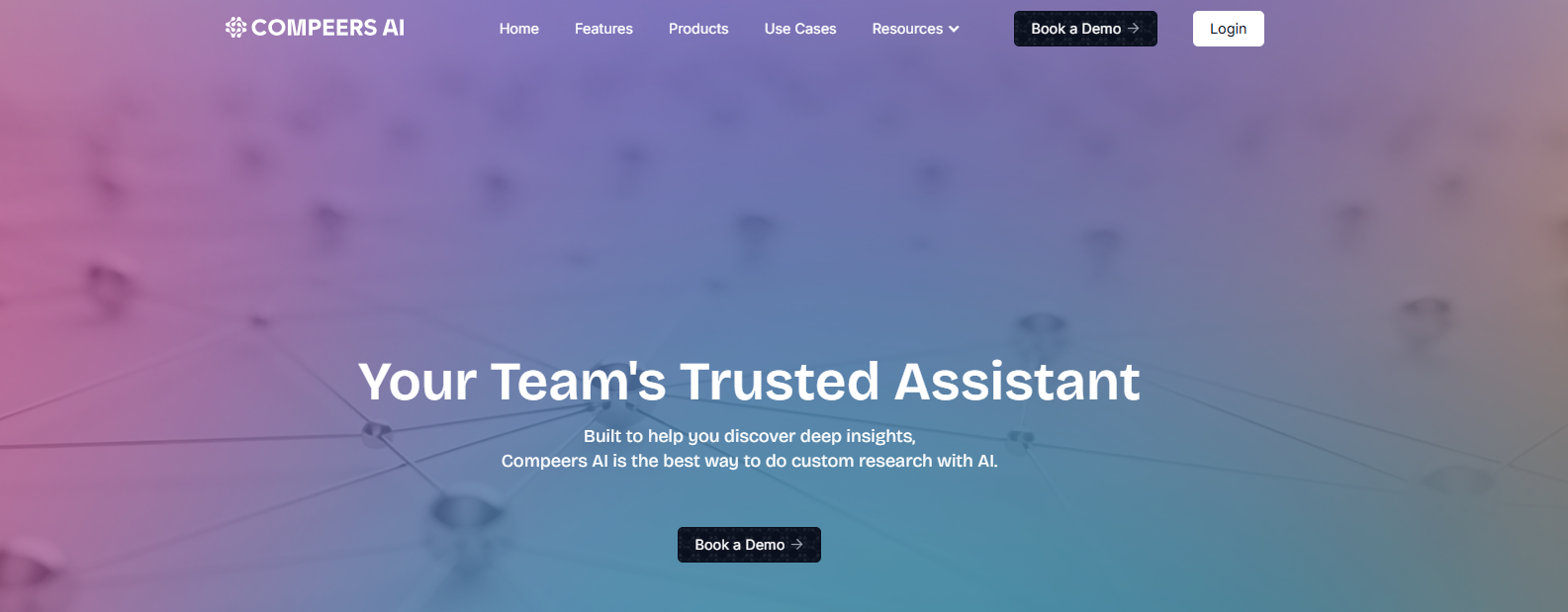
If your team is tired of splitting custom research across survey software, qualitative tools, outside vendors, and manual reporting, Compeers AI keeps it all in a single, connected system.
You can scope a project, build questionnaires and discussion guides, run qualitative and quantitative studies, evaluate product concepts, analyze findings, and move into first-draft reporting without having to rebuild context at every stage.

That depth comes from the product line inside the system:
- Qualitative Compeer supports interviews, focus groups, transcription, translation, coding, and the drafting of deliverables.
- Quantitative Compeer handles survey design, programming, respondent checks, cross-tabs, open-ended coding, and advanced analysis.
- Segmentation Compeer helps you identify audience segments with factor analysis and multiple segmentation models.
- Rapid Concept Evaluation Compeer supports concept testing, key driver analysis, and market share prediction.
- Short Responses Compeer gives your team a faster way to work through short-answer datasets.
- Savant helps you query project data, surface patterns, and build visual outputs while the research is still moving.
If you want AI to support the real research workflow, not just the summary at the end, Compeers AI gives your team one place to run the work with more continuity, traceability, and control.
Key Features
- Project scoping and questionnaire development for new studies
- Qualitative workflows for interviews, focus groups, translation, transcription, and thematic coding
- Quantitative analytics, including segmentation, key drivers, conjoint, and pricing research
- Short-response analysis for faster qualitative insights
- Concept evaluation workflows for product concepts and innovation decisions
- Savant AI analyst support for data extraction, analysis, and first-pass insight generation
- Secure project management that keeps research assets in one place
Pricing
- Custom pricing
Book a demo and see how Compeers AI helps your team run AI market research with more control!
2. Quantilope
Quantilope is a consumer intelligence platform built for automated quantitative research, advanced methods, and tracking studies.

It is a suitable fit for teams that want structured survey design, access to advanced automated methodologies, and an AI research co-pilot within a more quant-heavy workflow.
Its current positioning leans heavily into automation, AI, and real-time consumer insights, with Quinn now positioned as an end-to-end AI Research Partner.
The product is especially relevant when research teams need pricing, segmentation, brand tracking, or concept testing with greater methodological depth than basic DIY survey tools provide.
Key Features
- 15 automated advanced methods for pricing, segmentation, and strategic studies
- AI Research Partner Quinn for faster project buildout and insight support
- Panel-agnostic fielding so teams can connect with the respondents they choose
Pricing
- Business: Starts at $22,000
- Pro: Custom pricing
- Enterprise: Custom pricing
3. Suzy
Suzy is an enterprise market research cloud built around fast-turn consumer insights, integrated audiences, and AI-supported quant and qual.
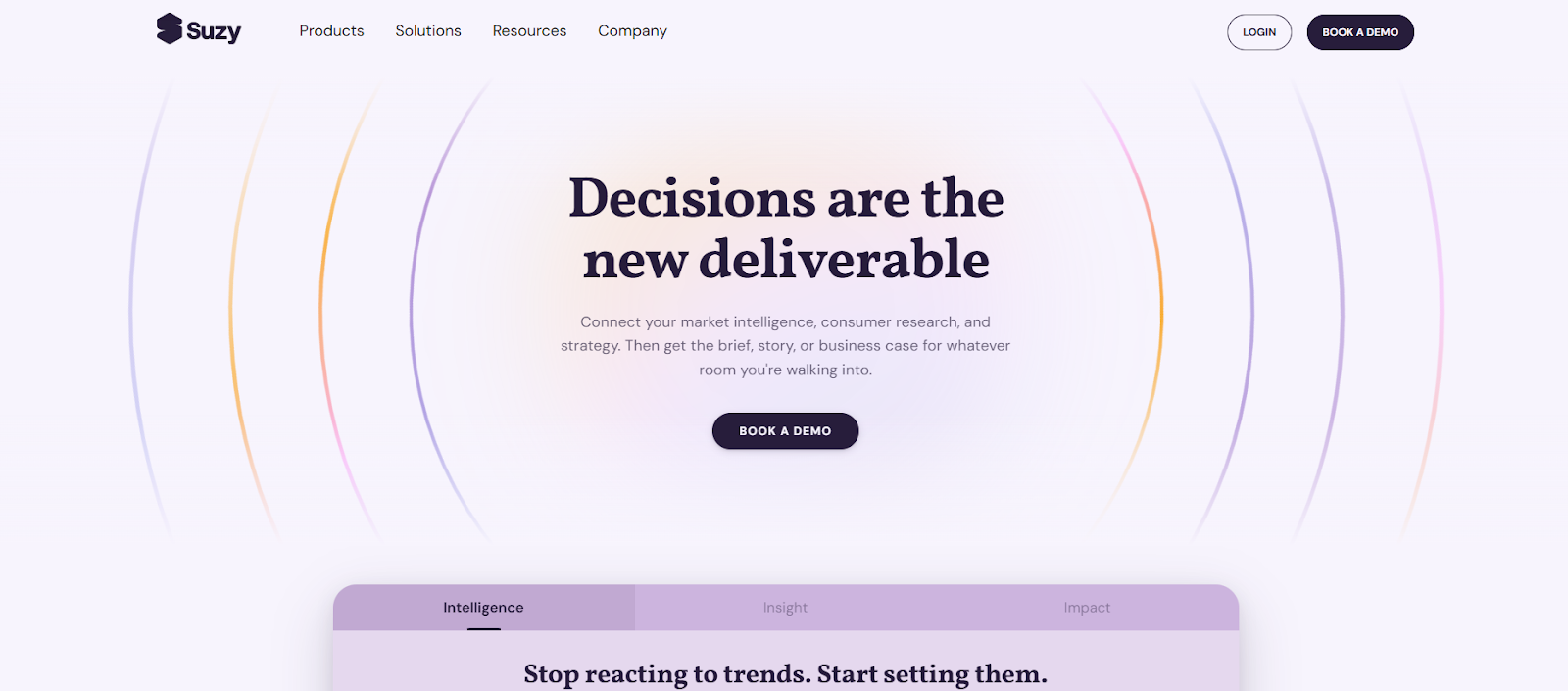
The platform has expanded from a quick-quant tool into a broader research system with real-time feedback, market intelligence, actionable insights, and connected qualitative options, such as Suzy Live and Suzy Speaks.
This is a practical option for marketing teams and consumer insights teams that need survey creation, concept testing, pricing work, focus groups, and AI-moderated conversations without heavy technical expertise.
Key Features
- Suzy Speaks for AI-moderated qualitative insights at a quantitative scale
- Suzy Live for virtual IDIs, focus groups, and in-home product testing
- Quant methods such as monadic testing, MaxDiff, and pricing analysis
Pricing
- Free: 25 credits
- Pro: $150/month for 100 credits
- Team: $200/month for 200 credits
- Enterprise: Custom pricing
4. GWI
GWI is an audience intelligence and consumer insights platform rather than a custom fieldwork system. Its value comes from verified human data, large-scale survey coverage, AI-assisted querying, and tools that help teams turn market research into strategic insights fast.

The platform now pairs its core datasets with Agent Spark, an AI analyst layer that can answer plain-language questions from 35 billion data points grounded in human survey data.
GWI is a practical fit for teams that need audience profiling, market insights, competitive intelligence, and trend work in multiple markets.
Key Features
- Agent Spark for natural-language answers inside GWI or other AI tools
- Audience profiling points, charts, dashboards, and crosstabs
- Coverage in 50+ markets with 15+ years of trended insight
Pricing
- Free
- Plus: $150/month
- Teams: Custom pricing
- Pro: Custom pricing
5. Zappi
Zappi is a connected consumer insights platform built for innovation, advertising, and brand work. It uses consumer data and AI to help teams test, learn, and iterate with the consumer voice built into product development and campaign work.
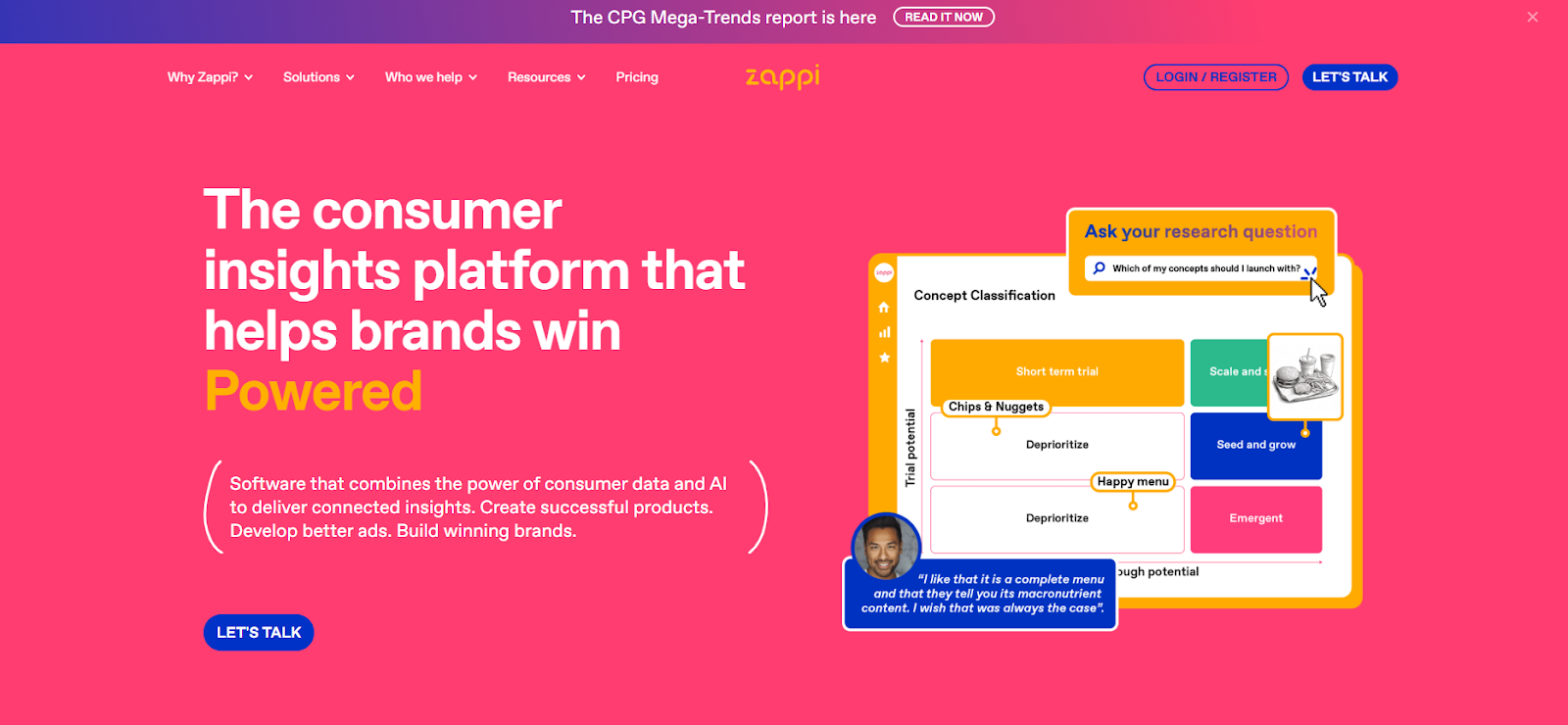
This makes it more specialized than broad workflow platforms, but very relevant for campaign optimization, creative testing, and tracking product concepts through launch.
It is a better fit for brands that want connected insights into ads, innovation, and brand health, rather than a full-stack qual-plus-quant execution system.
Key Features
- Integrated innovation, advertising, and brand insights
- Connected testing and iteration with consumers through the development cycle
- Brand Health Tracker and diagnostics for launch and campaign work
Pricing
- Premium: Custom pricing
- Enterprise: Custom pricing
6. Toluna Start
Toluna Start is an end-to-end market research platform that blends self-service tools, service support, AI, and a large global panel.
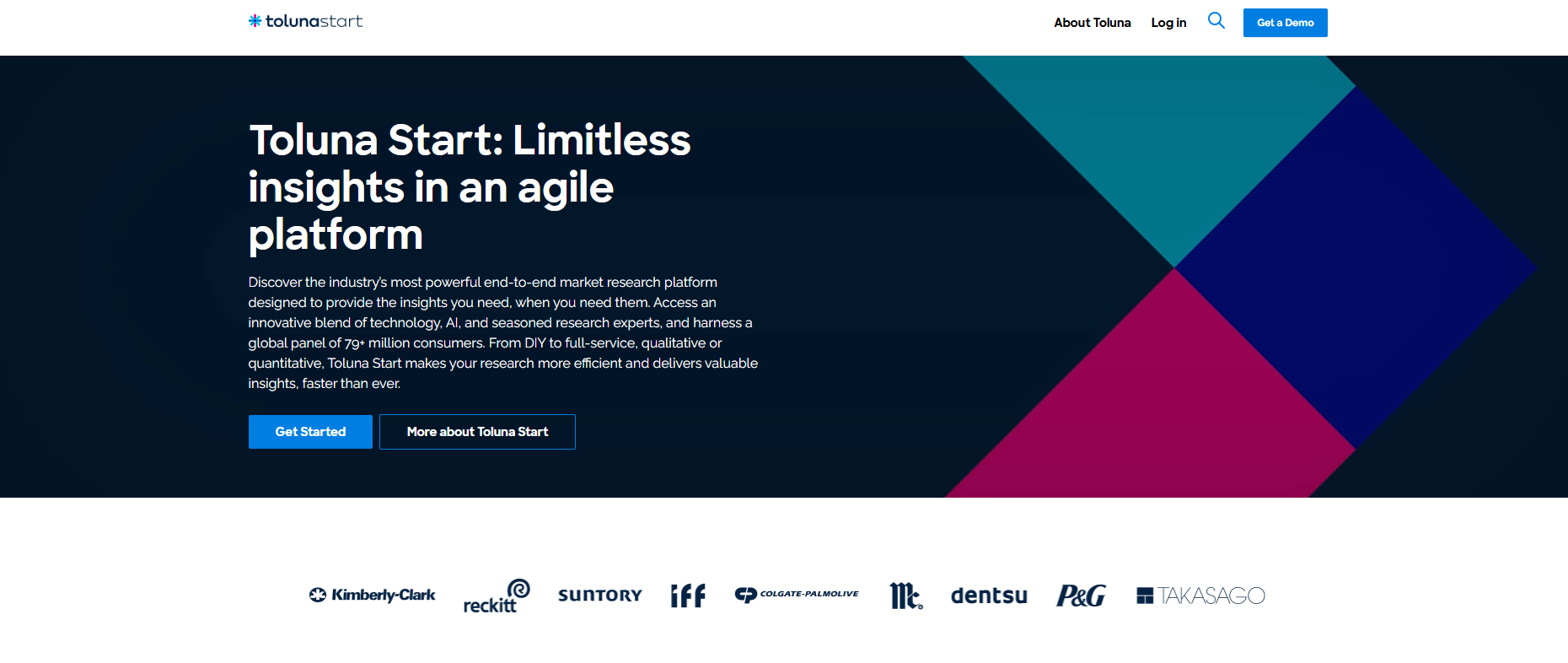
It covers both quantitative and qualitative work, with survey design, integrated respondents, reporting dashboards, and access to automated insights solutions.
That gives it a broader operational footprint than simple survey software, especially for teams that want a DIY-to-full-service model in one environment.
It is a suitable option for teams that need quick studies, broad respondent access, and straightforward fielding without building a custom system.
Key Features
- Global panel of 79+ million consumers
- Self-service and custom research support in one login
- Survey design, integrated respondents, and reporting dashboards
Pricing
- Custom pricing
7. Knit
Knit positions itself as an AI-native research agency and end-to-end AI research platform. It combines AI with human researchers, which is why it appeals to teams that want more support than pure software but still want faster execution than traditional methods.
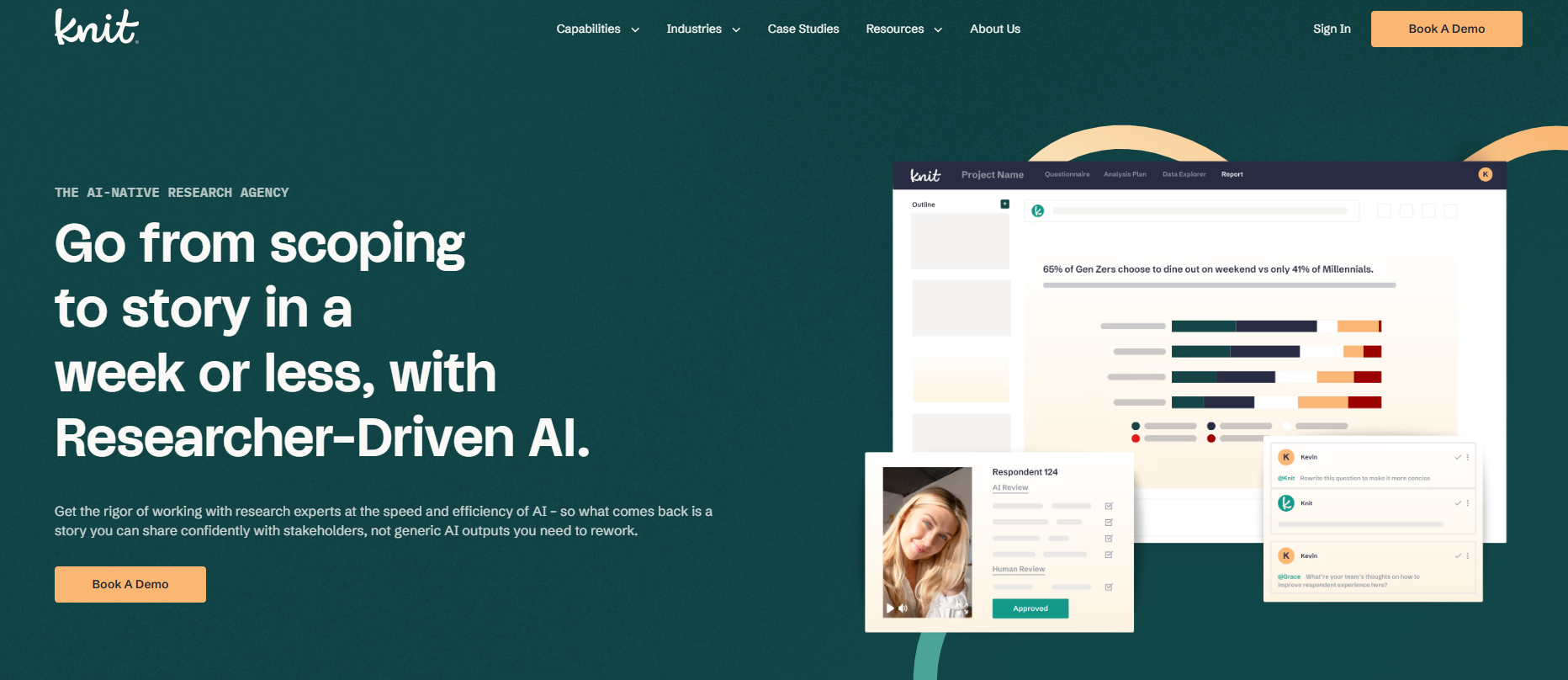
Its workflow covers scoping, questionnaire drafting, sampling and fielding, quantitative and qualitative analysis, and AI-generated reporting in a week or less.
The platform is most visible in quick-turn custom studies and Gen Z-focused work, though its current site also describes broader quant-plus-qual use cases and 65M+ vetted respondents.
Key Features
- AI-drafted questionnaires built from a research brief and past work
- Sample and fielding with 65M+ vetted respondents
- Automated quant-plus-qual analysis with cited insights and ready-to-share reports
Pricing
- Custom pricing
How To Choose The Right AI Market Research Platform
The right AI market research platform depends on what part of the workflow is slowing you down. Some teams need better respondent access. Others need help with survey design, analysis, or data visualization.
A great tool for campaign optimization may still be the wrong fit for foundational consumer insights, and a useful audience database may still fall short if your team runs its own custom studies.
Start with the research job you need the platform to handle, then check whether the product matches your research needs in real terms:
- Look at workflow depth. Can it support data collection, analysis, reporting, and new projects in one place?
- Check data inputs. Does it rely on real respondents, existing survey datasets, synthetic personas, or a mix?
- Review integration capabilities. Can it connect with the systems your research teams already use?
- Match the method to the decision. Some tools are built for strategic decision making, some for campaign optimization, and some for foundational audience work.
- Check the operational tradeoff. Faster output matters, but only if the platform still gives you reliable insights and enough human control.
The best choice is the one that fits your research process, your team shape, and the decisions you need to support next.
Use AI Through the Full Research Workflow
AI helps most when it supports the work before the summary. Many teams still use AI after fieldwork ends, once the survey is closed, the interviews are done, and someone has already stitched the project together by hand.
That leaves the hardest parts of market research outside the system, including project design, target audience setup, respondent management, analysis flow, and the handoff into reporting.
Compeers AI gives your team one place to run that work from start to finish.
You can scope the study, build surveys and discussion guides, run qualitative and quantitative work, test concepts, analyze consumer behavior, and move into first-draft reporting without sacrificing quality or pushing each step into separate tools.
Advanced algorithms help speed coding, pattern detection, and analysis, while AI algorithms support faster review without taking control away from the researchers responsible for strategic decision-making.
Book a demo and see how Compeers AI helps your team run custom research in one connected system!
FAQs About AI Market Research Platforms
How is an AI market research platform different from a regular research tool?
An AI market research platform supports more of the research process in one system. A regular research tool usually handles a single, narrower task, such as survey distribution or dashboard creation.
Are AI market research platforms replacing human researchers?
No. AI speeds up repetitive tasks and analysis, but researchers still set objectives, judge quality, and interpret the findings.
Do AI market research platforms rely on real respondents or synthetic inputs?
Some platforms use real respondents, while others use synthetic inputs or a mix of both. Teams should always check the data source before trusting the output.



.svg)
Custom research, reimagined
.svg)
.svg)
.svg)
.svg)