.svg)



AI for Market Research: 7 Best Tools in 2026

Market research used to mean long timelines, heavy manual work, and too many hours spent cleaning, sorting, and summarizing data.
AI changed that.
Today, AI for market research can help teams build surveys, analyze interview data, spot patterns in raw data, and turn research findings into outputs people can actually use.
We’ve broken down how AI fits into the market research process, where it helps most, and seven tools worth looking at in 2026 for different research needs.
TL;DR
These are the best AI tools for market research:
- Compeers AI
- Quantilope
- Suzy
- Upsiide by Dig Insights
- Zappi
- Knit
- Bolt Insight
What Is AI for Market Research?
AI for market research is the use of artificial intelligence to support survey creation, data collection, data analysis, and reporting within the market research process.
It uses AI systems such as natural language processing, machine learning, and predictive analytics to organize large data sources, process raw data, and surface research findings faster than traditional market research methods alone.
Market researchers still lead study design, quality control, and interpretation, but AI has made parts of research more accessible to product, sales, and marketing teams that need faster answers from customer and consumer research.
It can shorten repetitive work without removing the need for human researchers, especially when research informs strategy development, competitive intelligence, or high-stakes decisions.
How Does AI for Market Research Work?
AI for market research works by combining data gathering, automated processing, and guided interpretation. The system ingests research inputs, applies AI algorithms to them, and, finally, returns outputs that help teams move from raw data to valuable insights.
The benefits are:
AI Helps With Research Setup
AI helps at the front of the workflow by reducing manual setup work. It can turn a rough brief into a questionnaire draft, suggest follow-up questions, pull in secondary research, and structure research projects around clear research objectives.
That usually shows up in a few practical ways:
- It speeds up survey creation by drafting questions, defining the logic, and specifying answer options.
- It supports gathering data from more relevant audiences by using past studies, audience descriptions, and planning inputs.
- It helps teams combine proprietary, historical, and secondary research before launch.
AI Helps Analyze Data Faster
AI helps with data analysis by processing large volumes of structured and unstructured inputs faster than manual review. That includes open-ended responses, customer feedback, interview data, transcripts, and survey data across segments, cuts, and themes.
This part of conducting market research with AI usually covers:
- Natural language processing for extracting data from open text and surfacing consumer sentiment.
- AI analysis to identify patterns humans often miss when it comes to market trends, shifts, and customer feedback.
- Machine learning and predictive analytics for estimating future trends or likely future behaviors from existing data.
AI Helps Turn Findings Into Outputs
AI also helps turn research findings into something a team can share. That includes summaries, charts, dashboards, executive readouts, and first-draft reports that shorten the time between analysis and action.
Teams usually use that layer to:
- Generate automated report generation outputs from survey results and open-ended feedback.
- Translate raw data into key, strategic, and actionable insights for stakeholders.
- Support data-driven decision-making with clearer charts, summaries, and ongoing insights across repeated studies.
7 Best AI Tools for Market Research in 2026
The seven tools below cover different parts of the AI market research space. Some are built for end-to-end execution, some focus on concept testing, and some help research teams handle qual, quant, or reporting with less manual work.
The right fit depends on your research process, your data sources, and how much of the workflow you want to keep in one system.
1. Compeers AI
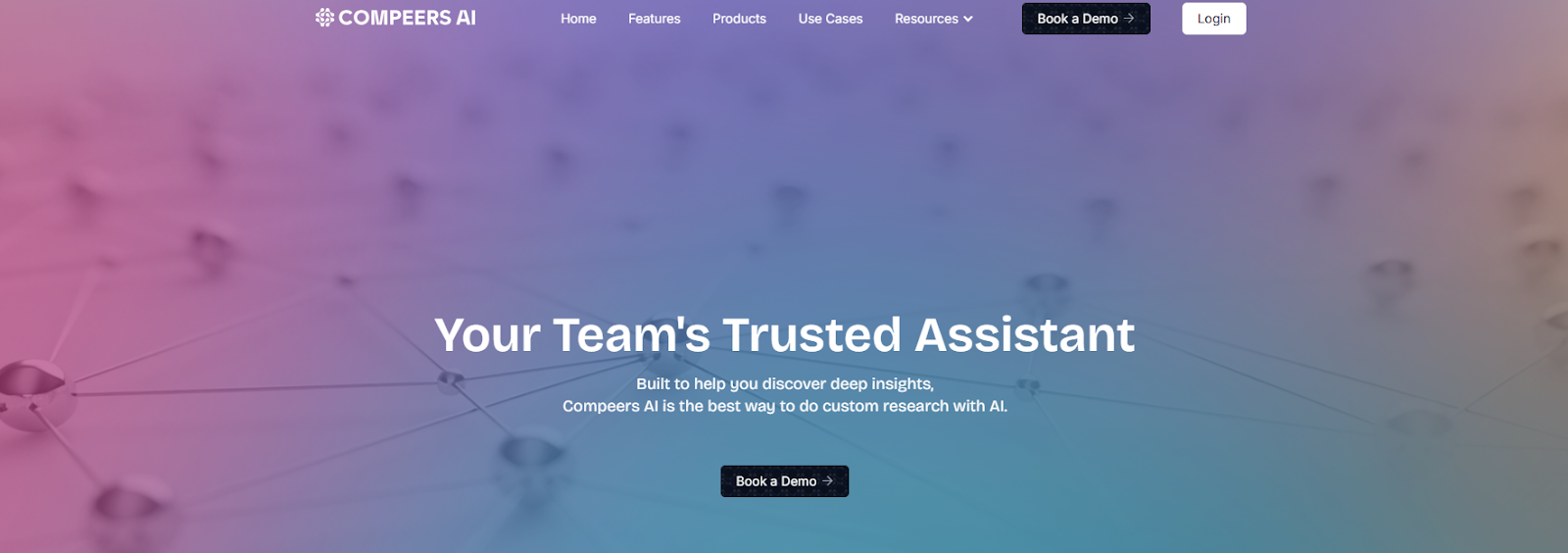
Compeers AI gives your team a single, connected system for custom market research across project design, data collection, analysis, and reporting.
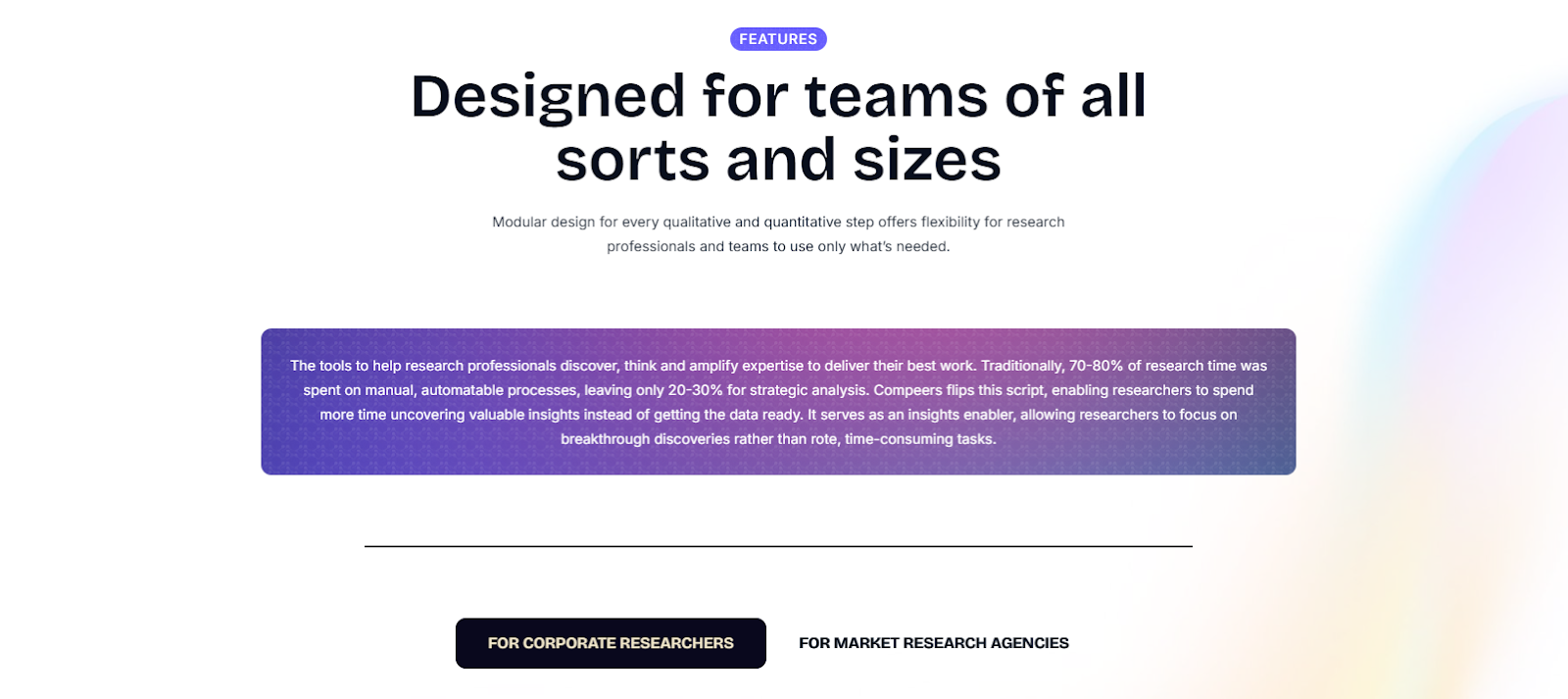
You can run qualitative, quantitative, and ad hoc analyses in a single workflow, without moving between separate survey tools, transcript tools, analysis tools, and slide files. That's useful when research teams need deeper insights, tighter continuity, and more confidence in how AI is used for the work.
The product suite is built around real research jobs.
- Qualitative Compeer supports interviews, focus groups, translation, transcription, coding, and first-draft narrative reporting.
- Quantitative Compeer covers questionnaire design, automated survey programming, data cleaning, respondent quality checks, cross-tabs, open-ended coding, auto-plotting, and advanced analytics.
- Savant, the AI data assistant, adds natural language querying, trend discovery, and traceable outputs across qual and quant data, while the broader suite also includes Segmentation Compeer, Short Responses Compeer, and Rapid Concept Evaluation Compeer.
This is the part that fits the pressure your team feels right now. Market research is more fragmented, with greater demand for faster delivery and increased scrutiny of data quality, security, and AI trust.
Compeers AI is here to keep human judgment in the loop, show how the AI reached its conclusions, and protect sensitive work with SOC 2 Type II and ISO/IEC 27001:2022 certification.
Key Features
- It supports discussion guide creation, questionnaire design, and automated survey programming inside the same research system.
- It combines transcription, translation, thematic coding, sentiment analysis, cross-tabs, and advanced analytics across qualitative and quantitative work.
- Savant gives your team conversational analysis, data slicing, advanced visualizations, and traceable outputs for stakeholder review.
Book a demo to see how Compeers AI supports custom market research from setup to reporting!
2. Quantilope
Quantilope is an AI-powered consumer intelligence platform built for quantitative research, advanced methods, and tracking.
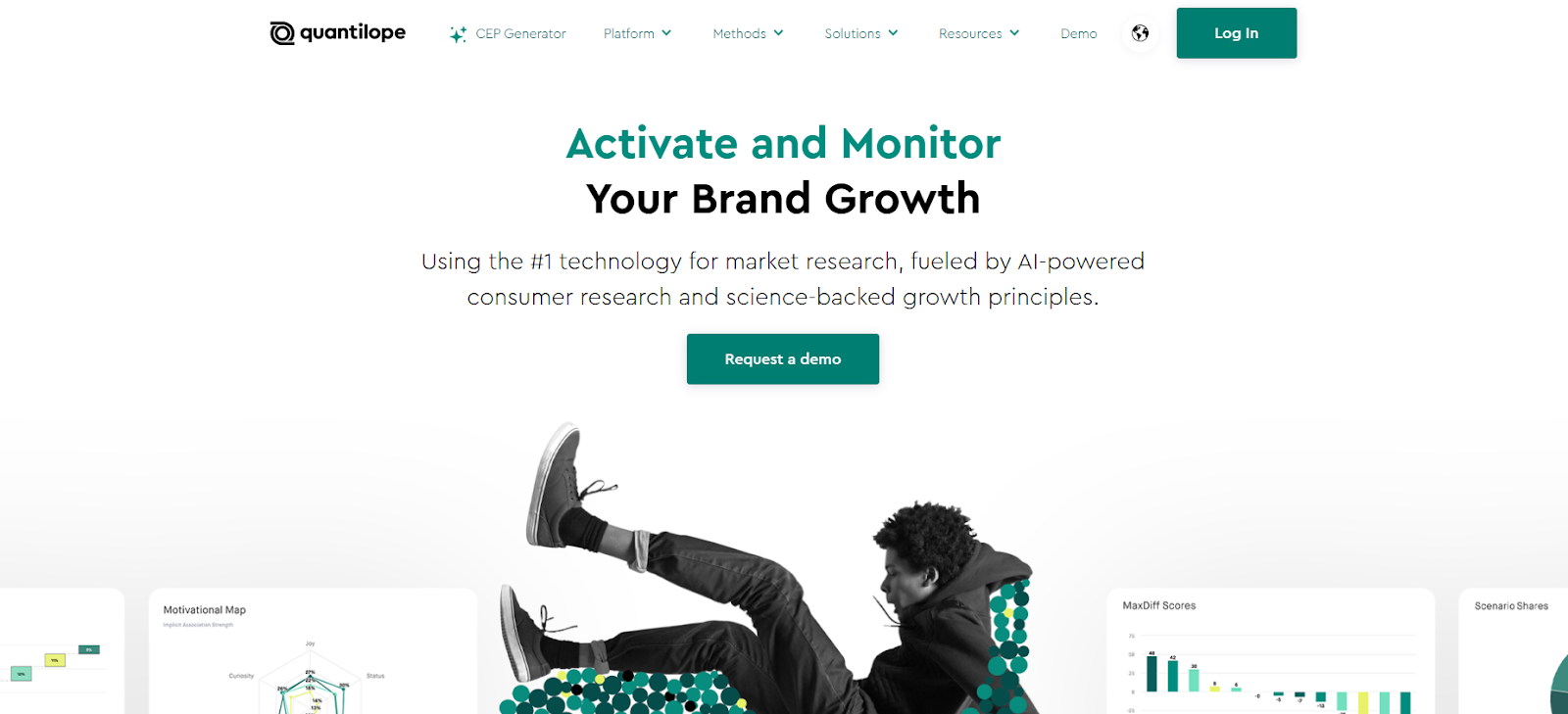
It's designed for teams that need structured market analysis, faster turnaround, and more automation for advanced survey work. The platform is built by researchers for researchers, with automation and real-time analysis at its core.
Its main use case is advanced quant at scale. Quantilope supports a large suite of automated methods, continuous tracking, and panel-agnostic fielding, so teams can work with their own list or tap partner panels.
The integrated AI co-pilot, Quinn, is built into the workflow and now supports study drafting, editing, and AI chat inside the platform.
Key Features
- It includes 15 automated advanced methods for structured quantitative research.
- It gives access to real-time insights and a global partner network that reaches 300M+ consumers.
- Quinn supports automated research setup and AI-guided work inside the platform.
3. Suzy
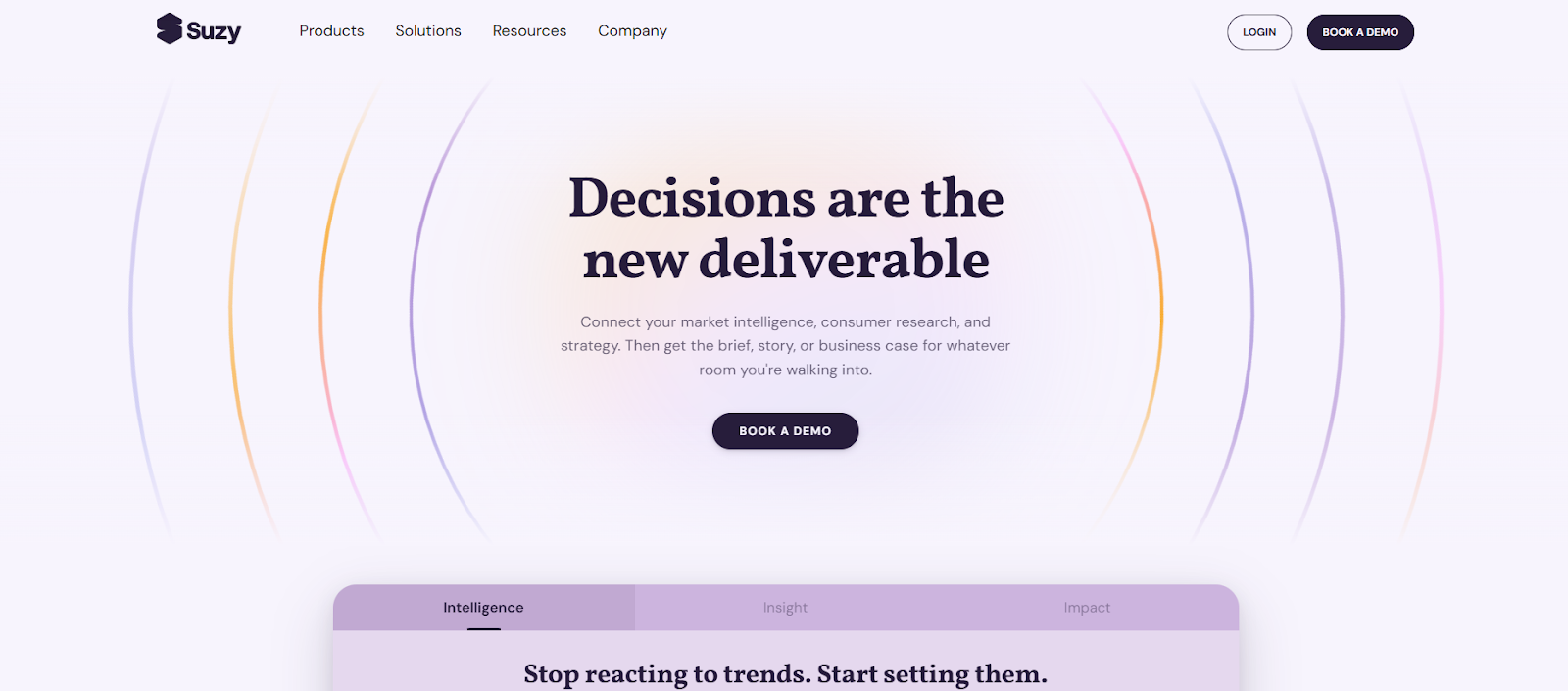
Suzy is a decision intelligence product that brings Signals, research, and data into one place. It's built for teams that need fast consumer insights tied to current culture, news, and business context, not only one-off survey results.
The product centers on quick decision support for brand, product, sales, and marketing work.
The platform organizes that work through a few core modules.
Ask Suzy Chat supports question-led exploration, Talk to Consumers handles conversational research with audiences, Query Data supports data exploration, and Signals connects research to trend and news context.
Key Features
- It unifies Signals, research, and data in one product for faster research workflows.
- It includes Ask Suzy Chat, Talk to Consumers, and Query Data as core AI features.
- Signals connect research to trend intelligence, business data, and cultural shifts.
4. Upsiide by Dig Insights
Upsiide is a research technology platform built for innovation testing. It helps teams test concepts, claims, products, packaging, and menu ideas in a format that feels closer to real consumer choice than many traditional methods.
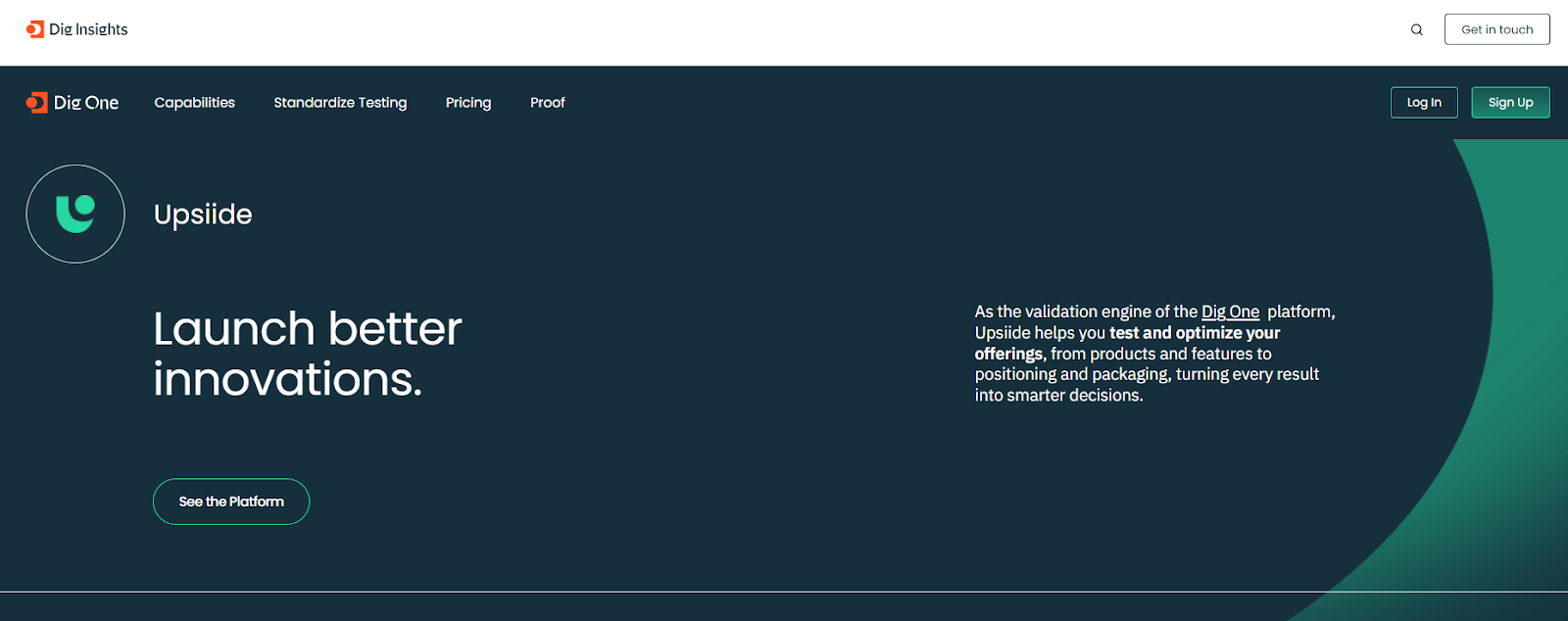
The product is built by Dig Insights and is designed around competitive context, trade-offs, and behavior-led signals instead of long monadic questionnaires.
The experience is built around swiping, commitment tradeoffs, emojis, and heatmaps. Teams can analyze results on five dashboards, forecast share of choice, source of volume, incrementality, and cannibalization through Market Simulator, and reach 300M global respondents in-platform.
Upsiide also now includes Storyteller, an AI feature that turns study results into editable, presentation-ready decks for stakeholder impact.
Key Features
- It uses swiping, tradeoff tasks, emoji feedback, and heatmaps to test ideas in a competitive context.
- It supports five dashboards, plus the Market Simulator, for share, incrementality, and cannibalization forecasts.
- Storyteller turns study results into editable reports and decks using AI.
5. Zappi
Zappi is an on-demand consumer insights platform built around repeated learning across innovation, advertising, and brand work. It gives teams one workspace for running studies, exploring results, and using prior research to guide the next test.
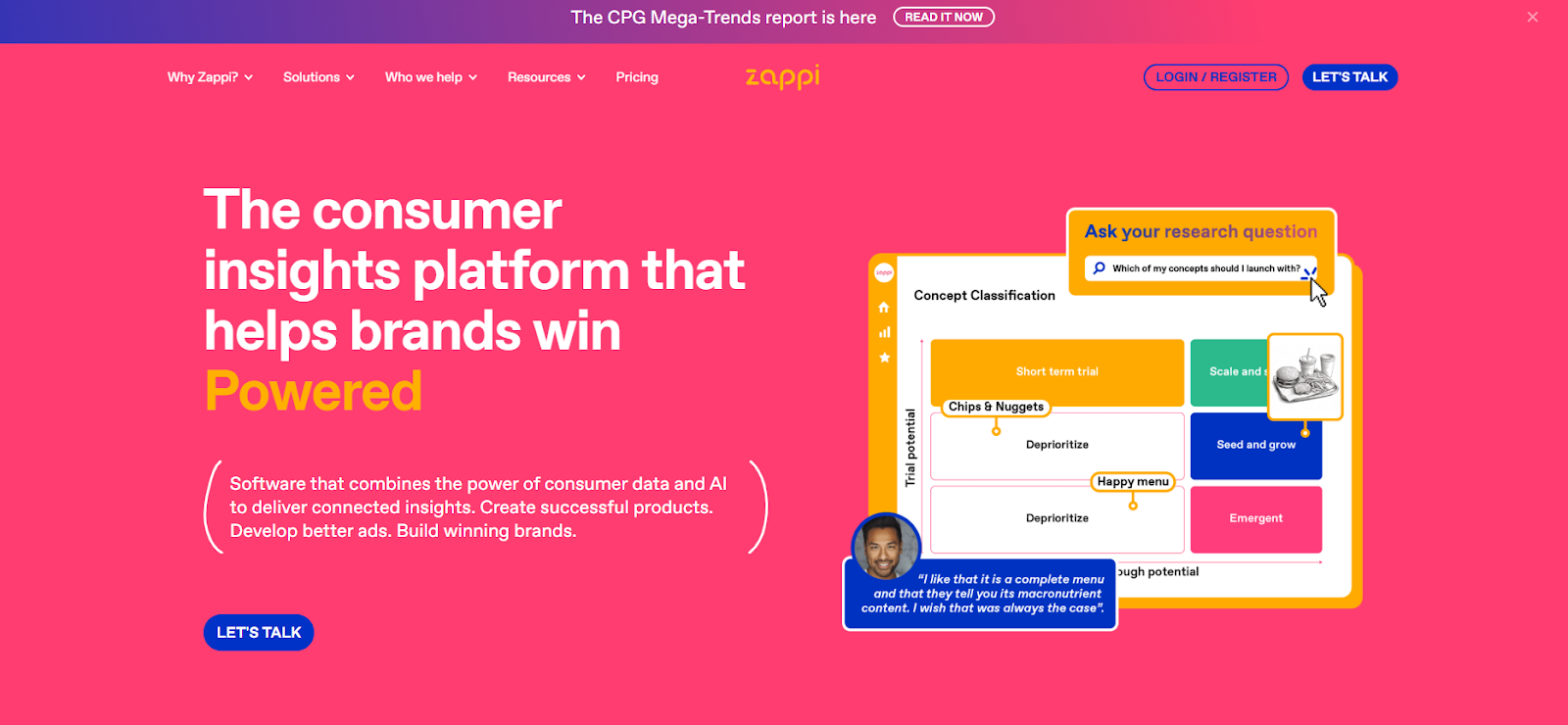
The product focuses on fast analysis and repeatable reporting. It offers automated AI-generated reports, automatically populated charts as data comes in, smart autocoding for open-ended themes, and flexible benchmarks across country, category, and brand.
It also pushes teams to learn from all their past work, which helps with ongoing insights and reduces repeated mistakes.
Key Features
- It offers on-demand research and automated AI-generated reports in one platform.
- It supports smart autocoding, verbatim review, and flexible benchmarking.
- It helps teams reuse past research to build a continuous learning loop.
6. Knit
Knit is a researcher-driven AI platform that blends AI execution with human research support. It's built for teams that want one research partner to handle scoping, questionnaire design, fielding, analysis, and reporting.
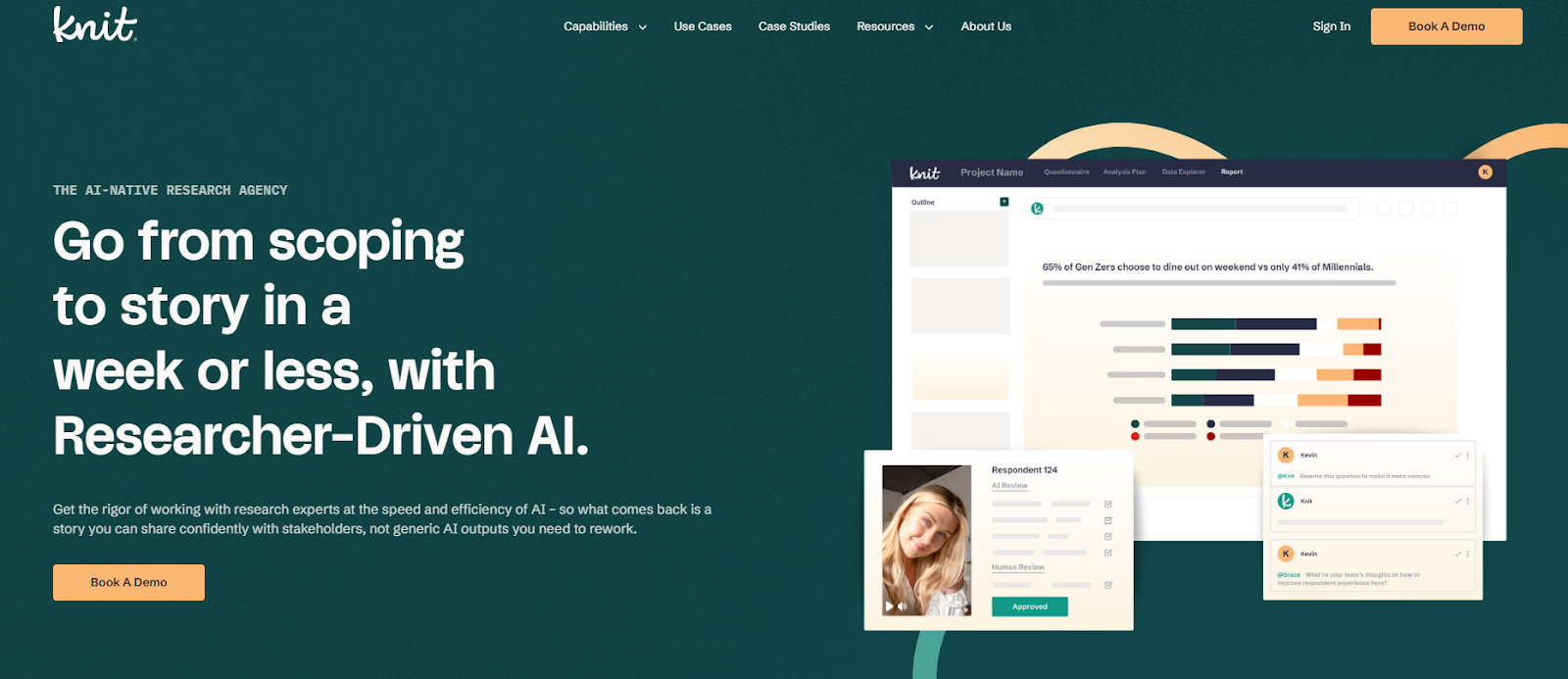
The product leans into the industry tension between speed and rigor by keeping dedicated researchers involved throughout the workflow.
Each project starts with a scoping call and an AI-generated research brief tied to audience, objectives, and deliverable needs.
From there, AI drafts the questionnaire, including mixed-method quantitative and qualitative video questions and AI-moderated video questions. Then the team moves into fielding through a global panel of 65M+ vetted respondents or a client list.
Once fielding ends, the system prepares cuts, charts, themes, sub-themes, and cited outputs, then builds a branded report ready for export.
Key Features
- It starts each project with an AI-generated Research Brief shaped around business context and research objectives.
- It supports mixed-methods quantitative and qualitative video questions, as well as AI-moderated video questions, within a single study.
- It analyzes quant and qual together and produces cited outputs your team can stand behind.
7. Bolt Insight
Bolt Insight is an AI-powered market research company that combines technology with human expertise across qualitative and quantitative studies. Its positioning centers on real consumer conversations, global fieldwork, and decision-ready insight rather than self-serve dashboards alone.
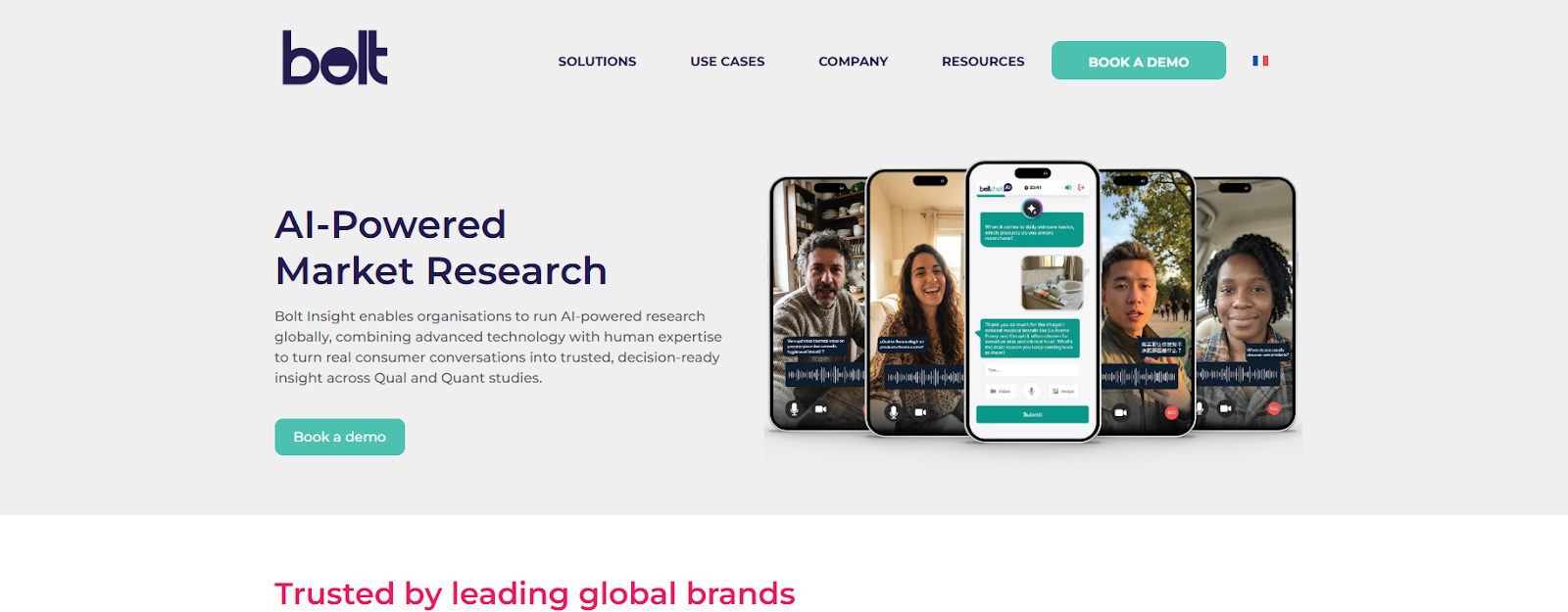
The company has a meaningful global scale for qualitative and mixed-method work. The site highlights more than 5,000,000 consumers interviewed, coverage for 50+ global markets, and research in 25+ languages.
BoltChatAI extends that core offer with features such as Meta-Analysis and Dynamic Personas, which let teams upload past studies, compare findings over time and throughout segments, and keep audience profiles up to date as new data comes in.
Key Features
- It combines AI-powered research with human expertise for qual and quant studies.
- It supports multilingual research for 50+ markets and 25+ languages.
- BoltChatAI adds meta-analysis and dynamic personas based on uploaded research data.
How to Choose the Right AI Tool for Market Research
The right tool starts with the real role your team needs to handle. Some AI tools for market research work only at one layer, such as survey creation, sentiment analysis, or data visualization. Some support the full market research process, including data collection, analysis, and reporting.
If your team already uses multiple tools for market research, start by mapping where the handoffs break down.
Here's a shortlist you can check before choosing:
- Research scope. Decide whether you need help with one task or the full research process. AI apps can save time on narrow jobs, but a broader system is more useful when you manage multiple research projects at once.
- Method fit. Check whether the tool supports the methods you actually use, including focus groups, concept testing, interview data, open-ended coding, or advanced quant. Traditional methods still matter, so the product has to match the real workflow.
- Data quality and trust. Look for data quality checks, cited outputs, and visibility into how the AI reached its output. That's especially important when AI systems handle proprietary data or perform high-stakes market analysis.
- Output quality. Good AI features should reduce manual work while also producing usable research findings, not just draft text. Teams need key insights, charts, and strategic outputs that hold up in real-world contexts.
- Security and governance. Security concerns need attention from the start if the work includes customer data, internal studies, or sensitive research briefs. Certifications, access control, and explainability all belong in the evaluation.
The right choice should help your team spend less time extracting data, cleaning files, and rewriting summaries. It should also leave more time for the strategic tasks that still need judgment, such as interpretation, prioritization, and strategy development.
That's the difference between adding another AI layer and improving the way market research actually works.
Amplify Your Market Research Expertise With Compeers AI
AI for market research should reduce manual work without turning your process into a black box. Your team still needs clear research objectives, defensible outputs, and a workflow that keeps context from setup through reporting.
When that work gets split with separate tools, the research slows down in the places that matter most.
With Compeers AI, the whole market research process is simplified.
Whether you need qualitative, quantitative, advanced analytics, or first-draft reporting, you get one connected system for custom market research.
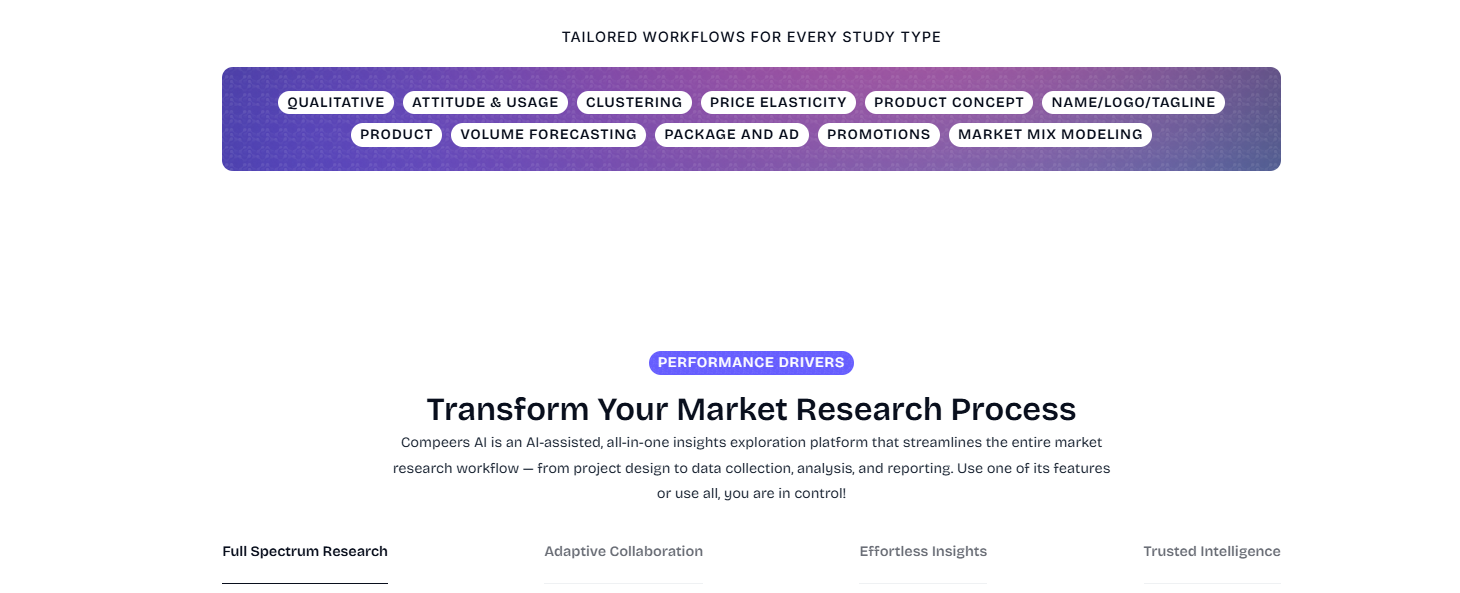
Your team can manage survey creation, data collection, analysis, and deliverables with greater continuity, traceability, and control over how AI is used.
Book a demo to see how Compeers AI supports end-to-end market research in one workflow!
FAQs About AI for Market Research
Can AI replace human researchers in market research?
AI cannot replace human researchers in any complete sense. It can speed up survey creation, analysis, coding, and automated report generation, but market researchers still need to frame the problem, judge the output, and connect the findings to business decisions.
What are the limits of AI in market research?
AI has limits when the task depends on lived experience, high-stakes final calls, or nuanced interpretation across culture and context. Synthetic data can help with early exploration, but it's less reliable for final launch decisions, detailed behavioral recall, or questions that need direct human input from real consumers.
How accurate are AI market research tools?
Accuracy depends on the method, the training data, the validation process, and the quality of the research setup. AI is useful for identifying patterns humans often miss, handling large volumes of text, and speeding up analysis, but weak input data and loose methodology still lead to poor output.
Do AI market research tools work for small teams as well as enterprises?
Yes, but the right fit changes by workload and risk. Small teams can start with narrower AI-powered tools or free tools for secondary research, survey drafting, or basic analysis, while enterprise teams usually need stronger governance, broader workflows, and support for more data sources, more users, and more complex research processes.
Latest articles
Browse all posts


.svg)
Custom research, reimagined
.svg)
.svg)
.svg)
.svg)