.svg)



6 Best Qualitative and Quantitative Research Tools for 2026

Qualitative and quantitative research tools should help you do more than collect data.
You need a platform that can connect surveys, interviews, focus groups, analysis, and reporting without having to rebuild the project after fielding.
That's where many workflows still break. Quantitative data is often stored in one system, qualitative data in another, and the final readout depends on manual cleanup before anyone can use the findings.
Below, we compare six market research platforms that handle qualitative and quantitative research more effectively.
TL;DR
These are the 6 best qualitative and quantitative research tools in 2026:
- Compeers AI
- Toluna Start
- Quantilope
- Suzy
- Knit
- Forsta
Why Market Research Often Needs Both Qualitative and Quantitative
Market research often requires both qualitative and quantitative research because the two methods address different aspects of the same business problem.
Qualitative research helps you explore meaning, motivation, and context through non-numeric data such as interview transcripts, open-ended questions, and focus group discussions.
Quantitative research measures patterns using numerical data and statistical methods, making it better suited for testing hypotheses, measuring variables, and demonstrating how results hold up in a sample or defined population.
The key differences between qualitative and quantitative work are well known, but most business teams don't run a single, clean methodology forever.
A real research project often needs qualitative methods to explore a research question first, then quantitative methods to validate what the team heard with broader populations, objective analysis, and descriptive statistics.
That's why mixed methods research keeps showing up in practice:
- Quantitative data collection methods help you gather primary data from a random sample, test two or more variables, and support quantitative studies built for statistical analysis.
- Qualitative data collection helps qualitative researchers run in-depth interviews, conduct focus groups, and identify themes within descriptive data that would be hard to see in a spreadsheet.
- Quantitative and qualitative methods used together provide a more comprehensive understanding, as you can validate signals with quantitative methods and then explain them qualitatively.
- Mixed methods also help you combine primary and secondary data, existing knowledge, a literature review, or even meta-analysis when the decision requires more than one lens.
You can use quantitative and qualitative research together because scale without explanation leaves gaps, and exploration without measurement makes it harder to generalize findings.
When the platform can connect quantitative and qualitative data within a single analysis, your team gains deeper insights, a more nuanced understanding, and a clearer path to data-driven decisions.
What to Look for in Qualitative and Quantitative Research Tools
A tool can support qualitative and quantitative studies on paper, but the real test is whether it helps your team move from collecting data to synthesis without treating the methods as separate projects.
Support for Surveys, Interviews, and Focus Groups
A platform that claims to support both methods should handle the core research techniques buyers expect. That usually means survey design and quantitative data collection on one side, then in-depth interviews, conducting focus groups, and other qualitative studies on the other.
That mix matters because teams rarely know at the outset whether a study will remain qualitative or quantitative.
A more useful platform gives you the option to choose qualitative or quantitative research based on the research question, then to expand to a mixed-methods approach when the findings need both explanation and validation.
Analysis That Connects Structured and Unstructured Data
The platform should help you read quantitative and qualitative data together instead of sending each method to a separate file.
Most teams need coding, sentiment analysis, theme detection, crosstabs, dashboards, and other tools to analyze qualitative data and structured survey results in one place.
This part is important because structured and unstructured inputs answer different parts of the same problem.
One stream may present non-numerical data and identify themes, while the other helps analyze data using statistical methods, descriptive statistics, and measures tied to independent and dependent variables.
Respondent Access and Fieldwork Control
Respondent access shapes how fast you can move and how much control you have over fieldwork.
Built-in panels, recruiting support, and field management matter even more if you need to collect quantitative, qualitative, or both data within a tight timeline.
This is also where many tools separate themselves operationally. Some platforms bring respondent access into a single environment, while others expect you to source a sample population elsewhere and manage the rest of the workflow independently.
Reporting That Brings Both Methods Into One Story
Reporting is where a mixed-method workflow either becomes useful or falls apart.
The tool should help you extract insights from quantitative and qualitative data, build one narrative, and demonstrate how the evidence supports the recommendation.
That matters because mixed-methods studies produce two distinct kinds of evidence.
One side gives structured measurement and objective analysis; the other adds context, holistic understanding, and the kind of explanation qualitative research helps uncover when numbers alone cannot tell the story.
Top 6 Market Research Platforms for Qual & Quant Insights
Use the shortlist below to compare how each platform handles data collection, mixed methods research, respondent access, and final outputs.
The right fit depends less on feature count and more on how well the platform supports your market research workflow from the first question to the final recommendation.
1. Compeers AI
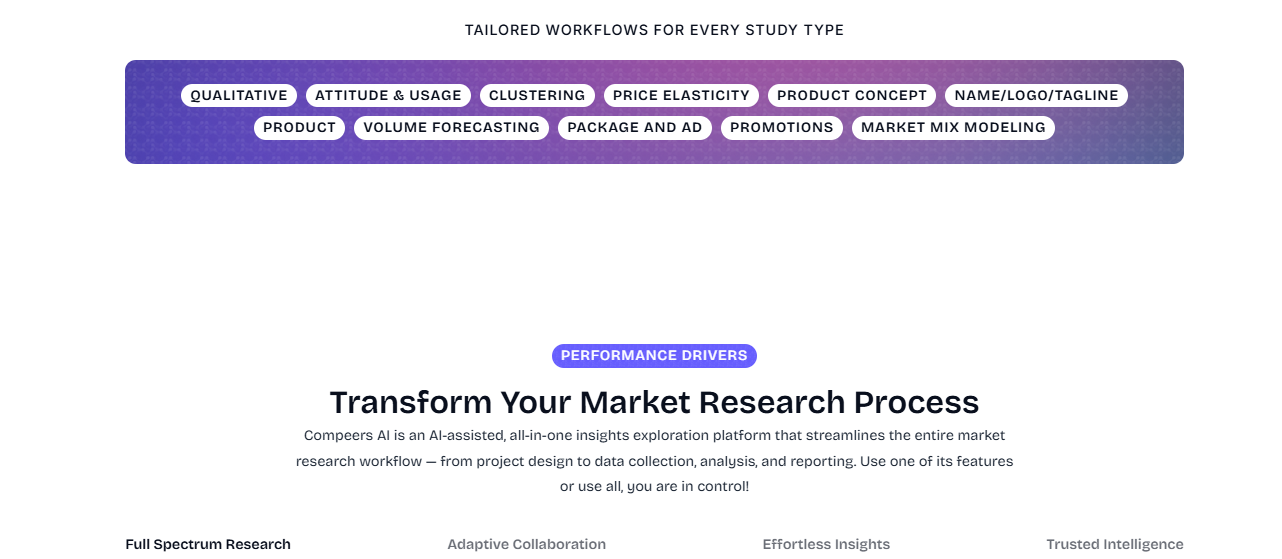
Compeers AI is the best choice if you want one connected system for qualitative and quantitative research, mixed-methods analysis, and first-draft reporting.

If your team is tired of splitting the brief, the survey, the transcripts, the crosstabs, and the final story across separate tools, Compeers AI keeps all that work in one place, from project design through reporting.
You can use it to build questionnaires and discussion guides, run qualitative and quantitative research within the same workflow, and keep evidence tied to the project context throughout the study.
Qualitative Compeer supports interviews, focus groups, transcription, translation, and thematic coding, while Quantitative Compeer covers survey creation, programming, automated cross-tabs, advanced analytics, and first-draft reporting.
The Compeers AI product set offers more than just qualitative and quantitative research.
Segmentation Compeer, Short Responses Compeer, Rapid Concept Evaluation Compeer, and Savant also help move from design to mixed-methods synthesis with a single, connected workflow rather than a long chain of handoffs.
Key Features
- Guided workflows for qualitative and quantitative custom studies
- Questionnaire and discussion guide creation in the same system
- Automated cross-tabs, advanced analytics, and draft reporting
- Multi-language transcription, translation, and qualitative data FAQs
- Segmentation, key driver, conjoint, and pricing research support
- Secure project management for qualitative, quantitative, and mixed-method work
- Savant AI support for exploration, pattern detection, and faster synthesis
Book a demo and see how Compeers AI connects qual and quant research!
2. Toluna Start
Toluna Start suits market research that depends on panel access and a flexible mix of self-serve and supported execution.

The platform combines qualitative and quantitative research, self-service and expert-led support, and access to a global panel of 79+ million consumers, which makes it useful when your team needs both speed and respondent access in the same environment.
It is a practical choice for agile research, fast-turn studies, and organizations that want one platform for survey design, integrated respondents, reporting dashboards, and recommendations.
The workflow leans toward end-to-end fieldwork and broad access rather than deep mixed-methods synthesis, yet it still covers both sides of the research process in a single system.
Key Features
- Access to a global panel of 79+ million consumers
- Support for qualitative and quantitative research in one environment
- Self-service and custom research support with one login
- Survey design, integrated respondents, and reporting dashboards
3. Quantilope
Quantilope is the advanced methodology option in this list. Its Consumer Intelligence Platform focuses on automated consumer research, AI-driven insights, real-time consumer data, and a deep set of quantitative research methods.
Its current plans also include qualitative methods, such as inColor, if you still need mixed-method capabilities.
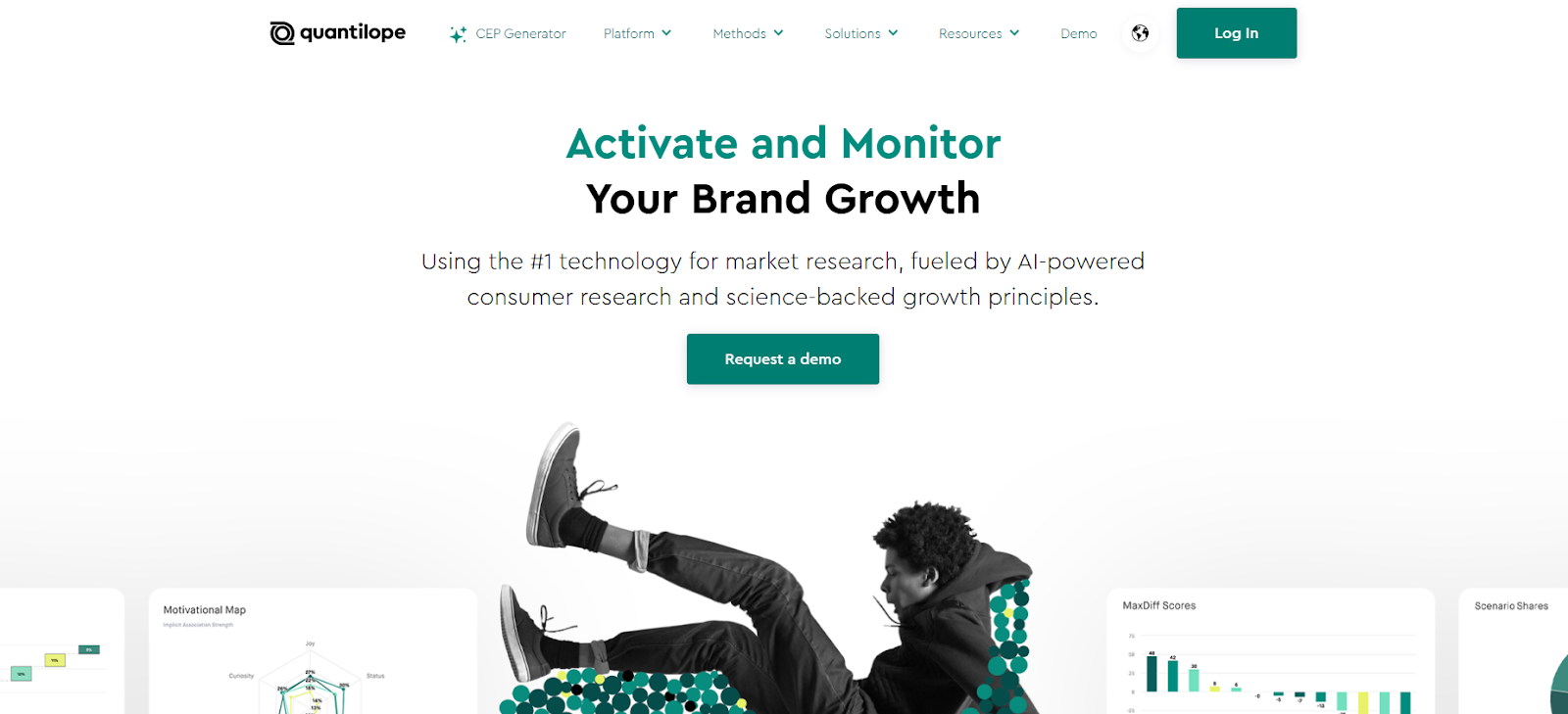
This makes Quantilope a better fit when your team needs more depth in advanced quant than most mixed-method tools provide.
If you're looking for segmentation, conjoint, MaxDiff, tracking, pricing, or other quantitative methodologies, you'll find a broader range of methods here than in simpler all-in-one tools.
Key Features
- 15 automated advanced methods for consumer research
- AI co-pilot Quinn for guidance and analysis support
- Access to 300M+ consumers through its panel network
- Qualitative methods, segmentation, and tracking in higher tiers
4. Suzy
Suzy focuses on fast-turn mixed-method consumer validation. Its current positioning ties quant and qual research, integrated audiences, AI-assisted analysis, and connected data into one decision engine, which makes it useful if you need answers quickly on messaging, concepts, product ideas, or ongoing consumer behavior questions.
The product is especially relevant when speed matters more than deep methodological customization.
Suzy supports standard surveys, monadic testing, MaxDiff, TURF, live-moderated in-depth interviews, focus groups, AI-moderated interviews, and access to 70+ verified global panels, so your team can move from validation to action fast.
Key Features
- Support for both quant and qual methodologies in one platform
- Access to 70+ verified consumer panels in 130+ markets
- AI-moderated interviews alongside live qualitative methods
- Signals, research, and data unified in one product
5. Knit
Knit is the AI-native mixed-method option. It's built around researcher-driven AI and positions itself as a platform that can run quant + qual in a single study, taking your team from scoping and survey creation through sample and fielding, analysis, and AI-generated reporting in a week or less.
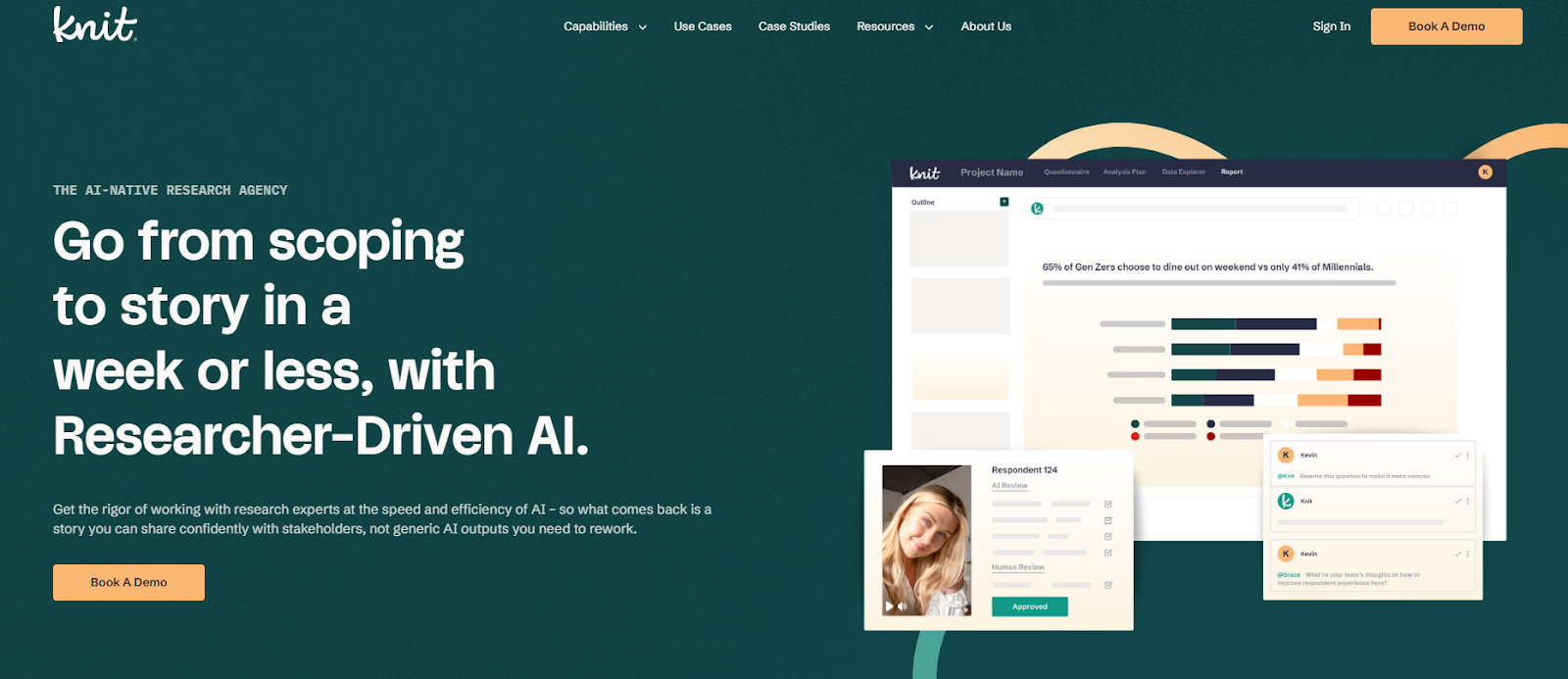
The platform is geared toward faster delivery, with a researcher still shaping the methodology, which helps when your team wants AI support but still needs the output to reflect business context and not just generic automation.
Key Features
- Quant + qual in a single study
- Access to 65M+ verified respondents for sample and fielding
- AI-generated surveys and automated reporting
- AI-moderated video questions for qual depth at quant scale
6. Forsta
Forsta is the enterprise-scale qual + quant suite on this list. Its market research offering covers advanced data collection, digital diaries, dashboards, multi-mode research, focus groups, interviews, analytics, and AI-powered reporting.

Forsta places greater emphasis on scale, control, and multi-mode infrastructure, making it suitable for large research programs that need surveys, interviews, focus groups, dashboards, and analytics in a single suite.
Key Features
- Multi-mode research with advanced logic, CATI, CAPI, qualitative research, and analytics
- Online interviews and focus groups that are built for research teams
- Data visualization for dashboards and dynamic stories
- AI-powered enterprise platform with integrations and secure scaling
Which Kind of Tool Fits Your Research Workflow Best
The right platform depends on where your research workflow breaks first. Some teams mainly need respondent access and rapid fielding, while others need tighter integration between qualitative and quantitative data so the final readout doesn't split the story in half.
It also depends on how your team currently handles research methods.
If the biggest problem is duplicated setup, disconnected reporting, or a weak handoff between qualitative and quantitative approaches, then workflow continuity matters more than a single feature list.
If the problem is advanced quant depth, panel reach, or enterprise controls, then the right choice may look different.
A simple way to sort the options is to start with the job:
- Choose a workflow-first platform if your team wants a single system for mixed-methods approaches, synthesis, and first-draft reporting.
- Choose a panel-backed platform if respondent access and faster fieldwork matter most.
- Choose an advanced quant platform if your research question depends on segmentation, conjoint analysis, pricing, or other quantitative methodologies.
- Choose an enterprise suite if you need multi-mode research, security, and large-team controls.
Run Qual and Quant Research in One Connected Workflow
You may write the questionnaire on one platform, run qualitative data collection elsewhere, analyze quantitative data in spreadsheets, and then stitch transcripts, themes, cross-tabs, and charts together by hand. It all makes your work harder to review, harder to reuse, and slower to explain.
Compeers AI gives your team one connected workflow for that work.

You can build the brief, create questionnaires and discussion guides, run qualitative and quantitative research, analyze data in context, and move into first-draft reporting without splitting the project into separate tools at each stage.
That makes a real difference for mixed-methods research, where the value lies in connecting explanation with measurement and turning both into a single usable recommendation.
Compeers AI helps your team keep the evidence, the analysis, and the story aligned from setup to reporting.
Book a demo and see how Compeers AI keeps mixed-method research in one system!
FAQs About Qualitative and Quantitative Research Tools
What are qualitative and quantitative research tools?
They are tools that help you collect and analyze qualitative, quantitative, or both. Qualitative tools handle interviews and themes, while quantitative tools handle surveys, numerical data, and statistical analysis.
What tools are used in qualitative research?
Qualitative research tools usually support in-depth interviews, focus groups, transcription, coding, and theme analysis. They help you analyze qualitative data and extract insights from non-numeric data.
What tools are used in quantitative research?
Quantitative research tools usually support surveys, quantitative data collection, crosstabs, dashboards, and statistical methods. They help you analyze data, measure variables, and test hypotheses with broader populations.
Can one platform support both qualitative and quantitative research?
Yes. Some platforms support surveys, interviews, focus groups, respondent access, analysis, and reporting in one workflow.
Which tools are best for mixed-method research?
Compeers AI is the best fit when the team wants a single, connected workflow for qual, quant, synthesis, and reporting. It is built to keep the project together from setup through first-draft delivery.



.svg)
Custom research, reimagined
.svg)
.svg)
.svg)
.svg)