.svg)



8 Best Suzy Competitors & Alternatives for 2026

When you start comparing Suzy's competitors, speed is only part of the decision. You also need to consider audience access, research format, workflow depth, and the level of support you need once the work moves beyond fast validation.
Suzy helps you make rapid decisions, get instant insights, and run AI-powered research workflows that move brands from questions to answers in hours. That model works well when the job is quick feedback, fast survey responses, and a tight link between consumer research and decision-making.
Brand teams, product teams, and insights teams may need broader quantitative and qualitative research, better data analysis, greater control over survey results, or a market research platform that carries context from setup through reporting instead of stopping at fast validation.
Below, you’ll find the eight best Suzy alternatives.
TL;DR
These are the Suzy competitors and alternatives:
- Compeers AI
- Zappi
- Attest
- Pollfish
- Voxpopme
- SurveyMonkey
- Alchemer
- Aytm
Why Teams Are Looking for Suzy Alternatives
Suzy is known for fast-turn consumer research, instant insights, and decision-support workflows built around speed.

It combines built-in audience access, survey research, conversational research, Signals, and Ask Suzy, so you can move quickly from a business question to consumer feedback.
Its current plans center on a free tier, paid monthly credit plans, and an enterprise option. For 100 credits, the Pro plan is listed at an estimated $150 per month, Team at an estimated $200 per month, and enterprise pricing is annual and sales-led.
That setup is useful when you need quick concept feedback, pricing checks, campaign reactions, or fast survey readouts. It's also why many of Suzy’s customers are larger brands and enterprise companies that want quick answers without a long custom setup.
However, there are a few downsides:
- Survey customization can feel narrow on more complex studies
- Survey design guardrails can get in the way of advanced methods or multi-stage models
- Niche audience reach can be harder when you need very specific professional or low-incidence groups
- The learning curve gets steeper once you move past quick-turn studies and need more careful question design
- Budgeting becomes less predictable when credits, one-off usage, or niche audiences start to add up
8 Best Suzy Competitors & Alternatives in 2026
To make the shortlist easier to compare, the table below shows where each alternative fits, what it does best, and how it approaches research.
Let's get deeper into each one.
1. Compeers AI
Compeers AI is the best Suzy alternative when you need a more comprehensive research workflow.
You can keep project design, concept evaluation, qualitative research, quantitative research, segmentation, analysis, and reporting tied to the same study instead of splitting the work between separate tools.

Suzy is built for fast answers and quick decision support. Compeers AI goes further by keeping the full project connected after the first readout. The brief, the instrument, the fieldwork, and the final report stay tied to the same project.
You can move from concept work to deeper analysis without shifting the project into separate tools. It also makes it easier to keep context, reduce manual cleanup, and produce clearer outputs for stakeholders.
Each product covers a specific part of that connected workflow:
- Qualitative Compeer supports discussion guides, interviews, focus groups, transcription, translation, coding, and narrative reporting.
- Quantitative Compeer handles survey design, programming, cross-tabs, open-ended coding, and advanced analytics for structured studies.
- Segmentation Compeer applies factor analysis and multiple segmentation models to identify useful audience groups.
- Rapid Concept Evaluation Compeer supports faster concept testing with discrete choice modeling and stronger early-stage evaluation.
- Short Responses Compeer speeds up open-ended analysis for fast-turn studies that still need structure and usable outputs.
- Savant lets teams query qual and quant data, surface patterns, and build first-pass outputs with traceability.
That gives you more than speed alone. It gives you a connected way to run custom research from brief to final report.
Key Features
- End-to-end workflow from project design to reporting
- Advanced analytics, including segmentation, conjoint, and pricing research
- Multi-language support for global research projects
- Natural-language analysis and first-draft report generation
- Secure project management with auditability and centralized knowledge
- Modular product lines that let a team use one capability or a broader connected system
Pros
- Connects concept testing, qualitative and quantitative research, and reporting in one workflow
- Keeps context tied to the original brief, the data, and the final output
- Supports custom research programs that need more depth than fast validation alone
Pricing
- Custom pricing
Book a demo and see how Compeers AI keeps consumer research connected from setup to final report!
2. Zappi
Zappi is one of Suzy's closest competitors in brand, ad, and innovation testing. Its core pitch centers on consumer validation, enabling teams to test ideas, learn from prior data, and run structured programs tied to in-market outcomes, rather than relying on one-off surveys.
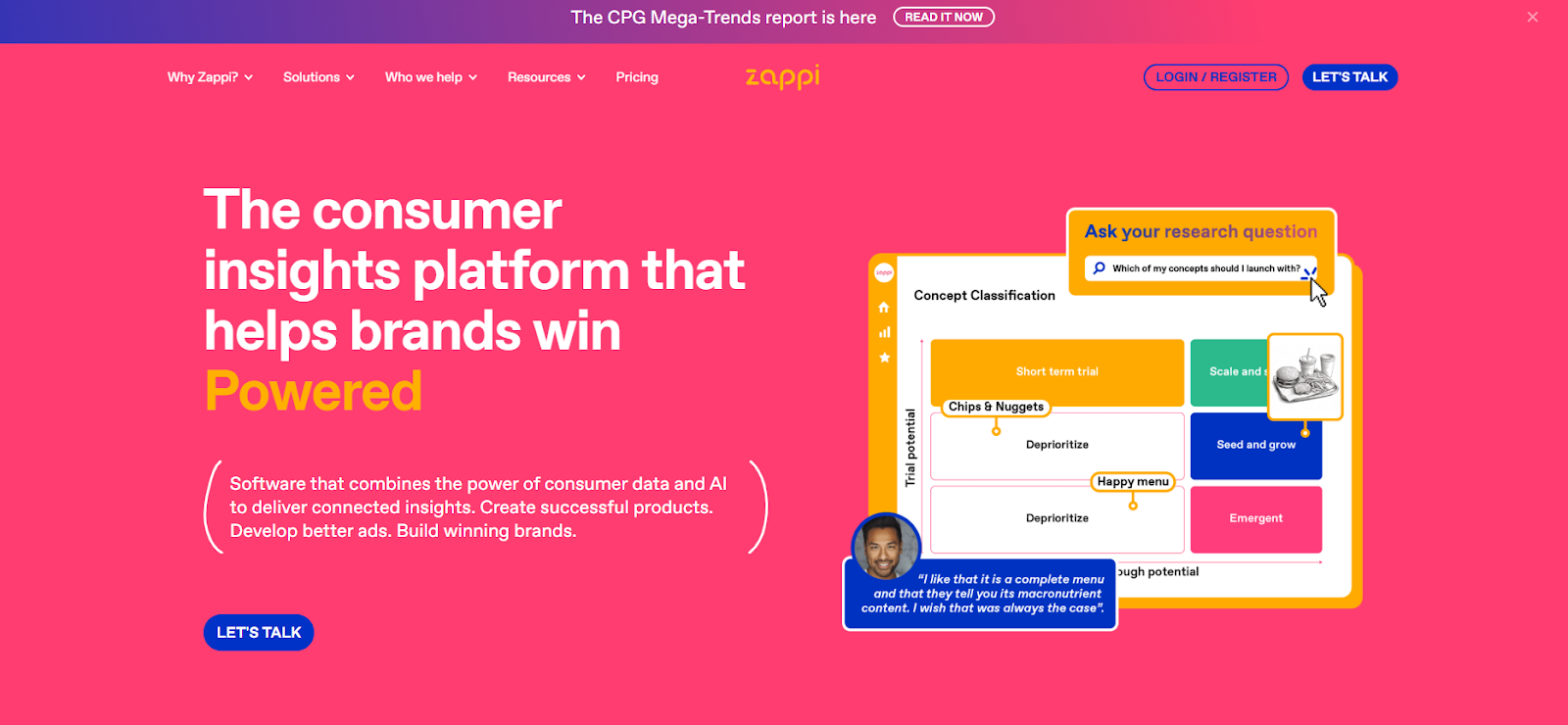
That makes Zappi a suitable choice for brand teams seeking repeatable concept testing, ad testing, and idea development within a guided system.
The platform is less about broad custom research and more about disciplined testing programs that help brands improve concepts, creative, and market readiness over time.
Key Features
- Connected ad development system tied to in-market outcomes
- Brand health and innovation testing programs in the same product family
- AI-powered system built to test, learn, and iterate with consumers looped in
Pros
- Customer support is a recurring positive in the reviews
- Helps teams gather product and campaign feedback in one place
- Supports consumer response collection tied to digital marketing and product ideas
Cons
- Customization can feel restrictive in some settings
- The workflow is narrower when a team needs broader methodology depth
- Pricing is not transparent
Pricing
- Premium: Custom pricing
- Enterprise: Custom pricing
3. Attest
Attest is a market research platform built for survey-led consumer research with global reach. It gives you access to audiences in 59 countries, supports 70+ languages, and sells subscriptions with a flat audience fee rather than charging more for harder-to-reach groups.
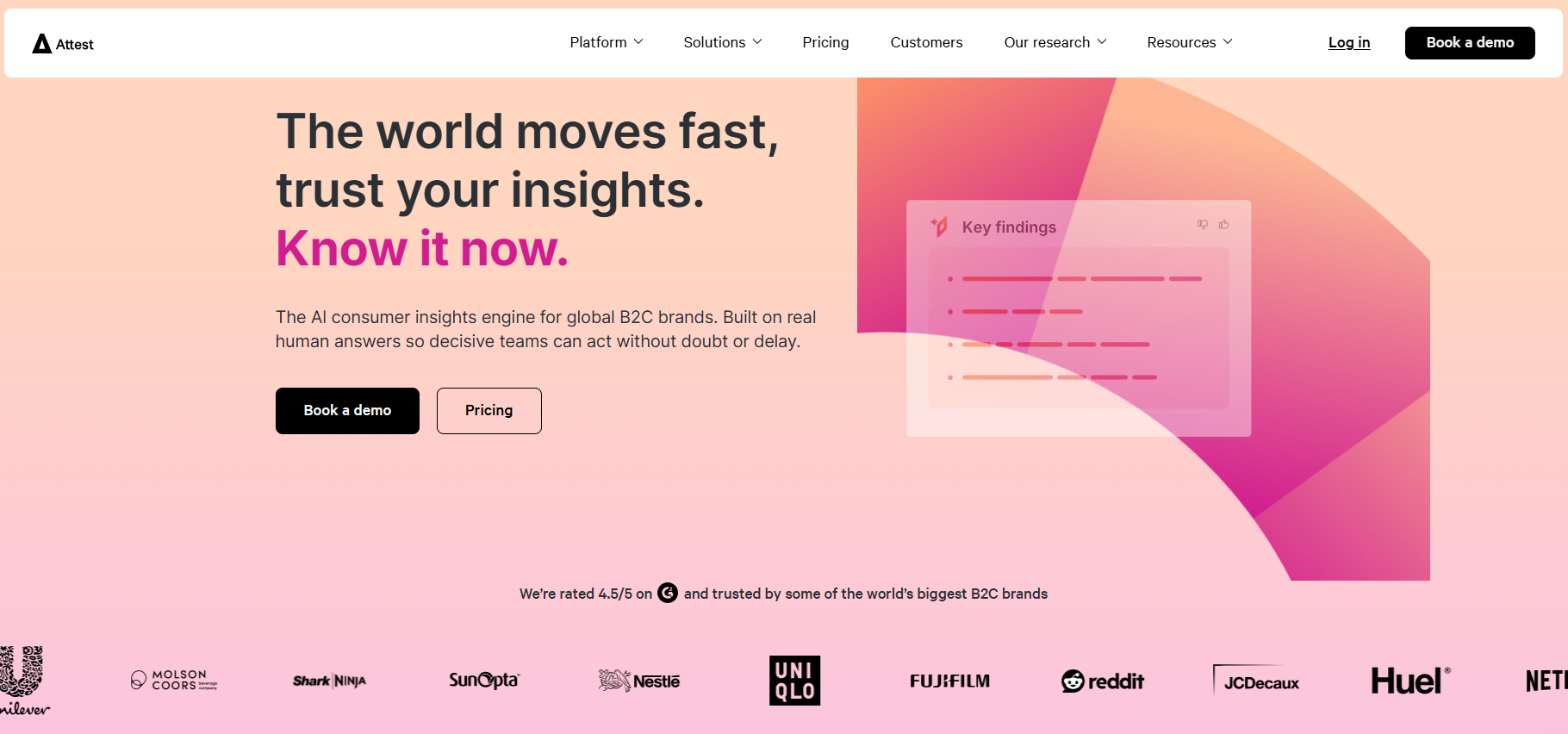
It is most useful for brand tracking, concept testing, and target audience work where quick survey results and broad geographic access matter more than deep qualitative research.
Key Features
- Global research reach in 59 countries and 70+ languages
- One flat audience fee with no premium for niche audiences
- Subscription tiers built around credits and unlimited seats
Pros
- Survey setup is easy to manage for non-technical teams
- Customer support is a clear strength in the review-based
- Access to target audience segments is a recurring reason teams use it
Cons
- Pricing can feel high for smaller projects
- Advanced analytics and deeper custom work are more limited
- Survey limits can get in the way of more complex projects
Pricing
- Basic: up to 50,000 credits
- Standard: up to 100,000 credits
- Elite: 200,000+ credits
- Custom: 400,000+ credits
4. Pollfish
Pollfish is a self-serve survey platform built for fast fielding, broad audience access, and transparent pay-per-response pricing.

It gives researchers and businesses access to 250M+ global consumers, live price calculations, and targeting filters covering demographics, behavior, geography, media use, and household income.
That makes it a cost-effective option for anyone who wants direct control over surveys, audience filters, and response volume. It's especially relevant for those who prefer variable pricing over a flat subscription fee, or for teams that need quick reads for niche audiences without a high fixed cost.
Key Features
- Pricing starts at $0.95 per response with real-time cost calculation
- 50+ targeting filters, including household income and purchase behavior
- Global access in 160+ countries with 50+ supported languages
Pros
- Survey creation and fielding move quickly
- Pricing is easier to predict than subscription models with hidden extra costs
- Support is active and useful when you need help with survey flows or data analysis
Cons
- A very fast turnaround can raise questions about response authenticity for some teams
- Parts of the interface feel clunky or dated
- Some features need a smoother user experience
Pricing
- DIY Platform: $0.95 per response
- Full Service Projects: $5,000/project
- Enterprise: $10,000/project
5. Voxpopme
Voxpopme centers on qualitative research through video surveys, live interviews, and AI-powered analysis. It gives you a way to collect video feedback, centralize qualitative evidence, and turn customer voice into presentation-ready reporting that stakeholders can act on.

That makes it a better fit for a richer consumer behavior context than a fast survey alone can provide.
If the brief calls for live interviews, emotional nuance, or evidence to support customer relationships, messaging decisions, or concept refinement, Voxpopme offers more depth than a standard self-serve survey tool.
Key Features
- One platform for video surveys, live interviews, and AI analysis
- Showreels and shareable proof built for stakeholder reporting
- AI tools that analyze qualitative feedback 60x faster
Pros
- Video and analytics make insights more vivid and easier to use in reporting
- The platform is simple to navigate for qualitative work
- Customer voice is easier to turn into stakeholder-ready output
Cons
- AI summaries and transcription quality can be inconsistent
- Video quality issues can affect the experience and the final output
- Pricing is not transparent
Pricing
- Custom pricing
6. SurveyMonkey
SurveyMonkey is broader than Suzy, but it is still a relevant competitor when the team needs flexible surveys, AI-supported analysis, and a familiar research platform with purpose-built market research solutions.

It supports concept testing, price optimization, MaxDiff, TURF, panel access, and real-time insights without forcing you into a single decision-support model.
This option is especially useful when you want self-serve flexibility, broad adoption, and easier collaboration than a more specialized platform offers.
Key Features
- Market research methods, including MaxDiff, TURF, concept testing, and price optimization
- AI-powered insights plus exports to CSV, XLS, PPT, PDF, and SPSS
- Audience panel access and fast feedback starting at $1 per response for market research
Pros
- Survey creation is quick for anyone who needs to launch fast
- Templates and built-in logic help you create surveys without heavy setup
- Real-time charts and export options make reporting easier
Cons
- Pricing climbs quickly as advanced features are added
- Free and lower-tier plans have meaningful limits
- Customization is lighter than many research-heavy teams want
Pricing
- Team Advantage: €30/month
- Team Premier: €75/month
- Enterprise: Custom pricing
7. Alchemer
Alchemer is a flexible survey and feedback platform that gives you more control over logic, scripting, reporting, and integration than lighter survey tools.
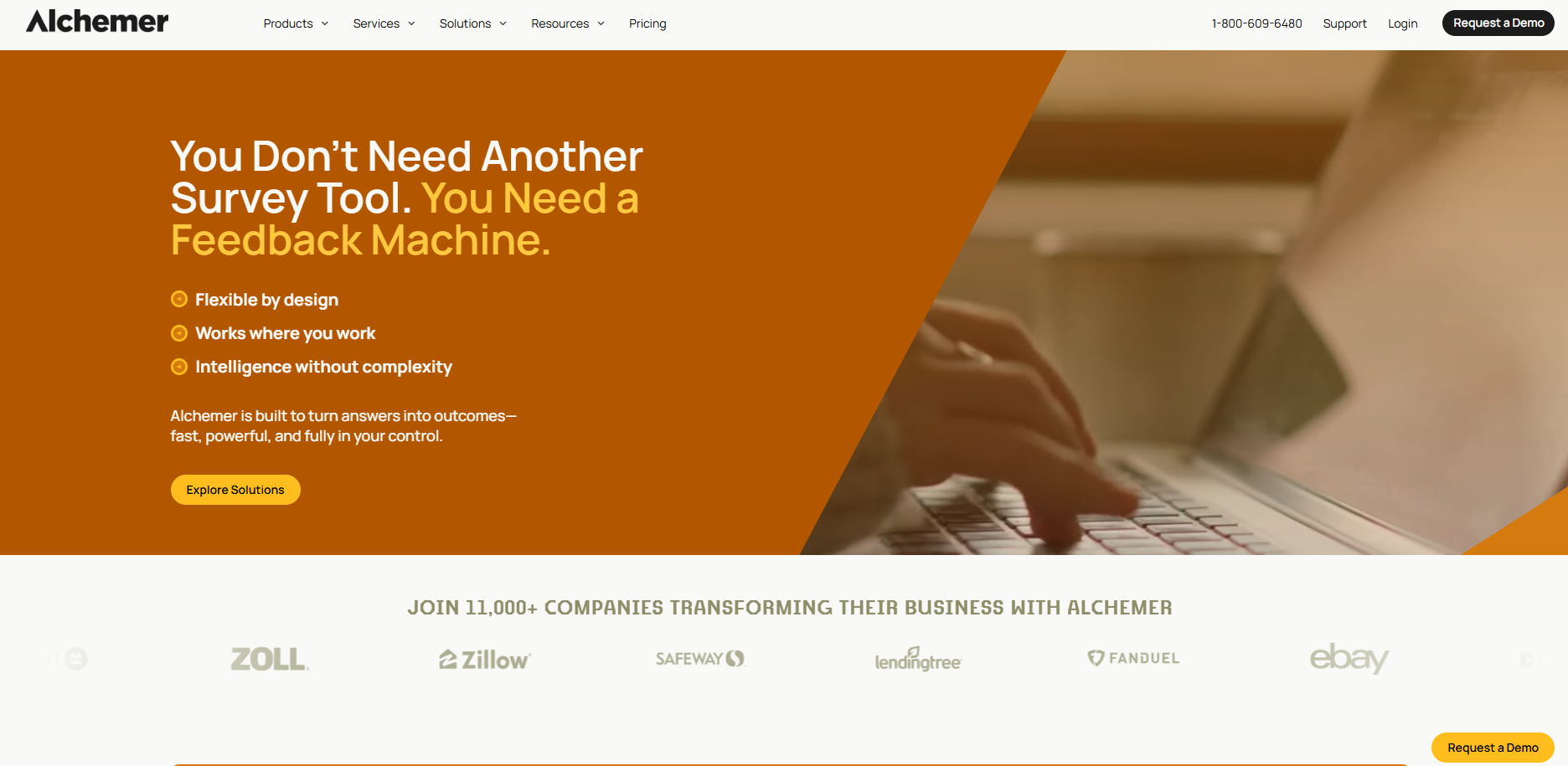
It is used for market research, brand health tracking, text sentiment analysis, and structured feedback programs, so it can cover a wider range of custom needs when the team wants to build its own process.
That makes Alchemer useful when workflow depth matters more than instant speed. If you need advanced logic, detailed reporting, or tighter integration with existing systems, you may find it more capable than simpler alternatives, though the learning curve and pricing are steeper.
Key Features
- Advanced logic, scripting, and research question types
- Advanced statistical analysis and reporting tools on Full Access
- Open architecture and integration options for custom workflows
Pros
- Advanced logic and branching support complex survey flows
- Reporting dashboards are useful for sharing results with stakeholders
- Support resources help you handle a more advanced setup
Cons
- The learning curve for advanced features
- Interface design can feel dated or harder to navigate
- Pricing is harder to justify for simpler survey needs
Pricing
- Collaborator: $55/month
- Professional: $165/month
- Full Access: $275/month
- Platform Plans: Custom pricing
8. Aytm
Aytm is a consumer insights platform if you want more control than a guided fast-turn tool, without losing access to support when you need it.

The platform combines survey authoring, advanced targeting, real-time reporting, AI-assisted survey design, Conversation AI, and a proprietary panel called PaidViewpoint, which offers a more flexible path among DIY, assisted DIY, and full-service work.
Key Features
- Proprietary PaidViewpoint panel built around respondent quality and trust scoring
- Survey authoring, predictive sample engine, and real-time reporting in one platform
- Skipper AI and Conversation AI for AI-assisted survey creation, open-ended analysis, and dynamic interview-style research
Pros
- The survey setup is intuitive enough for quick DIY work
- Targeting, analytics, logic, and reporting give you more control over quantitative research design
- Easy to reach granular respondent groups without relying on multiple vendors
Cons
- Pricing can run higher than lighter survey platforms
- The platform can feel complex for non-technical users once the methodology gets more advanced
- Incidence and hard-to-find profiles can push field timing or cost higher on some studies
Pricing
- Lite: Custom pricing
- Enterprise: Custom pricing
Have a Connected Research Workflow With Compeers AI
Fast validation solves only one part of the job. You may still design the study in one place, field it in another, analyze results in spreadsheets, and build the final story by hand.
That slows more than delivery.
It breaks continuity among the brief, the data, and the final recommendation, making the work harder to review, explain, and reuse later. It also creates more room for data quality issues when files, notes, and reporting steps move through too many tools.
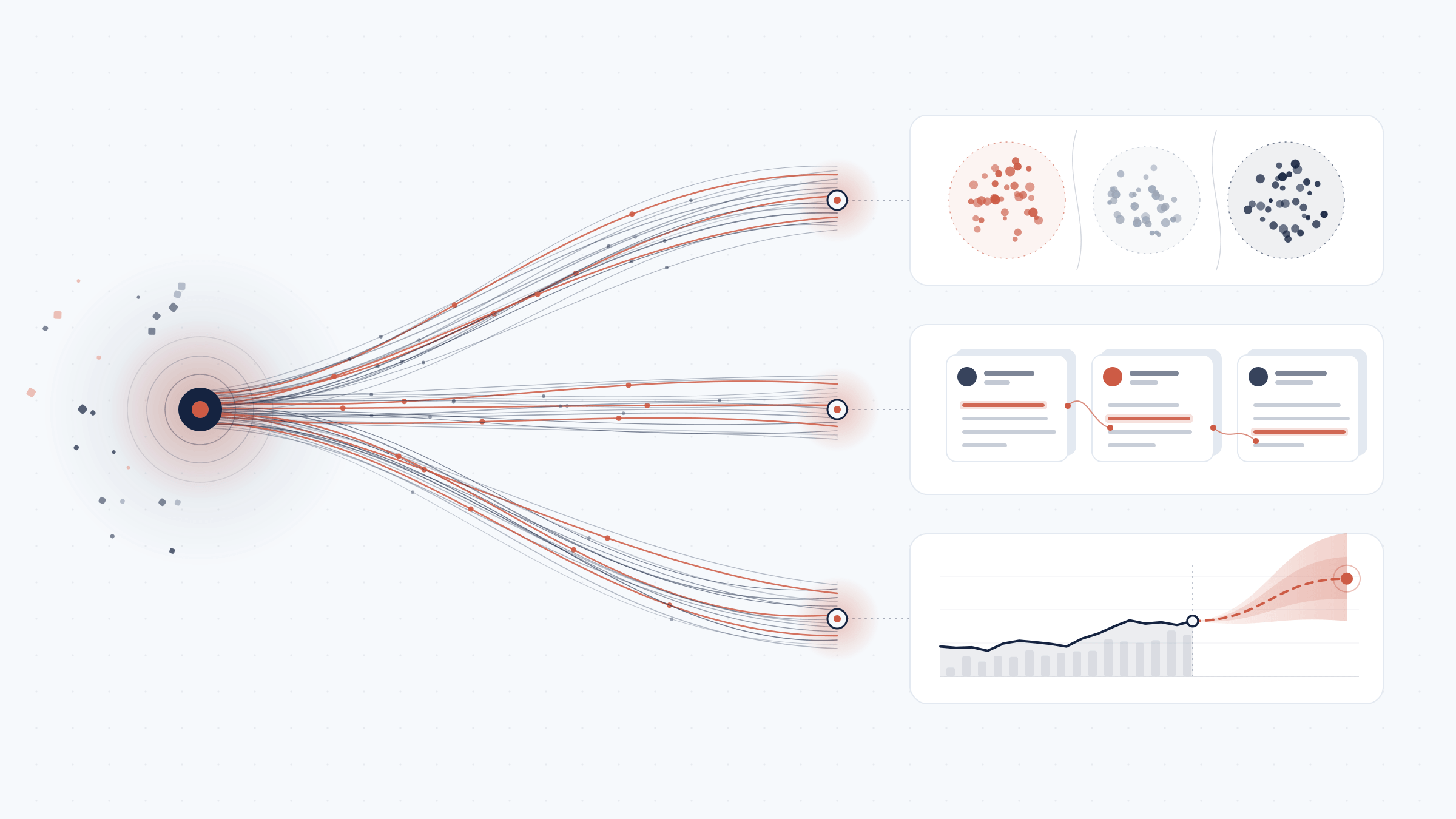
Compeers AI supports the entire research process within a single working system.

Project setup, concept evaluation, qualitative research, quantitative research, segmentation, analysis, and first-draft reporting stay connected, so the project does not lose context every time it moves to a new stage.
The result is cleaner handoffs, less manual cleanup, and sharper outputs for brand and consumer research.
When your team needs more than a fast answer, Compeers AI can carry the work from the opening brief to a decision-ready report.
Book a demo and move to a connected research workflow with Compeers AI!
FAQs About Suzy Competitors
Who should look for a Suzy alternative?
You should look for a Suzy alternative when fast validation is no longer enough for the work you need to run. That usually means deeper research methods, more flexible audience access, broader workflow support, or clearer pricing for ongoing research.
How should teams compare Suzy's competitors?
Start with the job you actually need the platform to handle. Compare audience reach, research format, reporting depth, workflow continuity, integration needs, pricing model, and the ability to support more complex research without adding manual work.
What is the closest competitor to Suzy?
Compeers AI is the closest competitor when you want Suzy’s speed benefits and deeper workflow support. It keeps setup, fieldwork, analysis, and reporting tied to the same project, which makes it a better fit for custom research than a tool focused mainly on fast validation.
Can Suzy's competitors support deeper consumer research than Suzy?
Yes. Several Suzy competitors from the list above go beyond fast validation and support deeper consumer research with broader market research workflows, stronger data analysis, live interviews, and more flexible study design.
What should you compare first when reviewing Suzy alternatives for niche audiences?
Start with audience access, data quality, and research format. If you need niche audiences, live interviews, stronger consumer insights, or more advanced data analysis, the right research platform should give you better control over sampling, methodology, and reporting instead of only helping you move faster.
Latest articles
Browse all posts

.svg)
Custom research, reimagined
.svg)
.svg)
.svg)
.svg)