.svg)



9 Best Knit Research Alternatives In 2026

If you are comparing different Knit alternatives, the real question is how much control, automation, and workflow depth you want from the platform.
Knit is known for AI-powered quant and qual research with human guidance built into delivery, but that model will not suit every research process.
You may need more self-serve flexibility, deeper analysis, stronger enterprise workflows, or a platform that keeps qualitative and quantitative research connected in one place.
In this article, we'll compare nine Knit alternatives that solve similar market research tasks in different ways.
TL;DR
These are the best Knit alternatives for mixed-method consumer research:
- Compeers AI
- Suzy
- Toluna Start
- Quantilope
- Voxpopme
- Zappi
- Strella
- Discuss
- Remesh
Why Consider Knit Alternatives for Market Research

Knit is an AI platform for mixed-method market research built around a guided, end-to-end process.
Each project starts with a scoping call and a dedicated researcher, then moves into an AI-generated brief, an AI-drafted questionnaire, sample and fielding, automated quant + qual analysis, and a branded report.
Knit also promotes access to 65M+ vetted respondents, AI-moderated video questions, and report-ready delivery in a week or less.
That model is useful when you want less execution work on your side.
You can bring your own audience or use Knit’s panel, mix quantitative and qualitative research in the same study, and get a finished output without handling every research step yourself.
If you want a guided process that uses artificial intelligence to automate more of the work, Knit is a credible option.
Where Knit Can Feel Limiting
The tradeoff usually comes down to control, flexibility, and planning. These are the common reasons teams are choosing Knit alternatives:
- You may want more direct control over setup and fieldwork. Knit is built as a guided service, not a fully self-serve app, so it is less suited to a workflow where you want to write, launch, and adjust everything yourself.
- You do not get a clear pricing view up front. Public pricing isn't listed on the site, making early budget planning harder.
- Panel targeting can be limiting for very specific audiences. Some user feedback indicates difficulty reaching narrower segment-level groups within the panel.
- You may need more visible integrations and broader data sources. If your process depends on existing SaaS applications, product integrations, CRM links, or other business data, a more self-serve research platform may be a cleaner fit.
- You may want a more user-friendly balance between support and control. Knit’s model is useful when you want help, but smaller teams or researchers who prefer user-friendly interfaces and direct ownership may be better served by a platform that gives them more hands-on control over the process.
9 Best Knit Research Alternatives in 2026
These nine Knit alternatives address the same mixed-methods research task from different angles.
Use the list below to compare how each platform handles data collection, analysis, reporting, and the level of support you get during the project.
1. Compeers AI
Compeers AI is the best Knit alternative when you want more control and continuity across the full research workflow.

It keeps project design, data collection, qualitative and quantitative research, segmentation, advanced analysis, and first-draft reporting tied to a single working system, giving you more control over the full project flow.
That difference becomes apparent once the study moves beyond initial data collection.
- Qualitative Compeer supports discussion guides, interviews, focus groups, translation, transcription, coding, sentiment analysis, and narrative reporting.
- Quantitative Compeer covers questionnaire design, survey programming, data cleaning, respondent quality checks, cross-tabs, open-end coding, and auto-plotting.
Compeers AI also covers the parts of mixed-method work that often get pushed into separate tools.
- Segmentation Compeer supports mixed-method segmentation workflows.
- Rapid Concept Evaluation Compeer handles AI-powered concept testing with discrete choice modeling.
- Short Responses Compeer speeds up fast-turn qualitative work.
- Savant gives you an agentic AI data analyst for exploration, visualization, and first-pass insight generation.
The brief, the instrument, the analysis, and the final deliverable stay connected, reducing manual cleanup and making outputs easier to review, explain, and reuse.
Key Features
- Qualitative workflows for discussion guides, interviews, focus groups, transcription, and coding
- Quantitative workflows for questionnaire design, survey programming, data cleaning, and cross-tabs
- Mixed-method segmentation support with synchronized survey and interview workflows
- AI-powered concept testing with discrete choice modeling
- Fast-turn short response analysis with transcription, coding, and sentiment analysis
- Savant for data exploration, visualization, and first-pass insight generation
- Advanced analytics, including regression, segmentation, conjoint, and related models
- Enterprise-grade security with SOC 2 Type II and ISO/IEC 27001:2022 compliance
Best For
Teams that want end-to-end mixed-method research continuity instead of a narrower execution layer.
Pros
- Keeps setup, analysis, and reporting inside one connected project
- Supports more custom workflows than a fieldwork-first provider
- Gives researchers and clients clearer output with less manual synthesis later
Pricing
- Custom pricing
Book a demo and see how Compeers AI gives your team more continuity than Knit!
2. Suzy
Suzy is a close Knit competitor for teams that care about speed, audience access, and fast decision support.
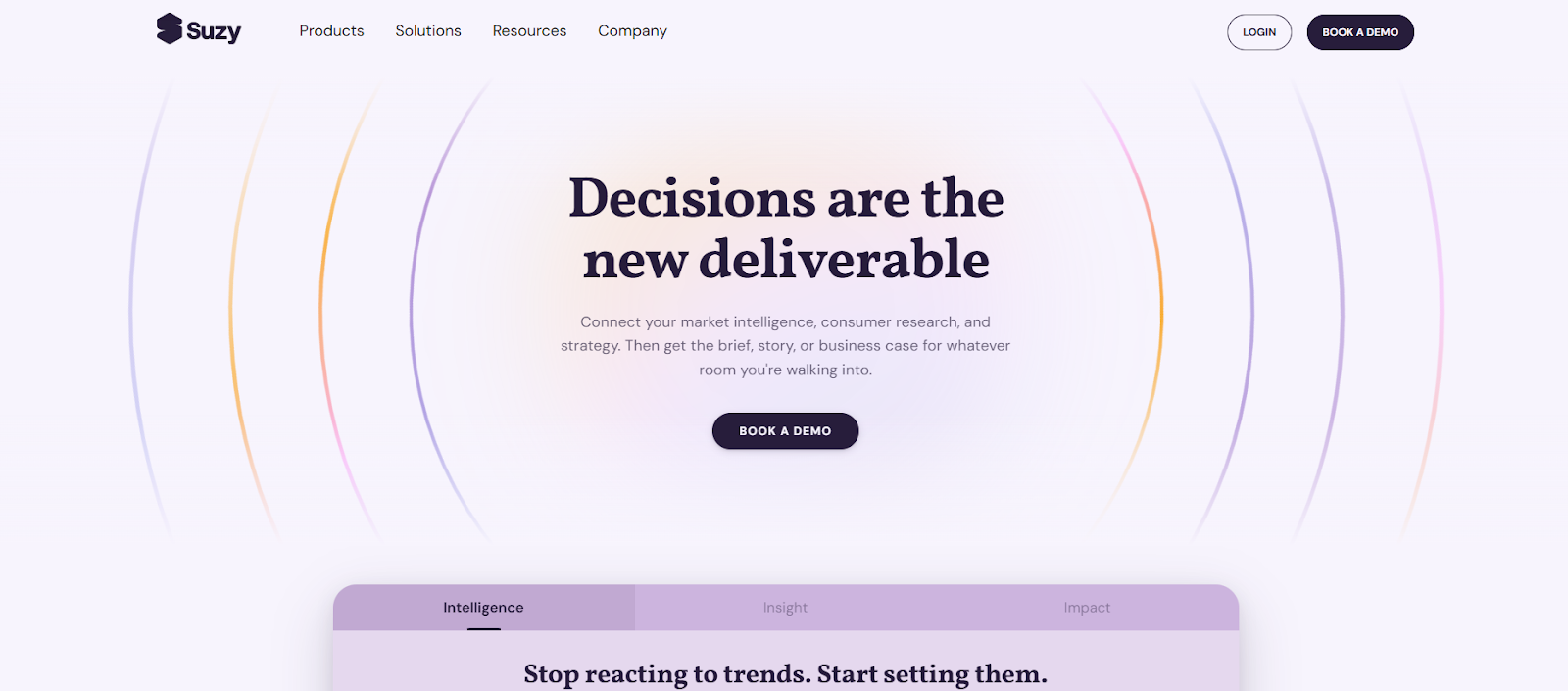
Its current platform beta unifies Signals, research, and data in one place, while Ask Suzy and conversational research tools help you move quickly from questions to consumer feedback.
That suits businesses that want real-time insights, faster survey responses, and quick reads on concepts, pricing, and messaging.
Suzy is more self-serve than Knit in some areas, but it still leans hard into fast validation and a proprietary audience model.
Key Features
- Signals, research, and data live in one connected workspace
- Conversational research and Ask Suzy are built into paid plans
- The audience model combines proprietary panels with iterative research workflows
Best For
Teams that want fast-turn consumer research with a built-in audience and decision-support tools.
Pros
- Credit-based plans make the entry point easier to understand than many enterprise research platforms
- The product combines quant, qual, and audiences in one research cloud
- Quick-turn concept and pricing work are central to the platform design
Cons
- Survey customization can feel limited on more complex studies
- Audience diversity can be a challenge for niche market research
- Credit planning adds friction for teams that want simpler budgeting
Pricing
- Free: 25 credits
- Pro: $150/month for 100 credits
- Team: $200/month for 200 credits
- Enterprise: Custom pricing
3. Toluna Start
Toluna Start is a broader, end-to-end market research platform with a wider range of services than Knit. It combines DIY tools, full-service options, AI features, and a global panel of 79+ million consumers in one ecosystem.

That makes it a practical alternative when you want quant + qual support, wider international reach, and more control over whether a project is self-serve, guided, or fully managed.
Toluna also leans more toward an enterprise-ready panel-and-services model. It's built for research teams that want a single platform for study design, fieldwork, real-time results, stakeholder-ready reports, and large-scale global programs.
Key Features
- Integrated global panel of 79+ million consumers
- Flexible service model from DIY studies to full-service support
- Real-time results and AI features inside one unified research platform
Best For
Insights teams and enterprise companies that need global research, flexible services, and broader operational support.
Pros
- Programming, fielding, and reporting can happen in one place
- Quick studies are easy to launch, even for less technical users
- Export options and centralized data help reuse the findings later
Cons
- Natural-representative quotas may still need weighting after fieldwork
- Logic options can feel limited on certain studies
- Cost can run higher than lighter survey software
Pricing
- Custom pricing
4. Quantilope
Quantilope is closer to Knit on AI-powered automation, but it leans more heavily into quantitative depth. Its official positioning centers on automated, advanced, and tracking research methods, real-time consumer insights, and AI support through its research co-pilot.

The platform is especially relevant when quant design drives the project. You can build surveys with advanced automated methods, connect to global panel partners or owned lists, and monitor responses as the report updates in real time.
Key Features
- 15 automated research methods for advanced quant studies
- Global respondent access through panel partners or customer lists
- Reports update in real time as new responses arrive
Best For
Market researchers who want a heavier quantitative design, advanced analytics, and tracking support.
Pros
- Advanced methods reduce the need to piece together separate quant tools
- Tutorials and customer support help you learn the platform faster
- Survey building is structured enough for recurring, method-heavy studies
Cons
- Dashboards can feel rigid when you want more polished data visualization
- Navigation gets harder once the survey setup becomes more involved
- The interface can feel cluttered for some users
Pricing
- Business: Starts at $22,000
- Pro: Custom pricing
- Enterprise: Custom pricing
5. Voxpopme
Voxpopme is a stronger alternative when the mixed-method brief leans heavily toward qualitative depth. The platform combines video surveys, live interviews, user research tools, and AI insights in one place.
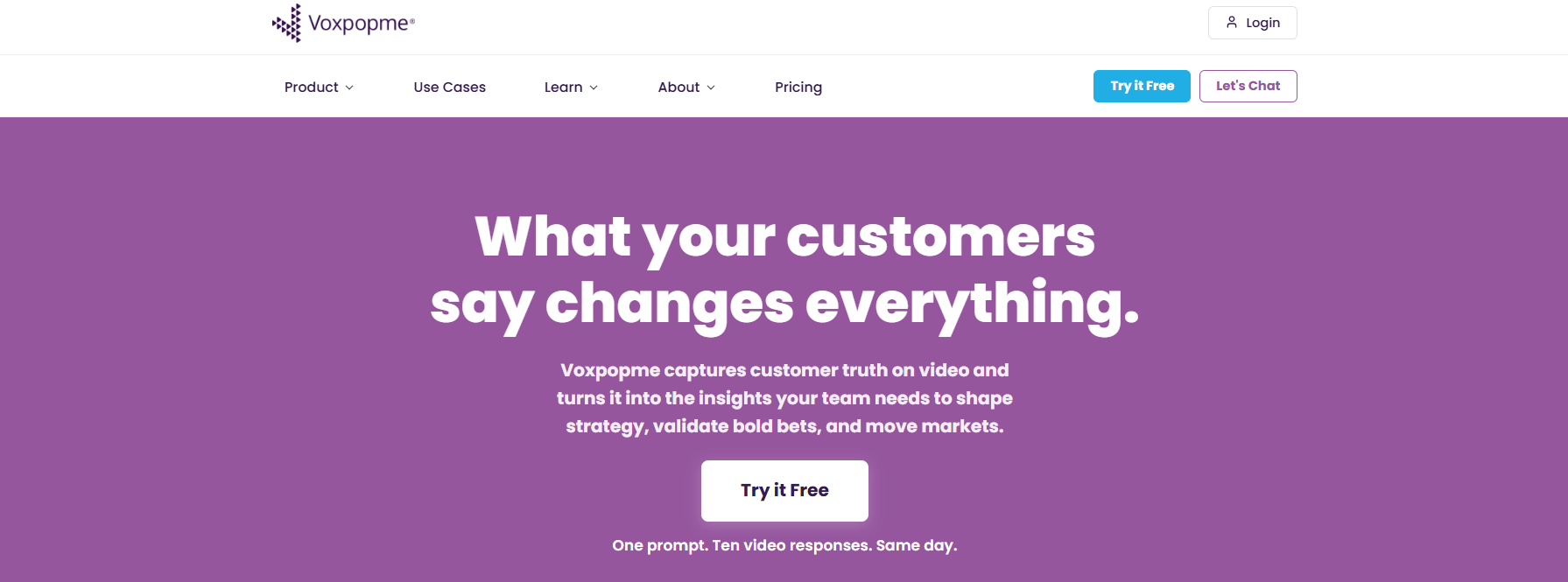
That makes it useful for brands that need richer consumer voice, faster synthesis, and more vivid reporting than survey-only tools can offer.
It does not mirror Knit on quant + qual balance. Instead, it goes deeper into live interviews, video evidence, showreels, and AI analysis for qualitative data.
If the team wants more emotional nuance, a more direct consumer voice, and less manual video synthesis, Voxpopme becomes one of the more specialized options in this list.
Key Features
- One platform for video surveys, live interviews, and AI analysis
- AI reports, AI showreels, and an interactive chatbot are built into the workflow
- Recruitment can use global panels or a brand’s own users
Best For
Teams that need video-led qualitative research, live interviews, and faster qualitative synthesis.
Pros
- Video feedback is quick to collect and easier to cut into shareable clips
- AI tools help generate summaries, reports, and highlight reels faster
- Live interviews and user research tools sit in the same environment
Cons
- Transcription and summary quality can be inconsistent
- Video quality issues can affect the final output
- Teams that prefer text-first studies may find the format less natural
Pricing
- Custom pricing
6. Zappi
Zappi overlaps with Knit in AI-powered consumer research, but the emphasis differs. Zappi centers on connected consumer validation for innovation, advertising, and brand work.
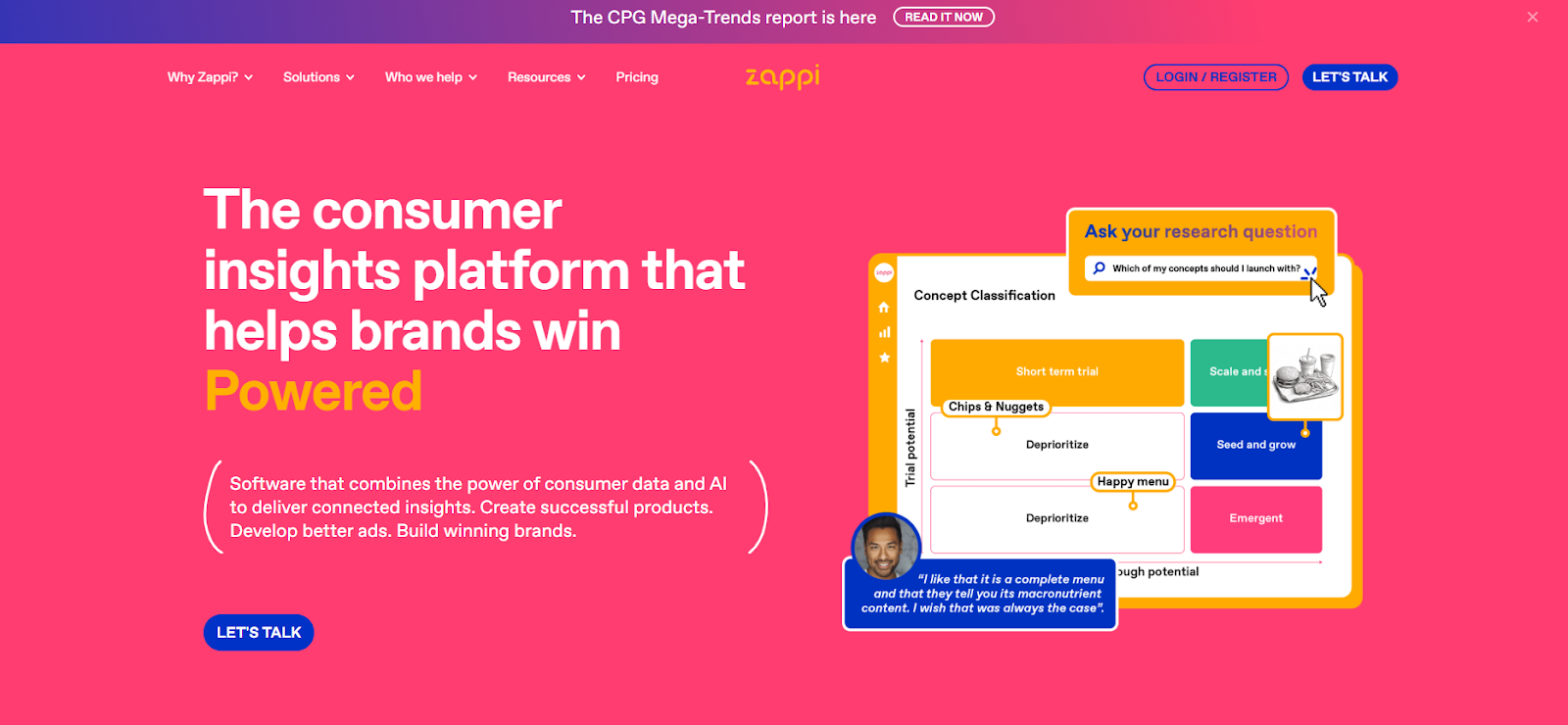
It is structured around concept testing, advertising development, and brand insights, making it more focused on repeatable validation programs than on broader, mixed-methods custom research.
That makes Zappi useful for brands that want consumer feedback tied closely to development and creative decisions.
Key Features
- Connected innovation, advertising, and brand insights in one platform
- AI-powered consumer data workflows tied to product and ad development
- Structured validation programs that support market share and category growth decisions
Best For
Brands that want a structured concept, ad, and brand testing rather than a broader custom research system.
Pros
- Customer support is a recurring positive in available reviews
- The platform helps you gather user and customer reactions without heavy manual setup
- Creative and product testing sit close to the development process
Cons
- Customization restrictions come up in reviews
- Pricing is not transparent
- The workflow is narrower when the brief calls for broader mixed-method custom research
Pricing
- Premium: Custom pricing
- Enterprise: Custom pricing
7. Strella
Strella is the most interview-led option in this list. It uses AI to conduct in-depth interviews, synthesize responses, and surface actionable insights within hours rather than weeks.

It's a relevant alternative to Knit if you want less fieldwork management, faster qualitative output, and more self-serve control than a researcher-guided delivery model.
The platform is built around customer questions, AI-generated discussion guides, adaptive interview moderation, and instant highlight reels.
It also supports market research, exploratory research, concept testing, usability testing, and mobile testing. If your team wants to automate interviews at scale, Strella offers a more specialized path than broader mixed-method platforms.
Key Features
- AI-moderated interviews adapt in real time to participant responses
- The platform supports 46+ languages and global time-zone coverage
- Instant highlight reels and research chat help you review findings faster
Best For
Teams that want AI-led interviews, quick synthesis, and a faster route from interviews to usable findings.
Pros
- Reviews describe the workflow as efficient and easier to fold into daily research
- The platform can launch interviews quickly without manual moderator scheduling
- Recruitment and CRM integration expand what the system can do in practice
Cons
- Pricing is not transparent, which makes budget planning harder
- The product leans heavily into qual, not broader quant support
- Review volume is still light compared with older competitors
Pricing
- Custom pricing
8. Discuss
Discuss is a closer Knit alternative if you want AI support without sacrificing the depth of live qualitative research.

The platform brings together human-led interviews, AI interviews, self-paced feedback, uploaded research, and analysis tools into a single market insights system. It's suitable if you want more direct control over qualitative work than a guided fieldwork-to-report model alone provides.
Its fit gets stronger when the brief needs stakeholder visibility, multilingual work, or a smoother path from live sessions to reporting.
Key Features
- AI and human-led interview workflows
- Self-paced feedback and uploaded research analysis
- Simultaneous translation and backroom collaboration tools
Best For
Teams that want mixed-method flexibility with deeper qualitative research control, multilingual support, and live stakeholder collaboration.
Pros
- Easy interview setup and focus group access
- Simultaneous translation works well for multilingual sessions
- Support is easy to reach during live research
Cons
- Bandwidth demands can create lag in weaker connectivity markets
- Respondent management and scheduling can feel clunky for DIY users
- Focus groups can feel constrained by participant limits or chat complexity
Pricing
- Consumer Reach: Custom pricing
- Consumer Reach+: Custom pricing
9. Remesh
Remesh is a solid alternative to Knit if you want conversation-led research at scale. Its platform supports live dialogues with up to 1,000 consumers at once, giving you qualitative insight with quantitative reach and a faster route from discussion to usable findings than traditional focus groups or interview-heavy fieldwork.

That makes Remesh especially useful when the project needs fast concept reactions, exploratory feedback, or a hybrid qual-quant readout without a long setup cycle.
Key Features
- Live AI-powered conversations with up to 1,000 consumers
- Qualitative insight at a quantitative scale
- Embedded AI assistant plus optional white-glove research support
Best For
Teams that want fast, large-scale conversational research and quick qual-quant readouts without traditional focus group logistics.
Pros
- Easy to set up for both quant and qual studies
- Real-time feedback is useful for quick concept work
- Support is consistently described as helpful and responsive
Cons
- Detailed demographic analysis and merging sessions can be harder
- Projects still need clear question planning before launch
- Lighter customization than some teams may want
Pricing
- Custom pricing
Manage Mixed-Method Research in One Workflow
Mixed-method research becomes harder to manage when the project spans too many tools. You may design the study in one place, collect data in another, review qualitative material somewhere else, and then rebuild the final story by hand before anyone can use it.
That process slows more than reporting. It also weakens the continuity among the brief, the data, the analysis, and the final recommendation, making the work harder to review, explain, and reuse later.
Compeers AI keeps those parts of the process connected into a single working system.

You can manage project setup, qualitative and quantitative research, segmentation, concept evaluation, advanced analytics, and reporting without pushing the project into separate files and disconnected workflows at each stage.
You spend less time on manual synthesis, version checks, and cleanup, and more time turning research into usable output for brands, agencies, and internal stakeholders.
Book a demo and see how Compeers AI handles the mixed-method research in one workflow!
FAQs About Knit Research Alternatives
Who should compare Knit alternatives?
You should compare Knit alternatives when you want a different mix of researcher support, self-serve control, workflow depth, or panel access. That usually includes market researchers, insights teams, agencies, and companies that need deeper qual or quant work, broader workflow support, or more control over how the research runs.
What should you compare first when reviewing Knit alternatives?
Start with the basics that shape the work: quant and qual balance, data quality, analysis depth, support model, security, reporting, and integrations. Budget, output quality, and the amount of manual work left after fielding will usually tell you faster than a feature list whether the platform fits your process.
Which Knit alternative is best for end-to-end research workflows?
Compeers AI is the best Knit alternative for end-to-end research workflows. It keeps project design, data collection, advanced analysis, and reporting tied to the same platform, which gives you more continuity than a fieldwork-to-report tool alone.
Do Knit alternatives support AI-powered and real-time research?
Some do, but not all handle it the same way. Certain Knit alternatives focus on AI-powered automation and real-time updates, while others put more weight on researcher guidance, deeper analysis, or stronger workflow control.
Are Knit alternatives built for market researchers and insights teams?
Yes, but the fit depends on how you run market research. Some platforms are better for insights teams that need speed and guided support, while others offer market researchers greater control over setup, data collection, analysis, and reporting.
Latest articles
Browse all posts

.svg)
Custom research, reimagined
.svg)
.svg)
.svg)
.svg)