.svg)



Top 7 Enterprise AI Insights Software for Market Research
Microsoft and LinkedIn’s Work Trend Index found that 75% of knowledge workers already use AI at work, and leaders increasingly see AI adoption as critical to staying competitive.
For insights teams, that shows up in how research gets done. Surveys, interviews, concept tests, and tracking studies are expected to move faster, with clearer outputs and fewer handoffs.
What makes this possible is AI insights software.
The right tools help you design studies, collect data, analyze results, and turn findings into clear recommendations without dealing with multiple platforms or waiting on long research cycles.
We’ve reviewed seven AI insights platforms built for market research teams, so you can compare how each one supports your workflow, from setup to final report, and find the best fit for your team in 2026.
TL;DR
These are the seven best enterprise AI insights software for market research:
- Compeers AI
- Quantilope
- Suzy
- Upsiide by Dig Insights
- Zappi
- Knit
- Bolt Insight
What Is Enterprise AI Insights Software?
You will see the term enterprise AI insights software used in many ways. It can refer to tools that support analysis across finance, operations, and other enterprise AI applications.
Today, we focus on a more specific category: AI insights platforms for market research teams.
These tools are built to support the full research workflow, including designing studies, collecting data through surveys or interviews, analyzing results, and turning findings into clear reports.
Most platforms combine qualitative and quantitative research methods with AI support, such as natural language processing for open-ended responses, and AI agents that assist with analysis and reporting. This helps your team move faster while keeping control over how insights are interpreted.
Many organizations also treat these tools as part of a broader AI strategy, where research becomes a continuous source of input for product, brand, and innovation decisions.
Instead of switching between tools for fieldwork, analysis, and reporting, your team works in one system where the context stays connected from the first question to the final recommendation.
If a platform cannot support that flow, it often creates more fragmentation rather than helping you reach better insights.
Top 7 Enterprise AI Insights Software for Market Research
We chose these tools based on what enterprise buyers usually need from AI insights software in 2026.
That includes support for qualitative and quantitative research, faster time to insight, reliable data collection, and clear reporting.
Some platforms focus on full end-to-end workflows, from study design to final output. Others specialize in areas like concept testing, continuous feedback, or AI-assisted analysis.
1. Compeers AI
Enterprise insights teams and research agencies already manage enough moving parts. Survey design, interviews, transcription, coding, analysis, and reporting often span multiple tools, vendors, and handoffs.
With Compeers AI, your team keeps that work in one connected system built for custom qualitative and quantitative research, so the brief, the data, and the first draft stay tied together from start to finish.
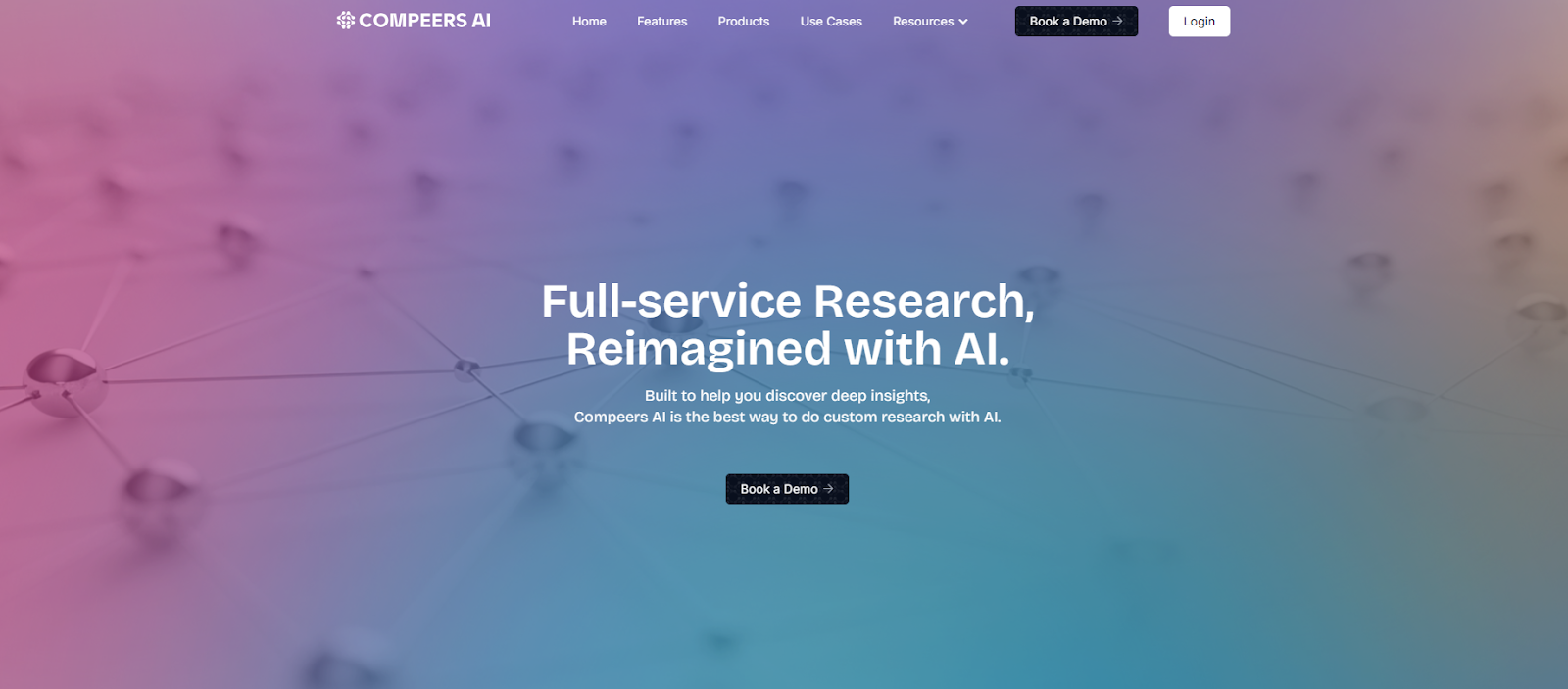
The product suite is built around actual research tasks.
- Qualitative Compeer supports the creation of discussion guides, secure audio/video interviewing, translation, transcription, thematic coding, sentiment analysis, and narrative reporting.
- Quantitative Compeer handles questionnaire design, automated survey programming, data cleaning, respondent quality checks, cross-tabs, open-ended coding, advanced analytics, and first-draft reporting.
- Short Responses Compeer allows for quick question generation for immediate research setup, simple file upload and automated transcription, sentiment analysis, and qual data analysis using quant methodologies.
- Rapid Concept Evaluation Compeer offers top of the funnel concept testing using discrete choice conjoint analysis. It helps the innovation team with market share prediction, audience segmentation, visual summaries, and a workflow from setup to insight delivery.
- Segmentation Compeer uses industry-standard factor analysis and multiple segmentation models to quickly identify audience segments. It creates appealing visuals, narratives, segment-specific personas, demographic and behavioral characteristics, and a decision-ready segment profile for marketing activation.
- Savant, the AI data assistant, is the always-on analyst for data exploration, visualization, and first-pass insight generation.
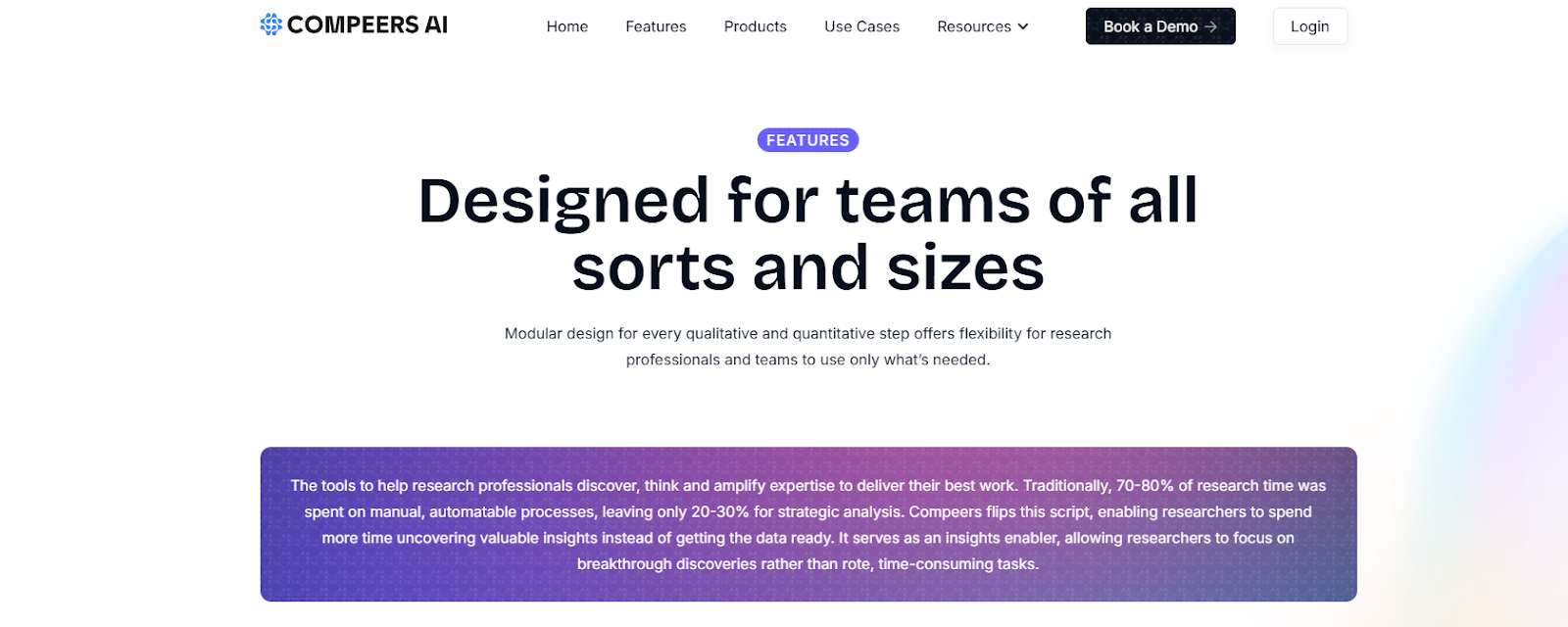
Compeers AI also includes enterprise-grade security, with SOC 2 Type II compliance and ISO/IEC 27001:2022 certification for teams handling sensitive client and market data.
Key Features
- Qualitative research workflows for guides, interviews, transcription, coding, and reporting.
- Quantitative research workflows for survey design, programming, cleaning, cross-tabs, and advanced analytics.
- Mixed-method research support through QualiQuant Compeer.
- Savant for AI-powered exploration, visualization, and first-pass insight generation.
Pricing
- Custom pricing via demo.
Book a demo to see how your team can get client-ready insight in one system!
2. Quantilope
Quantilope is a consumer intelligence platform for teams that need automated, advanced methodologies, real-time results, and structured tracking without relying on traditional agency processes.
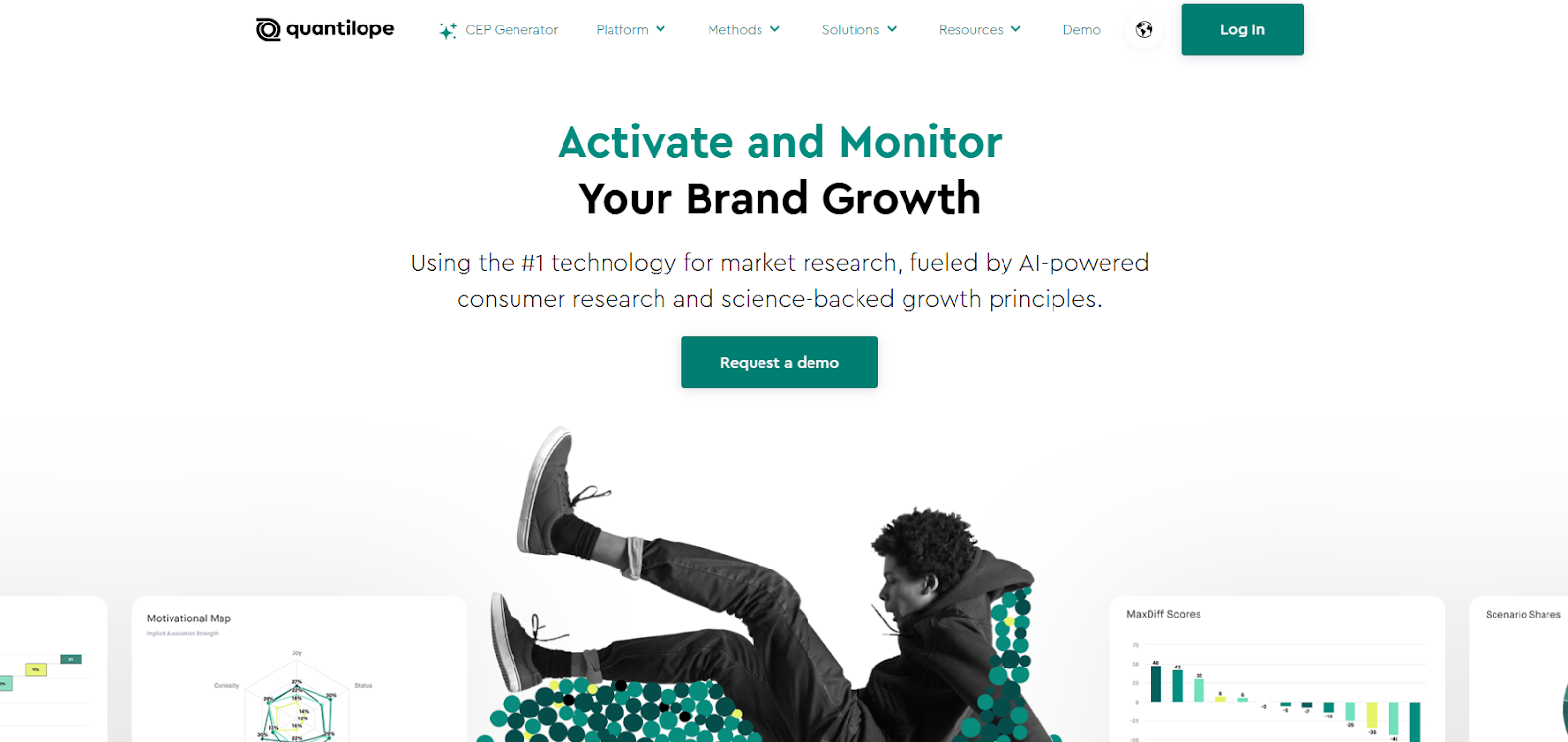
Image Source: quantilope.com
It fits enterprise insights teams that run segmentation, pricing, concept testing, and brand tracking work at scale and want faster access to analysis inside one platform.
Its platform is split across CI Advanced and CI Tracking. CI Advanced focuses on automated advanced methods, while CI Tracking is built for real-time tracking studies, automated waves, and dashboard-based monitoring.
Quantilope also positions quinn as an AI co-pilot across the research process and highlights access to global respondents through its panel network.
Key Features
- 15 fully automated advanced research methods for pricing, segmentation, concept testing, and other strategic questions.
- Real-time tracking with automated waves, significance testing, and shareable dashboards.
- AI co-pilot support plus access to 300M+ consumers through its trusted panel network.
Pricing
- Business plan: Starts at $22,000
- Pro plan: Custom pricing
- Enterprise plan: Custom pricing
3. Suzy
Suzy is a consumer insights platform built for teams that need to connect market data, internal strategy inputs, competitive intel, and direct consumer feedback in one place.
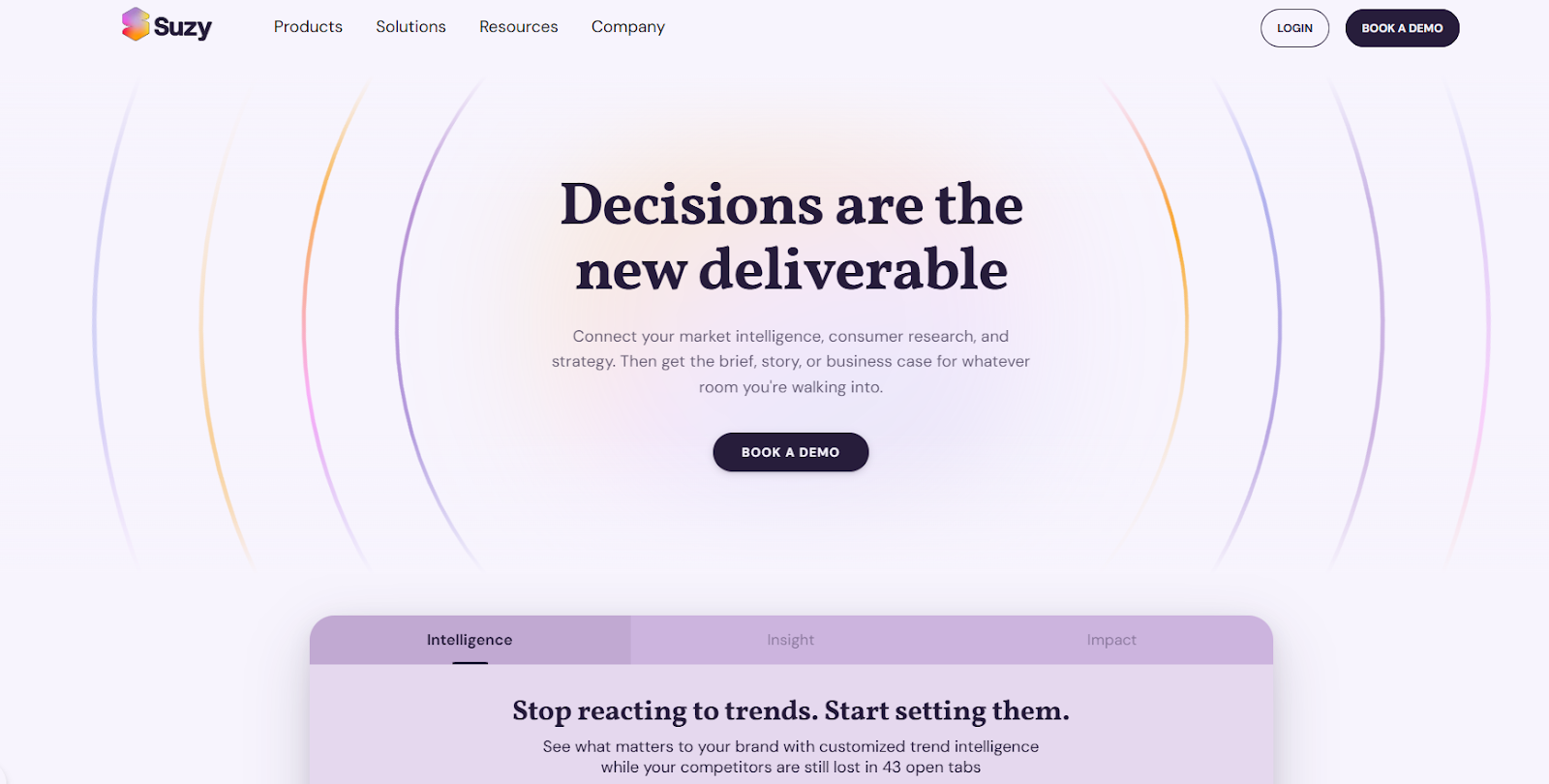
Image Source: suzy.com
It fits brand, insights, and innovation teams that want a faster way to pressure-test decisions, run conversational research, and move from question to answer without waiting on long research cycles.
The platform brings together Signals, research, and data, then layers in Ask Suzy chat, conversational research, and queryable data workflows.
That makes it suitable for enterprise teams that need quick validation, ongoing consumer access, and a more continuous decision-support system.
Key Features
- Unified workspace for Signals, research, and data in one platform.
- Ask Suzy chat plus conversational research workflows for direct consumer interaction.
- Queryable data layer that connects market data, strategy documents, competitive intel, and consumer voices.
Pricing
- Free plan: 25 credits
- Pro plan: $150/month for 100 credits
- Team plan: $200/month for 200 credits
- Enterprise plan: Custom pricing
4. Upsiide by Dig Insights
Upsiide is built for teams that need to test innovation ideas, quantify potential, and prioritize what to take forward.
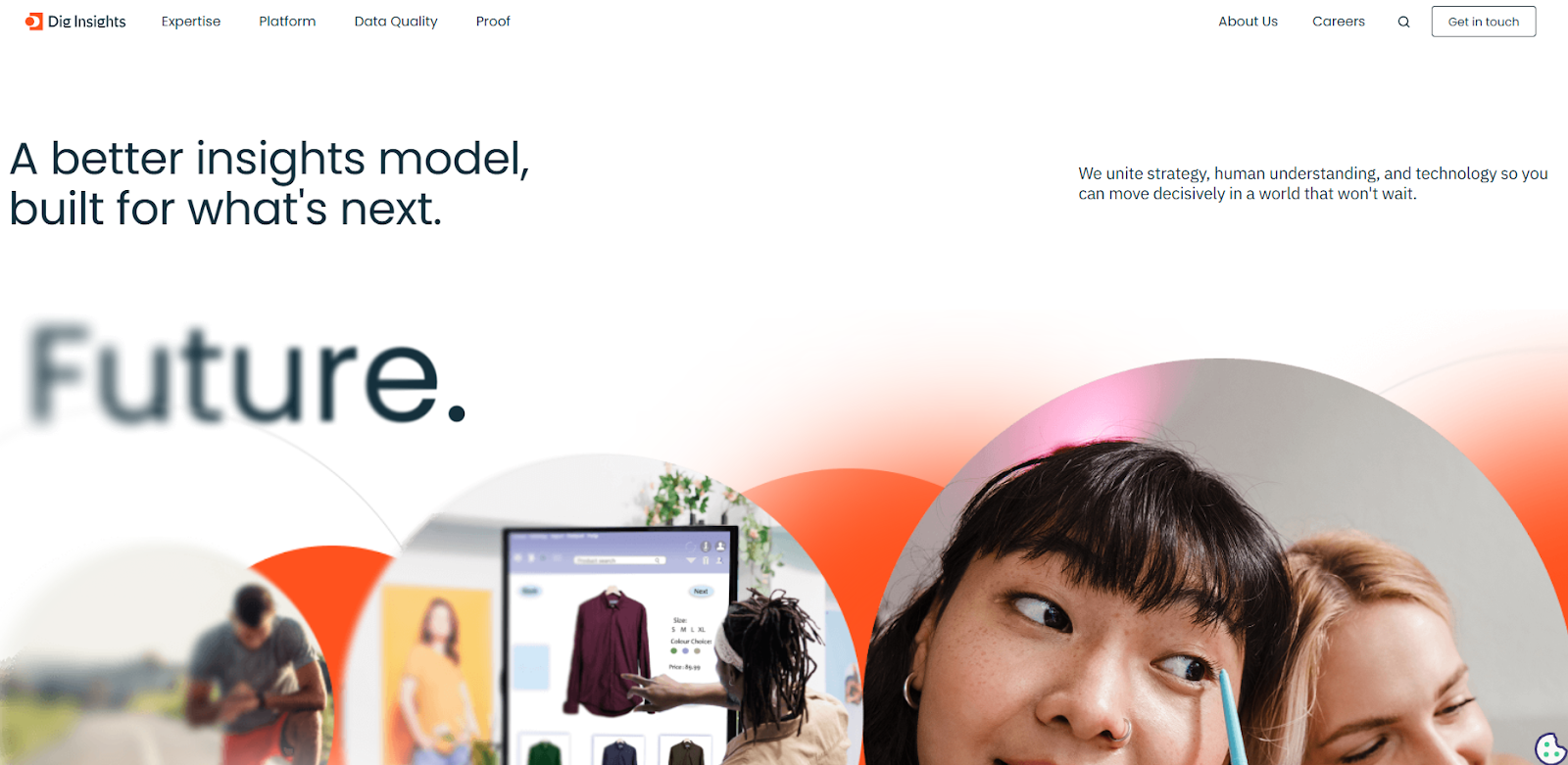
Image Source: diginsights.com
It's now part of Dig One, Dig Insights’ platform that connects exploration, validation, and learning. It's a better fit for innovation and concept-testing workflows than for full-service, end-to-end custom research.
The value here is connected innovation work. Dig One combines Upsiide with OneCliq, so teams can pull in real-time social conversation data, identify emerging themes, and use that context to shape testing programs.
Dig also positions the platform around fewer handoffs, rigorous analytics, and decisions that teams can defend.
Key Features
- Agile idea and innovation testing through Upsiide inside the Dig One platform.
- Social conversation discovery through OneCliq to seed testing with current cultural signals.
- Standardized testing workflows and analytics designed to support higher-stakes brand and innovation decisions.
Pricing
- Professional plan: $349/month
- Enterprise plan: Custom pricing
5. Zappi
Zappi is a consumer insights platform for brands that need continuous consumer feedback across product development, advertising, and brand work.
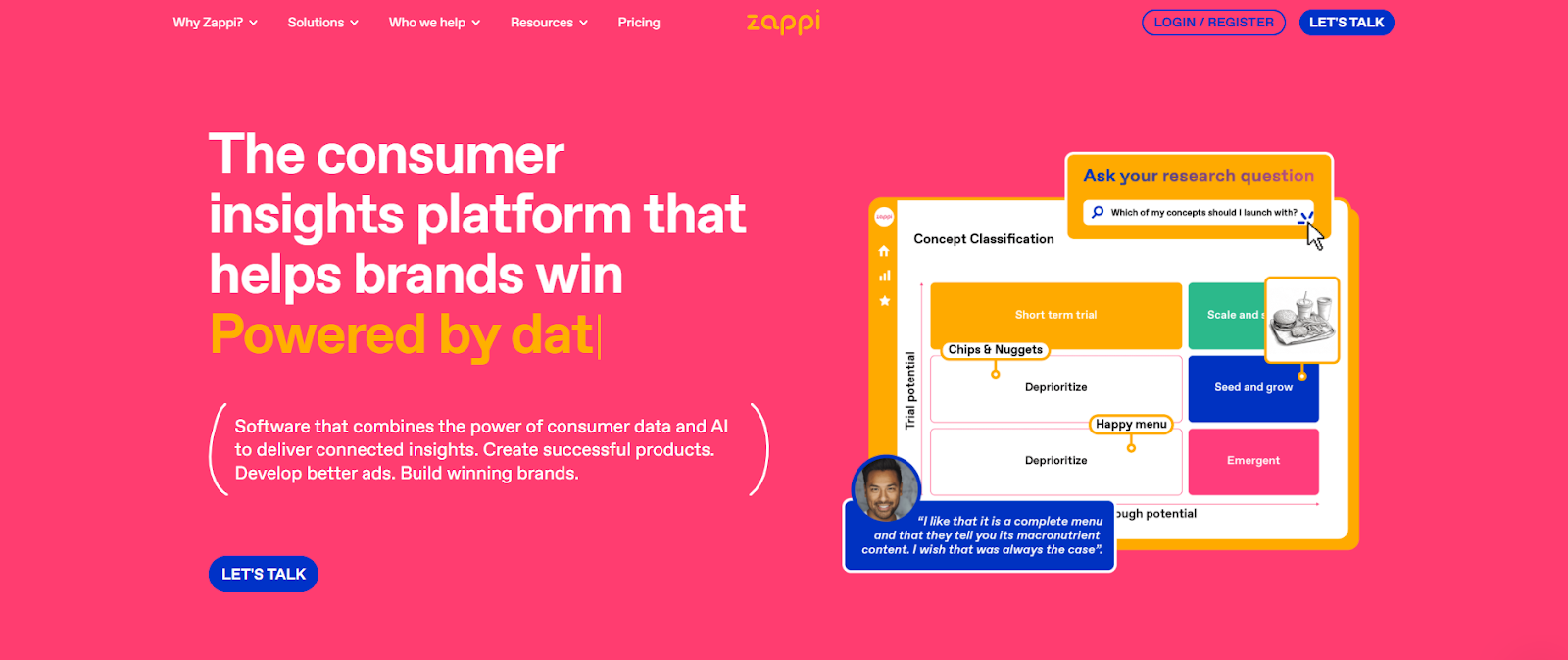
Image Source: zappi.io
It fits enterprises that want to test concepts, product ideas, and creative work in a more repeatable system while keeping the consumer voice close to launch decisions.
The platform is built around connected learning rather than one-off project work. Zappi combines consumer data and AI tools to support innovation, advertising, and brand insights in a single system, positioning the setup as a way to make launch decisions with greater confidence over time.
It also emphasizes research customization, quality controls, and cumulative learning across repeated use.
Key Features
- Integrated innovation, advertising, and brand insights inside one consumer insights platform.
- Testing tools for concepts, ads, and innovation programs with diagnostics and optimization guidance.
- AI-supported analysis plus customizable research and ISO- and ESOMAR-backed data quality positioning.
Pricing
- Premium plan: Custom pricing
- Enterprise plan: Custom pricing
6. Knit
Knit is an AI-native research platform for teams that want quant and qual in one study, with AI handling execution and researchers shaping the work.
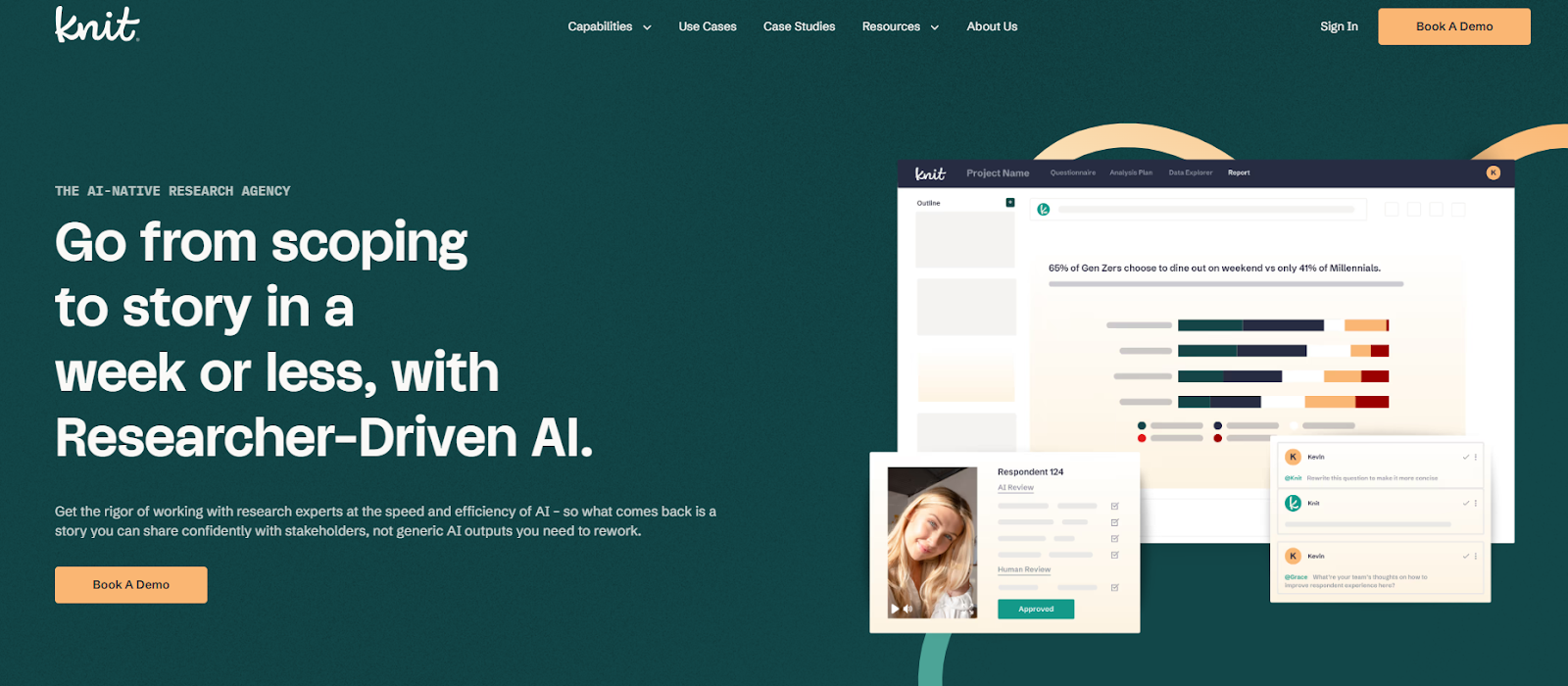
Image Source: goknit.com
It fits insights teams that need faster turnaround times for custom research but do not want outputs that feel generic or detached from the business context.
The platform covers scoping, survey creation, sample and fielding, analysis, reporting, and AI-moderated video questions, and its messaging focuses on reducing execution work without removing research judgment.
Its public site also highlights AI-generated reports within 24 hours and access to 65M+ verified respondents.
Key Features
- End-to-end workflow from scoping and survey creation to analysis and reporting.
- Quant and qual in a single study, including AI-moderated video questions.
- Access to 65M+ verified respondents and AI-generated reports within 24 hours.
Pricing
- Custom pricing
7. Bolt Insight
Bolt Insight is an AI-powered market research platform built around AI-moderated qualitative work, video responses, and global participant access.

Image Source: boltinsight.com
It fits teams that need to run qualitative research across markets and languages without relying on the slower setup of traditional moderated studies.
The platform combines AI technologies with human expertise and includes quantitative work, but its clearest differentiator is qual at scale through BoltChatAI.
Bolt also highlights its global reach, tailored qualitative studies, and access to quantitative research in 120 countries, making it relevant for brands that need rapid international input on concept, product, and brand questions.
Key Features
- AI-moderated qualitative research with video responses and global participant access.
- Support for qualitative studies across 40+ countries and multiple languages.
- Quantitative research coverage in 120 countries with advanced analysis.
Pricing
- Custom pricing
Why Do Enterprises Need AI Solutions?
Insights teams are expected to deliver clear answers faster, with more data and fewer delays between questions and results.
AI software helps you keep up with that pace. Instead of running separate tools for surveys, interviews, analysis, and reporting, your team can manage the full research process in one place.
That supports data-driven decision-making. You move from scattered findings to structured outputs that stakeholders can act on with confidence.
It also improves how research fits into everyday business processes. Insights are no longer one-off projects, but part of ongoing product, brand, and customer decisions.
Many companies also see these tools as part of a broader digital transformation effort. Research is no longer isolated. It connects directly to strategy, planning, and execution.
With stronger AI capabilities, teams can analyze larger volumes of data, handle open-ended responses, and generate faster summaries without losing context. This leads to a deeper understanding of customer behavior and market changes.
Rather than waiting weeks for results, you can build a system of continuous learning, where each study adds to what your team already knows.
The result is more consistent, valuable insights that support decisions across teams, without adding more manual work or more tools.
For many organizations, integrating AI into research is no longer optional, but the fastest way to keep insights relevant and usable.
Discover Deep Insights With Compeers AI
Insights teams and research agencies are under pressure to deliver clear answers with more rigor, stronger continuity, and higher stakeholder confidence.
Compeers AI helps you keep custom qual, quant, and mixed-method research in one connected system, so your brief, source material, analysis, and first draft stay aligned from project setup to final delivery.
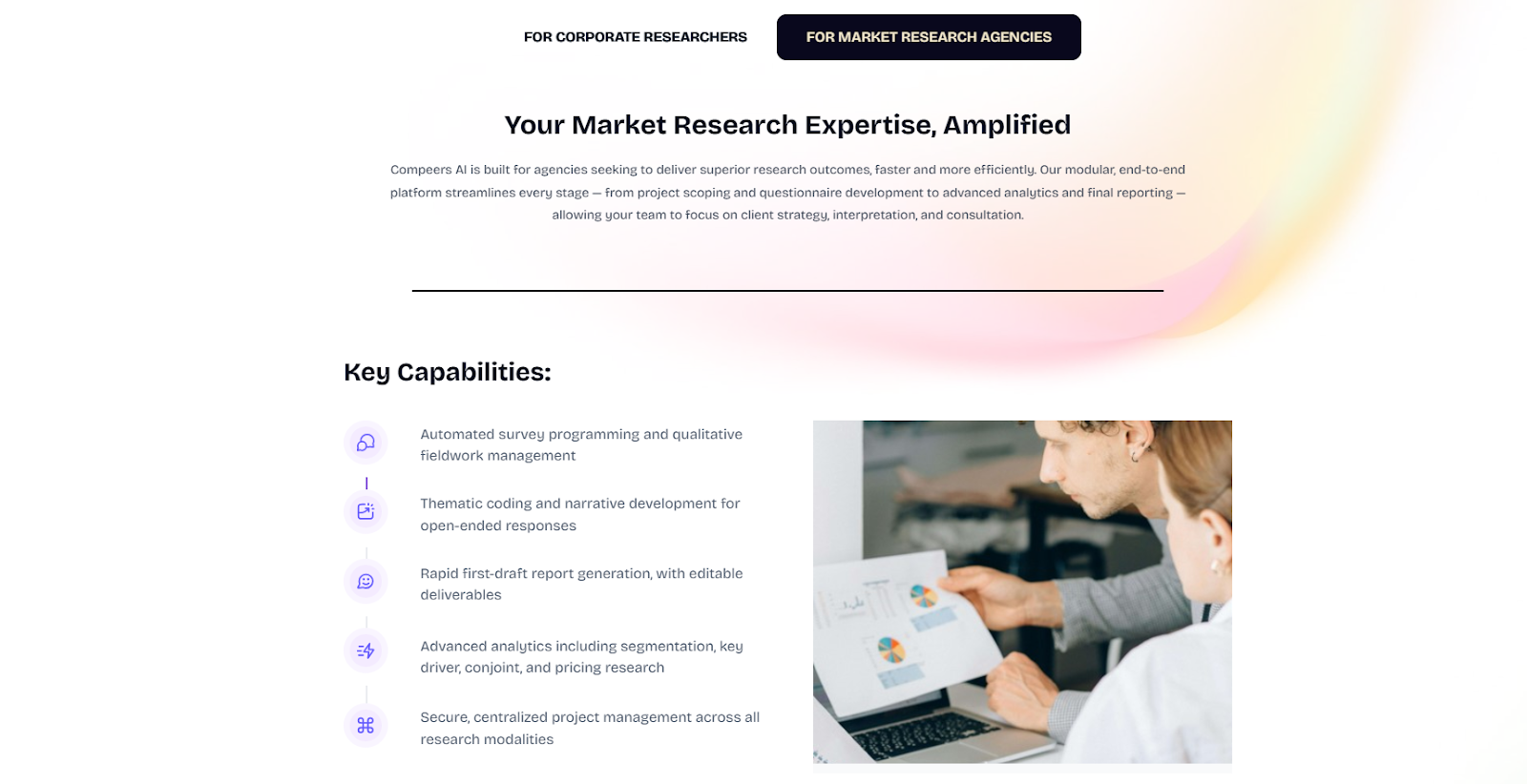
Your team stays in control of the research while Compeers AI supports the work that usually gets split across separate tools and handoffs, including questionnaire design, interviewing, transcription, coding, analytics, and reporting.
Book a demo and see how Compeers AI turns custom research into clear, usable insights!
FAQs About Enterprise AI Insights Software
What are the key features to look for in enterprise AI insights software?
Look for strong data integration, natural language support, reporting, and data security controls. The best tools also include AI-driven workflows that help you move from raw data to structured outputs without extra manual steps.
Many platforms now build on artificial intelligence to support analysis, automate repetitive tasks, and enable users to work with both structured and unstructured data in one place.
When should a company choose a dedicated research tool over a broader enterprise AI setup?
If your team runs regular studies, a dedicated enterprise AI solution built for market research will give you faster setup, better workflows, and clearer outputs.
A broader enterprise AI platform may support many use cases, but it often requires more customization to handle surveys, interviews, and reporting properly.
Can non-technical users work with these tools?
Yes, if the product is designed for guided workflows, search, and natural language interaction. Non-technical users should be able to ask questions, review outputs, and find useful answers in just a few clicks, without building machine learning pipelines.
Do enterprises need custom AI models for insight work?
Not always. Many teams get strong results from built-in AI features and managed tools before investing in custom AI agents or fully tailored models.
The priority should be clean data, clear workflows, and reliable outputs. Custom setups only make sense once those foundations are in place.



.svg)
Custom research, reimagined
.svg)
.svg)
.svg)
.svg)