.svg)



Full Custom Market Research Guide for Better Decisions

Broad market reports can help your team understand a category, but they often miss the exact questions your business needs answered.
Custom market research is built around a specific business question, target audience, market, product, or decision, so the findings connect directly to your next move.
This guide explains what custom market research includes, how it differs from syndicated research, when it makes sense, and how it supports market expansion, competitive positioning, customer needs analysis, and strategic decision-making.
TL;DR
- Custom market research is designed around one company’s specific business needs, target audience, market, product, or strategic decision.
- It can combine primary research, secondary research, competitive analysis, customer data, and voice-of-customer inputs.
- A custom market research project makes sense when your team needs tailored insights for market expansion, product launches, pricing, positioning, or growth planning.
- With Compeers AI, your team can turn surveys, interviews, segmentation, and analysis into report-ready findings tied to one business question.
What Is Custom Market Research?
Custom market research is research designed for one company’s specific question, audience, market, product, or decision. It helps your team move beyond general industry trends and collect data that speaks to your unique goals, business strategy, and next step.
A custom market research project can use:
- Surveys
- Interviews
- Focus groups
- Secondary research
- Competitive analysis
- Market sizing
- Customer data
- Voice-of-customer inputs
- Desk research
The work should answer common questions that syndicated market research reports can’t fully address, such as why customers choose one offer, what blocks adoption, or which market has the strongest demand.
Custom market research is most useful when your team needs actionable insights tied to a real decision. That decision might involve entering a new market, adjusting pricing, refining marketing strategies, improving customer satisfaction, or identifying customer groups with the most growth potential.
Custom Market Research vs Syndicated Market Research
Custom market research is built exactly for one client and one set of business questions. Syndicated market research is pre-built or broadly collected research sold to multiple buyers, often as a finished report, category dataset, or industry overview.
Both can support decision-making, but they serve different jobs. Syndicated research can help your team understand market dynamics, broad trends, and key players, while custom research helps answer questions tied to your specific needs, customers, products, and competitive positions.
Relying solely on syndicated research can leave gaps when your question involves a niche audience, a new product, a specific market, or a decision with financial risk. A custom approach gives your team more control over the research design, data points, analysis, and final output.
When a Custom Market Research Project Makes Sense
A custom market research project makes sense when the decision is specific, high-stakes, or tied to a unique audience, product, market, or growth plan. General research can provide context, but custom research gives decision-makers answers that address the exact business problem.
Your team should consider custom research when the decision affects budget, market entry, brand direction, customer experience, or long-term growth. It can reduce guesswork before you invest in a new offer, an expansion plan, a campaign, or a pricing model.
Custom research is especially useful for:
- Market expansion: Your team needs to compare demand, competitive landscape, distribution channels, customer needs, and local market barriers before entering a new region.
- Product launches: You need to test demand, positioning, product fit, purchase intent, and unmet needs before moving resources into launch.
- Pricing and packaging decisions: Your team needs actionable data on willingness to pay, perceived value, feature bundles, and buyer tradeoffs.
- Customer satisfaction and loyalty work: You need to understand churn drivers, service gaps, customer expectations, and the factors that shape customer retention.
- Competitive positioning: Your team needs to map competitors, market share, differentiators, and the reasons buyers switch or stay.
- Buyer behavior and unmet needs: You need deeper insight into consumer behavior, purchase triggers, pain points, and decision criteria.
- Voice-of-customer research: Your team needs direct customer language from interviews, surveys, focus groups, or support data.
- Strategic planning: You need tailored insights to guide business strategy, marketing spend, product priorities, or investment decisions.
Custom research can also support situations where the market is changing quickly. Growing demand, new technologies, recent years of category disruption, or new customer expectations can make older reports less useful.
What a Custom Market Research Project Includes
A custom research project should connect the research plan, data collection, analysis, and final recommendations to one clear business decision.
The sections below show what your team should define before the project begins.
Research Question and Scope
The project should begin with the business decision your team needs to make.
The scope should cover the target market, research objectives, audience, geography, timeline, required data, and expected output.
Weak scoping leads to vague findings. If your team only asks for “market insights,” the final report may miss the exact answers needed for pricing, market expansion, competitive positioning, or customer growth.
Primary and Secondary Data Collection
Custom market research can collect data through primary research and secondary research.
Primary research may include surveys, interviews, focus groups, customer calls, expert interviews, and voice-of-customer work.
Secondary research can include desk research, government sources, market reports, company websites, industry data, trade publications, CRM (customer relationship management) systems, and competitor research.
A mixed approach helps your team combine market context with current customer and buyer evidence.
Audience, Customer, and Competitor Inputs
Custom research should focus on the exact people and market factors your team needs to understand. That may include:
- Customers
- Potential buyers
- Lost buyers
- Distributors
- Competitors
- Partners
- Market experts
- Internal sales teams
These inputs help your team see the market from multiple angles. Customers reveal needs and friction, competitors reveal positioning gaps, and partners or distributors can show how the market works beyond your direct customer base.
Analysis and Tailored Insights
Raw data becomes useful when your team turns it into tailored insights tied to the original decision.
The analysis may include segmentation, theme analysis, market sizing, opportunity scoring, customer needs analysis, pricing patterns, competitive mapping, and advanced analytics techniques.
Advanced analytics, artificial intelligence, and machine learning can support pattern detection, segmentation, data cleaning, and first-pass synthesis. Research judgment still matters because the final answer needs to reflect business context, not only what the model finds.
Final Report and Decision Support
The final output should explain what the findings mean, which options look strongest, what risks remain, and what your team should do next. A report that only summarizes data creates extra work for decision-makers.
A useful custom research report connects findings to business decisions. It should help your team align around strategy, prioritize marketing efforts, refine messaging, plan growth, or adjust the customer experience.
How Custom Market Research Supports Market Expansion and Growth
Custom market research helps your team enter new markets, understand local demand, compare growth opportunities, identify buyer needs, and reduce risk before investing. It gives your team a personalized approach when a broad report can’t answer the exact question behind your expansion plan.
For market expansion, custom research can help your team assess:
- Demand signals: How much need exists, which customer groups show interest, and where demand is growing.
- Market fit: How your product, price, message, or service model matches local expectations.
- Competitive pressure: Which companies already serve the market, and how buyers compare options.
- Channel strategy: Which distribution, sales, or marketing channels can reach the right customers.
- Adoption barriers: Which objections, costs, habits, or trust issues may slow growth.
- Revenue potential: Which segments, use cases, or regions may drive growth with better focus.
Compeers AI can support this work when your team needs both qualitative and quantitative evidence.
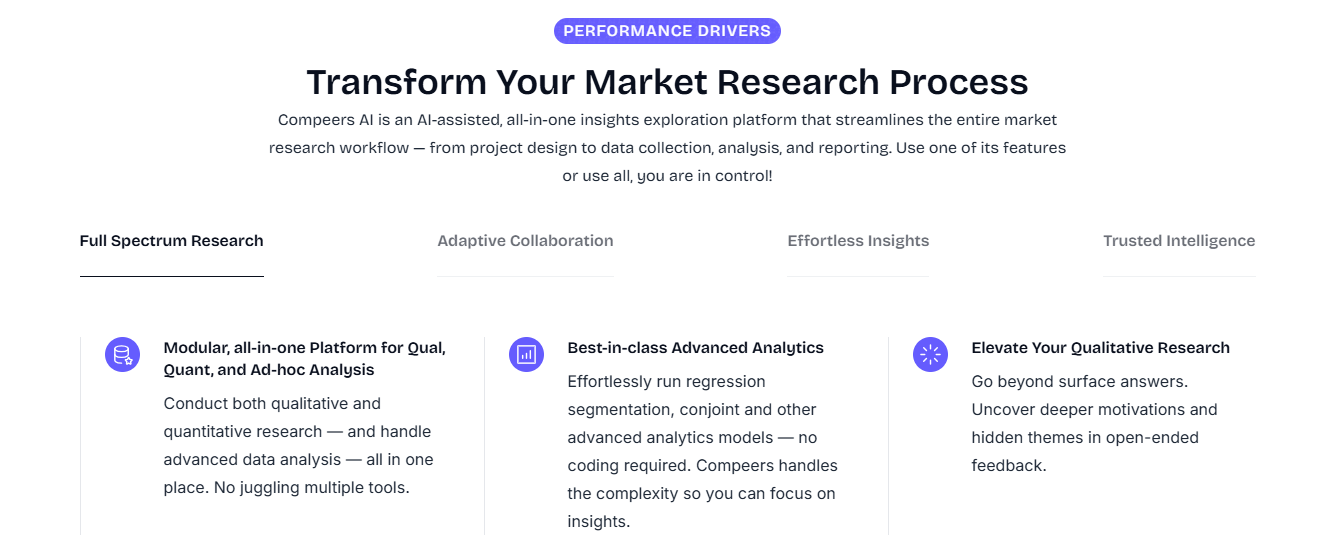
Qualitative Compeer can help explore buyer needs through interviews or focus groups, while Quantitative Compeer can support surveys, cross-tabs, and advanced analytics.
Segmentation Compeer can help your team identify valuable customer groups and compare differences by need, behavior, or market potential.
Savant can support data exploration, charts, and first-pass analysis, while traceable outputs and first-draft reporting help your team move from evidence to decisions with less manual handoff.
Book a demo to see how your team can turn market expansion research into clear, traceable decisions!
What to Do Before Starting Custom Research
Review the business decision before you start the custom research process. A clear decision helps your team avoid a project that collects interesting data but fails to answer the questions management needs answered.
Start by checking whether syndicated research already answers part of the question. If a pre-built report covers market size, category trends, or key players well enough, your custom work can focus on the gaps.
Your team should clarify these points before the project starts:
- Decision: What business decision will the research support?
- Existing evidence: What do you already know from syndicated research, internal data, or previous studies?
- Audience: Which customers, consumers, clients, or market experts need to be reached?
- Sources: Which data sources are available, including CRM systems, surveys, interviews, sales data, or support records?
- Budget and timeline: How much time and budget can the project use without slowing down the decision?
- Stakeholders: Who will use the findings after the report is finished?
- Output: What format will help your team act, such as a report, dashboard, segmentation model, or presentation?
This review prevents vague scope, weak data, poor stakeholder alignment, and slow reporting. It also helps your team choose the right integrated research platform, avoid unnecessary costs, and keep the research tied to business success.
Run Custom Market Research in One Connected Workflow
Custom research often slows down when planning sits in one place, data collection happens in another, analysis moves into spreadsheets, and final reporting gets rebuilt in slides. Each handoff can strip away context, delay decisions, and make it harder to trace findings back to their source.
Compeers AI helps your team manage custom market research from project setup to first-draft reporting in one workflow.
It supports qualitative research, quantitative studies, segmentation, advanced analysis, open-ended response synthesis, and report development for teams that need clearer answers without splitting the work between disconnected tools.
Your team can use Compeers AI to design studies, collect evidence, analyze data, compare customer groups, and create traceable reports for strategic decision making.
We make custom research easier to use when the final answer needs to guide market expansion, pricing, customer experience, brand strategy, or growth planning.
FAQs About Custom Market Research
How much does custom market research cost?
Custom market research costs depend on scope, audience, geography, methods, sample size, and reporting needs.
How long does a custom market research project take?
A custom market research project can take a few weeks for a focused survey or several months for a larger study with interviews, secondary research, analysis, and reporting. Timeline depends on the audience, data collection method, review process, and the complexity of the final recommendations.
Who owns the data from custom market research?
In most custom research projects, the client owns the research output because the study is designed and funded for that client. This differs from syndicated research, where the data or report is usually sold to multiple buyers.
When is syndicated research enough?
Syndicated research is enough when your team needs broad market context, category trends, market size, or competitive background before making early decisions. Custom research becomes more useful when your question involves your own customers, product, market, pricing, or strategy.
Can custom research use both surveys and interviews?
Yes, custom research can combine surveys and interviews in the same project. Surveys help quantify patterns, while interviews and focus groups explain customer motivations, needs, objections, and decision processes.
What should go into a custom research brief?
A custom research brief should include the business decision, research objectives, target audience, geography, known data sources, timeline, budget range, and expected output. It should also explain who will use the findings and which decisions the research must support.


.svg)
Custom research, reimagined
.svg)
.svg)
.svg)
.svg)