.svg)



How to Engineer Your Brand Toward the Middle: Why AI Personas Can Miss Your Biggest Growth Opportunities (2026)
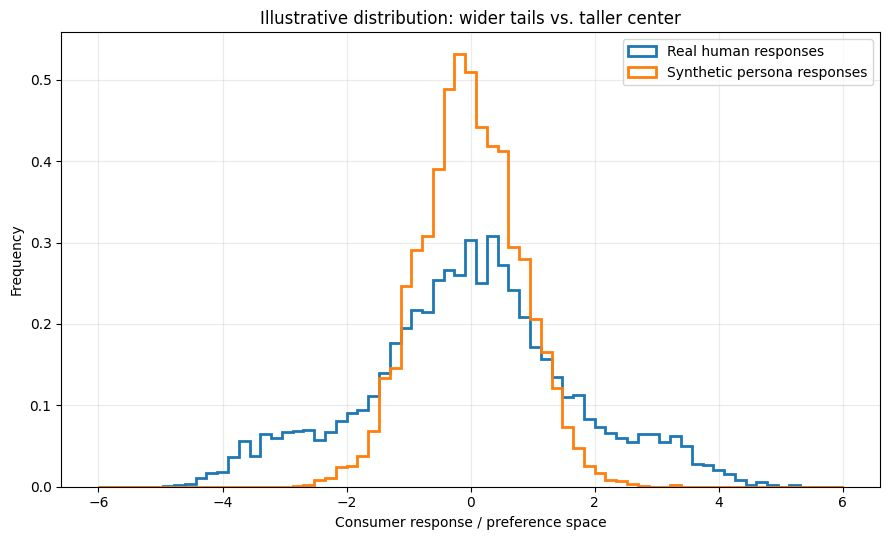
As AI personas become more common in market research, many organizations are using them to generate consumer feedback, test concepts, and evaluate messaging faster than ever before.
The promise is compelling: lower costs, shorter timelines, and instant insights powered by large language models (LLMs) such as ChatGPT, Gemini, Claude, and similar AI systems.
But there is an important question every brand should ask:
What if the biggest opportunity for growth isn't found in the average consumer response?
In highly competitive consumer markets, the answers that create competitive advantage often come from the edges – not the middle.
Why the Most Valuable Consumer Insights Often Come from the Edges
In hypercompetitive CPG categories, meaningful growth rarely comes from average opinions.
It comes from:
- unexpected behaviors,
- conflicting motivations,
- niche preferences,
- emerging needs,
- and weak signals that most competitors overlook.
These outliers often reveal opportunities for product innovation, positioning, messaging, and entirely new demand.
That is why replacing real research participants with AI personas deserves careful consideration.
Why AI Personas Tend to Produce "Average" Answers
Large language models are designed to predict the most probable next token based on patterns learned during training.
That makes them exceptionally good at producing responses that are:
- coherent,
- plausible,
- well-structured,
- and likely to satisfy users.
But qualitative research is not about generating the most likely answer.
It is about discovering the unexpected one.
On top of probabilistic generation, many modern AI systems undergo Reinforcement Learning from Human Feedback (RLHF) – an alignment process that encourages responses people generally prefer.
The result is not necessarily inaccurate.
It is simply optimized for a different objective.
The Hidden Risk: Probability Collapse
One of the less discussed challenges of AI personas is what can be described as probability collapse.
Rather than preserving the full range of possible human responses, language models naturally favor higher-probability outputs.
The risk is not that every unusual opinion disappears.
The greater risk is that non-obvious responses become systematically underrepresented.
Those responses are often the ones that help brands identify:
- market whitespace,
- unmet customer needs,
- emerging trends,
- differentiated positioning,
- and new sources of demand.
When those signals become weaker, research may still appear convincing while becoming less useful for strategic decision-making.
AI Personas vs. Real Research Participants
AI Personas
- Generate statistically plausible responses
- Tend toward coherent, high-probability answers
- Excellent for rapid ideation and hypothesis generation
- Can smooth out unusual responses
Real Research Participants
- Express genuine opinions and experiences
- Often provide contradictory, emotional, or incomplete answers
- Essential for understanding authentic customer behavior
- Preserve valuable outliers and weak signals
Neither approach is inherently better.
They simply solve different problems.
How to Choose the Right Research Approach
If your objective is internal brainstorming or exploring early concepts, AI personas can be a valuable tool.
If your objective is making strategic brand, product, or marketing decisions, ask yourself:
- Do we need authentic customer opinions or simulated responses?
- Are we looking for consensus or differentiation?
- Could the most valuable insight come from an outlier rather than the average?
- Are we comfortable making decisions based on probability-optimized outputs?
The answers will often determine whether AI personas are sufficient – or whether real human research remains essential.
Don't Engineer Your Brand Toward the Middle
If your research process continually pulls extreme responses toward the center, you may obtain cleaner reports and faster decisions.
But you may also remove exactly the signals that help brands stand apart from competitors.
That is the real risk.
Not that AI personas fail completely.
But that they make everything look slightly more average than reality.
Before adopting AI personas as a substitute for qualitative research, ask your vendor one simple question:
How does your product account for probability collapse and ensure that rare but commercially valuable consumer responses are not systematically lost?
The answer may tell you far more about the quality of the research than the speed of the technology.
Frequently Asked Questions
Why does Compeers AI not advocate the use of AI personas in consumer insights workflow?
Compeers AI does not advocate using AI personas as substitutes for real respondents because LLMs are optimized to generate plausible, coherent language, not to faithfully represent the inconsistency, contradiction, and edge-case behavior that real consumer insight depends on. Their outputs can also shift with prompts, model settings, and version changes, which makes them an unstable measurement instrument for decisions about brands, products, and markets.
What is probability collapse in AI personas?
Probability collapse refers to the tendency of language models to favor highly probable responses over less common ones. In market research, this can reduce the visibility of unusual but valuable consumer insights.
Can AI personas identify market opportunities?
They can help generate ideas and hypotheses. However, opportunities driven by niche behaviors, emerging trends, or unexpected customer motivations may require direct feedback from real research participants.
Why do outliers matter in qualitative research?
Outliers often reveal unmet needs, new customer segments, product innovation opportunities, and competitive differentiation that average responses may hide.
Should AI personas replace qualitative research?
AI personas are valuable for accelerating research workflows and early-stage exploration. However, when important business decisions depend on understanding authentic human behavior, they should complement – not replace – real qualitative research.
Latest articles
Browse all posts


.svg)
Custom research, reimagined
.svg)
.svg)
.svg)
.svg)