.svg)



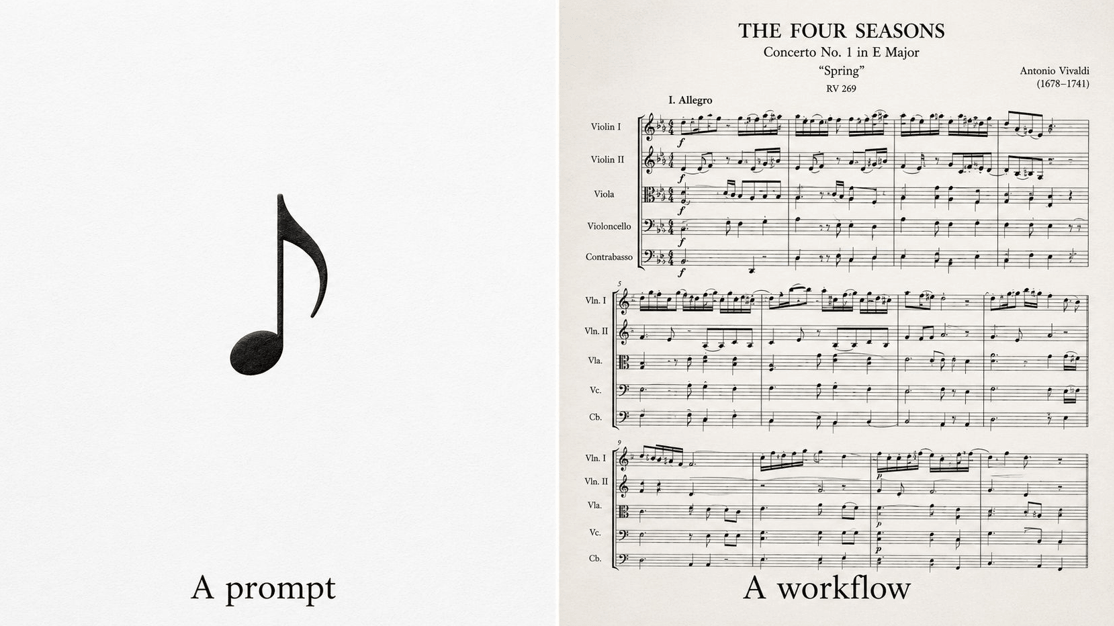
Prompts Make Notes. Workflows Make Music. A Practical Guide to AI Workflows in Market Research
A general-purpose AI chatbot can be a powerful assistant for researchers. Tools such as ChatGPT, Claude, and Microsoft Copilot can help write, summarize, brainstorm, organize information, and work through analysis when the researcher provides the right context, files, prompts, and quality checks.
But there is an important distinction between using AI to help with research and using AI as the environment in which the entire research process happens.
Research is not a collection of independent tasks. It is a sequence of connected decisions.
The research objectives shape the questionnaire. The questionnaire shapes survey programming and data structure. The data structure affects analysis. Analysis shapes the findings. The findings shape the report and the recommendations that ultimately inform a business decision.
When that sequence lives inside a general-purpose chatbot, the burden of maintaining those connections remains with the researcher.
The chatbot can help with individual steps. But it does not automatically become the system that holds the study together.
That distinction matters more as research becomes more complex, teams become larger, and deadlines become tighter.
The difference between a prompt and a research workflow
A prompt is an instruction.
A workflow is a system of connected instructions, decisions, inputs, outputs, checks, and review points.
For example, a researcher might ask Claude to:
- Draft a questionnaire
- Summarize interview transcripts
- Code open-ended responses
- Create a first-pass analysis
- Draft a report
- Rewrite findings for an executive audience
Each of these tasks can be useful.
The problem appears when the researcher has to manually maintain the relationship between all of them.
The chatbot does not automatically know why a question was included in the questionnaire. It may not know that a particular quota was introduced because of a stakeholder requirement. It may not know that a specific segment matters to the business decision. It may not know why one finding was considered more strategically important than another.
The researcher has to provide that context again, keep track of decisions, check the outputs, and make sure that each step remains consistent with the study design.
That can work for an individual task.
It becomes much harder to scale across an entire research program.
Why research context matters
Consider a typical custom research project:
- A business stakeholder defines a decision that needs to be made.
- Researchers translate that decision into research objectives.
- The objectives shape the questionnaire or discussion guide.
- The instrument determines what data is collected.
- The collected data is structured for analysis.
- Researchers analyze the data and identify patterns.
- Findings are connected back to the original objectives.
- The final report turns those findings into a narrative and recommendations.
Every step contains information about the steps before it.
That means context is not just background information. Context is part of the research itself.
If the context disappears between steps, the researcher has to reconstruct it.
This is where a collection of individually useful AI tools can create a surprisingly inefficient workflow.
What happens when every step lives in a separate tool?
A researcher might use:
- Google Docs for the brief
- ChatGPT for questionnaire development
- Qualtrics for survey programming
- Excel or SPSS for analysis
- another AI tool for coding
- PowerPoint for reporting
- Slack and email for stakeholder decisions
There is nothing inherently wrong with any of these tools.
The problem is the handoffs between them.
The researcher has to move information from one environment to another, explain the context again, verify that the next output still reflects the original objectives, and maintain a record of decisions that may otherwise exist only in their own memory.
The result is a workflow that looks automated from the outside but still depends heavily on manual coordination.
That creates three recurring problems.
1. Context loss
A tool working on a transcript may know what respondents said but not why those interviews were conducted.
A tool analyzing a dataset may know the variables but not the original business question.
A tool drafting the report may know the findings but not the reasoning that determined which findings mattered most.
Each tool sees a slice of the study.
2. Rework
When context is lost, researchers have to reconnect the pieces manually.
They explain the project again.
They upload files again.
They recreate instructions.
They check whether the output matches earlier decisions.
They correct inconsistencies.
The individual AI tasks may be fast, but the overall workflow can still be slow.
3. Inconsistency
If the process depends on an individual researcher remembering every instruction and applying the same methodology every time, quality becomes dependent on individual execution.
That makes it harder to reproduce the same process across:
- different projects
- different researchers
- different markets
- different research methods
- different deadlines
This is particularly important in research because reproducibility and traceability are not optional extras.
Step-level AI vs. workflow-level AI
A useful way to evaluate AI in research is to distinguish between step-level AI and workflow-level AI.
Neither approach is inherently better for every situation.
A general-purpose chatbot can be exactly the right tool when a researcher needs help drafting an email, summarizing a document, brainstorming hypotheses, or rewriting a paragraph.
The issue is different when AI is expected to support an entire research study.
At that point, the question becomes:
Does the AI help with individual tasks, or does it help preserve the logic of the research from beginning to end?
When should researchers use a chatbot?
General-purpose AI tools remain extremely useful in research.
They are particularly effective when the researcher remains responsible for the underlying research logic.
Good use cases include:
- Brainstorming research questions
- Creating a first draft of a questionnaire
- Rewriting questions for clarity
- Summarizing source documents
- Organizing notes
- Generating initial coding suggestions
- Summarizing transcripts
- Drafting sections of a report
- Comparing alternative ways to communicate a finding
- Synthesizing existing research
In these situations, the researcher is using AI to accelerate work.
The researcher still decides what the study is trying to measure, what evidence matters, whether the analysis is sound, and what conclusions are defensible.
That is an important distinction.
When does a workflow become more valuable?
A structured research workflow becomes more valuable when multiple connected steps need to remain aligned.
For example, imagine a study where the stakeholder wants to understand why consideration of a brand has declined.
The research objectives are developed around that question.
The questionnaire is designed to investigate the potential drivers.
The survey collects specific measures.
The analysis examines those measures across relevant segments.
The findings are interpreted against the original business question.
The report then needs to explain not only what happened, but why it matters.
If the AI system only sees the final dataset, it can analyze the data.
But it cannot necessarily determine whether the analysis answers the original business question.
If it only sees the questionnaire, it can suggest improvements.
But it does not necessarily know what ultimately happened in the field.
If it only sees the transcripts, it can summarize what respondents said.
But it may not know which comments are strategically important.
A connected workflow can preserve those relationships.
That is where the difference between AI assistance and AI infrastructure becomes important.
How to choose an AI research platform in 2026
If you are evaluating an AI research platform, do not stop at asking what individual AI features it offers.
Ask how the system handles the study as a whole.
1. Does it preserve the original research objectives?
The AI should understand what the study is trying to answer, not just what files it has been given.
2. Does context carry from one stage to another?
If researchers have to repeatedly explain the study to each AI feature, the workflow is still fragmented.
3. Can you trace findings back to source material?
A useful research system should make it possible to understand where a finding came from.
4. Are review points built into the workflow?
AI should not quietly make every decision without researcher involvement. Strong workflows give researchers opportunities to review and adjust important outputs.
5. Does the platform apply consistent methodology?
If the same research process is rebuilt manually for every project, the technology is automating tasks rather than improving the research system.
6. Does it reduce handoffs?
Adding another AI tool to an already fragmented stack may create another handoff instead of eliminating one.
7. Can stakeholders interact with the output?
Research does not end when the PowerPoint deck is delivered. Stakeholders often have follow-up questions that were not anticipated during reporting.
A system that preserves the underlying research context can make those questions easier to answer.
Where Compeers AI fits
Compeers AI is built around a different premise from a general-purpose chatbot.
The goal is not simply to give researchers a more powerful prompt box.
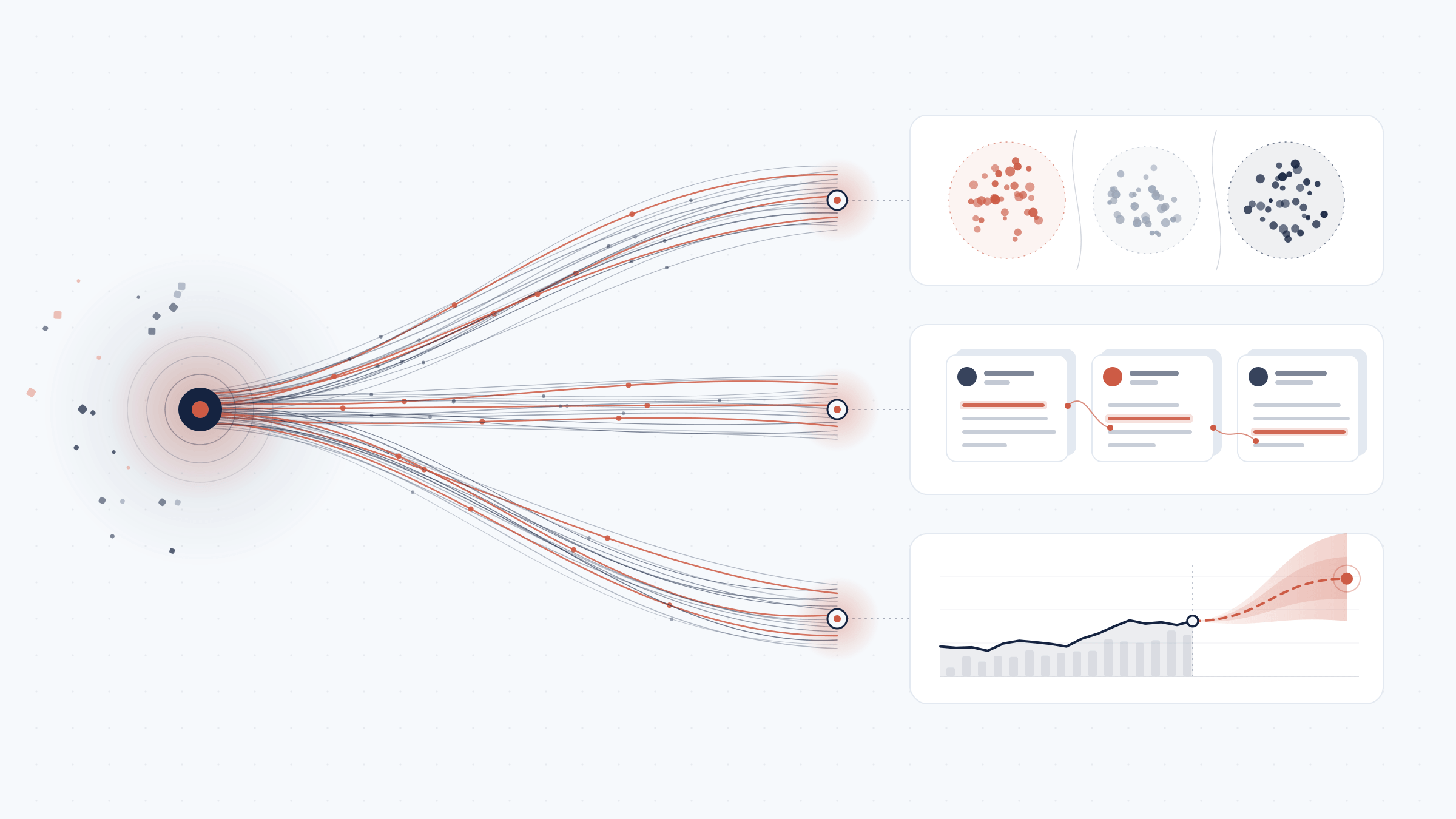
It is to provide a structured environment for custom research where context carries throughout the process.
The brief, research objectives, data collection, analysis, reporting, and source material are connected rather than treated as isolated AI tasks.
Review points are built into the process.
Methodologies can be applied consistently.
Findings can be connected back to the evidence behind them.
This matters because research quality depends on more than the quality of an individual AI response.
A beautifully written summary does not make a weak analysis strong.
A sophisticated prompt does not automatically make a research methodology rigorous.
And a convincing AI-generated finding does not become valid simply because it sounds plausible.
The system needs to preserve the logic that connects the work together.
The real advantage is not fewer prompts
It is tempting to describe workflow-based AI simply as a way to save researchers time.
That is part of the benefit, but it misses the larger point.
The bigger advantage is reducing the amount of research knowledge that exists only inside an individual's head.
When a researcher has to remember every instruction, every stakeholder decision, every methodological choice, and every connection between outputs, the process is difficult to scale.
When those relationships are embedded in the workflow, the system carries more of the operational burden.
That allows researchers to spend more time on the parts of the job that require human judgment:
- Understanding stakeholder needs
- Challenging assumptions
- Questioning unexpected findings
- Applying business context
- Deciding what evidence matters
- Framing implications
- Making defensible recommendations
AI should make those activities easier, not replace them with a sequence of disconnected generated outputs.
FAQ: AI prompts vs. research workflows
Is ChatGPT useful for market research?
Yes. ChatGPT and other general-purpose AI tools can be useful for drafting, summarizing, brainstorming, coding support, and working with research documents. Their value depends heavily on the context and quality controls provided by the researcher.
What is the difference between prompting and a research workflow?
Prompting gives AI an instruction for a particular task. A research workflow connects multiple stages of a study and preserves the relationships between them.
Why is context important in AI research?
Research decisions are connected. The original business question influences the objectives, the objectives influence the questionnaire, and the questionnaire determines what data is collected. Losing that context can create rework and inconsistent interpretation.
Should researchers stop using general-purpose AI?
No. General-purpose AI can be highly useful for individual research tasks. The key is to use it where it accelerates work without transferring responsibility for research validity and judgment to the model.
What should I look for in an AI research platform?
Look for connected workflows, persistent study context, source traceability, methodological consistency, review points, and the ability to connect research objectives, data, analysis, and reporting.
The bottom line
A prompt can make an individual researcher faster.
A workflow can make an entire research process more consistent, traceable, and scalable.
That is the distinction that matters.
Prompting puts quality on the individual. Workflow puts quality into the system.
A prompt is a note.
A workflow turns an individual talent into music – organized by a score, disciplined by rehearsal, and held together by a conductor.
Compeers AI is designed to do the work AI should do, so researchers can spend more time doing the work only humans can do.
Latest articles
Browse all posts

.svg)
Custom research, reimagined
.svg)
.svg)
.svg)
.svg)