.svg)



Why Market Research Workflows Are Still Fragmented in the Age of AI
AI is everywhere in market research. The workflow still isn't connected.
Market research has never had more AI tools. Yet most research teams still run projects across a patchwork of separate platforms, and only about one in ten say AI is fully embedded in their standard workflows.
The problem isn't a lack of AI. It's that each tool solves one step, and the context gets lost in between.
Our founder, Vijay Rajan, recently discussed this with International Business Times in Is AI Finally Modernizing Market Research?. Below, we break down why fragmentation persists and what it takes to fix it.
What a fragmented research workflow looks like
Most research projects move through four stages. In a typical team, each one lives in a different tool:
- Planning. Objectives and hypotheses sit in documents and slide decks.
- Fieldwork. Surveys run on one platform, interviews and focus groups on another.
- Analysis. Data is exported to spreadsheets, statistical software or custom code.
- Reporting. Findings are rebuilt by hand in slides.
Every handoff means an export, a re-upload or a copy-paste. And every handoff drops a piece of context: why a question was asked, which hypothesis it tests, which segment an insight came from.
Why AI hasn't fixed fragmentation yet
Adoption isn't the issue. As cited by IBTimes, Greenbook's 2026 GRIT report found that 73% of analytics professionals already use agentic AI for data preparation and integration.
But most AI tools were built as point solutions: one for survey design, one for transcript coding, one for charts. They make individual steps faster without connecting them. Teams end up with more tools, not fewer handoffs.
The numbers reflect this. According to the Market Research Institute International's 2026 study, also cited by IBTimes, only about one in ten insights professionals say AI is fully embedded in their standard workflows. No single AI use case passes roughly 40% adoption.
Part of the reason is how the industry evolved. Teams adopted specialized tools one by one, long before a unified AI approach was possible. As Vijay put it in the interview:
"When you are within a system, you are not able to correctly identify the issues of the system."
After 12 years inside market research, he moved into AI and machine learning. Looking back from the outside, the bottleneck was clear: not any single tool, but the workflow itself.
What fragmentation costs research teams
- Time. Analysts spend hours moving data between tools and rebuilding reports instead of interpreting results.
- Traceability. When data is scattered, it's hard to trace a finding back to the question and hypothesis behind it.
- Trust. If an AI-generated insight can't be traced to its source data, stakeholders have little reason to act on it.
- Strategic relevance. Insights teams are expected to move up the value chain. That's hard when most of the week goes to operational work.
What a connected research workflow looks like
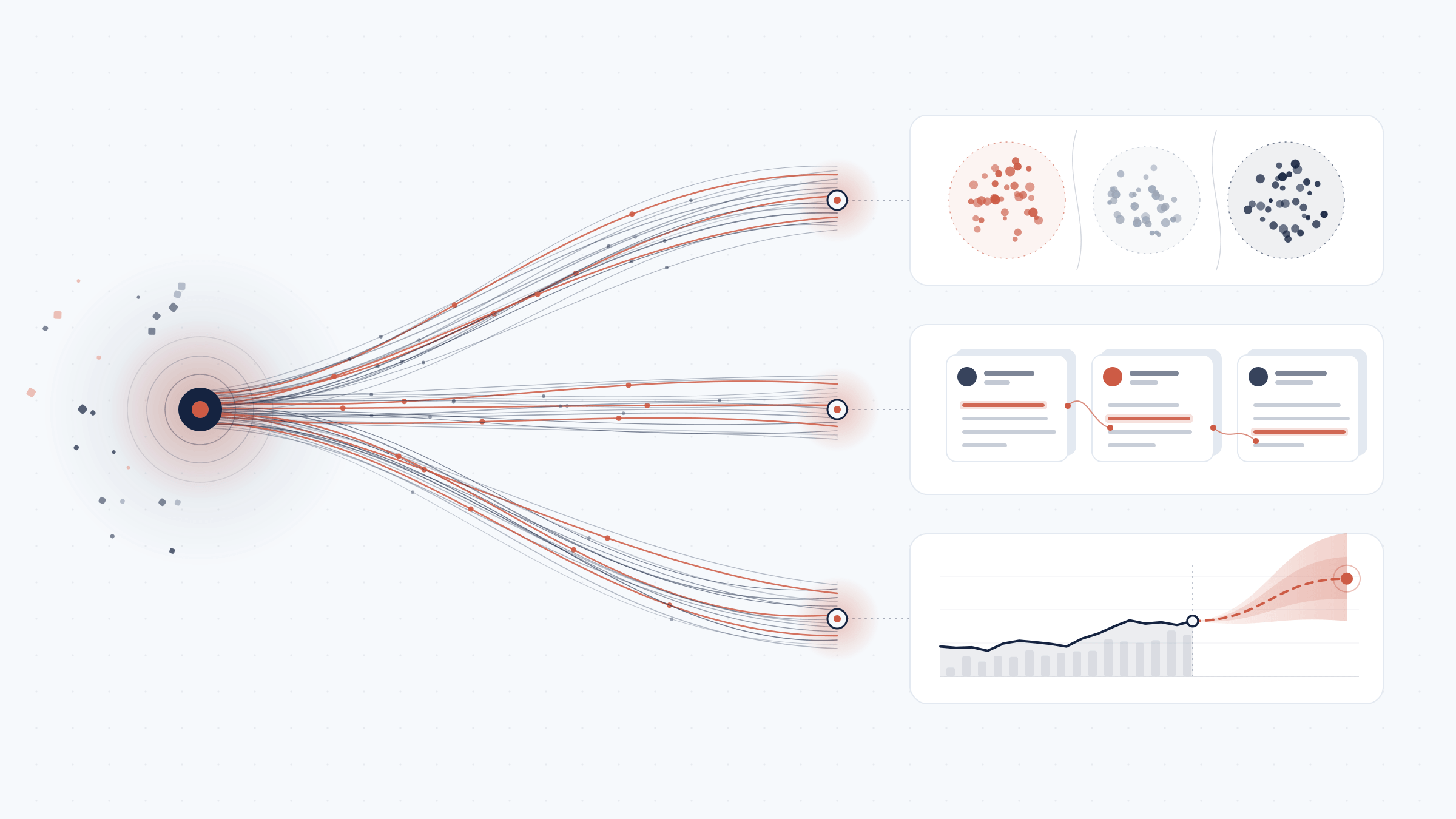
Adding another point tool does not solve the underlying problem. A connected system can preserve context from the first objective to the final report.
In a connected workflow:
- Survey questions, interview transcripts and statistical outputs live in one place, tied to the same research objectives.
- Every finding can be traced back to the data and the question that produced it.
- Reports are generated from the analysis directly, not rebuilt by hand.
- Qualitative, quantitative and advanced analytics work side by side, not in separate silos.
This is what we built Compeers AI to do. The platform brings planning, fieldwork, analysis and reporting into one system, across qual, quant and advanced analytics. It automates technical and operational parts of the research process that previously required more manual work or specialist support, while keeping researchers involved in methodology, interpretation and recommendations. Report assembly that once took hours can be reduced to minutes.
Speed matters, but context matters more. When everything stays connected, AI output becomes something researchers can verify and stand behind.
FAQ
Why are market research workflows fragmented?
Most teams adopted specialized tools one stage at a time: one for planning, one for fieldwork, one for analysis and one for reporting. Each handoff between tools loses context, so the workflow never becomes a single connected process.
Why hasn't AI solved fragmentation in market research?
Most AI tools are point solutions that speed up a single step. They don't connect the stages, so teams gain speed in places but still lose context between tools. Only about one in ten insights professionals say AI is fully embedded in their standard workflows.
What is an end-to-end market research platform?
It's a single system that covers planning, fieldwork, analysis and reporting, so data and context stay connected across the whole project. Compeers AI is an example, covering qualitative, quantitative and advanced analytics in one platform.
Why does context matter in AI-driven research?
Context makes AI output verifiable. When a finding can be traced to the question, data and hypothesis behind it, researchers and stakeholders can trust it and act on it.
How can AI speed up market research reporting?
When analysis and reporting live in the same system, AI can generate reports directly from the analyzed data. Compeers AI can reduce report assembly from hours to minutes by connecting analysis, visualization and reporting within the same research workflow.
The bottom line
Market research doesn't need more tools. It needs workflows that keep context intact, so researchers can spend their time on what machines can't do: interpretation, advice and decisions.
Read the full International Business Times feature: Is AI Finally Modernizing Market Research?
Want to see a connected research workflow in action? Book a demo of Compeers AI.
Latest articles
Browse all posts
.svg)
Custom research, reimagined
.svg)
.svg)
.svg)
.svg)