



How to Select a Great Consumer Insights Platform for Your Team
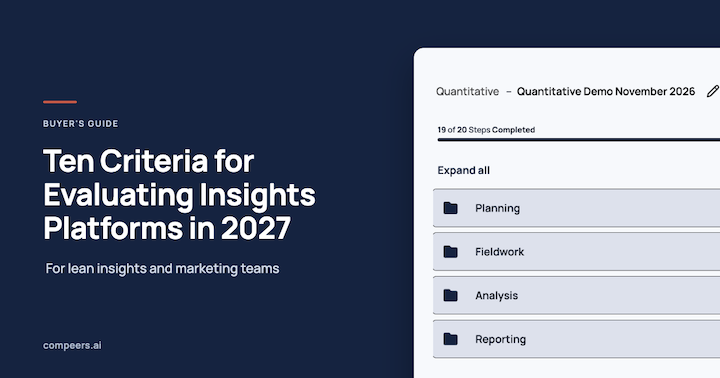
Insights teams and lean marketing teams without a dedicated insights function evaluating research platforms today face a crowded market. Most published rankings of the best platforms are written by vendors, and feature lists tend to look similar from one product to the next. A more useful starting point is what research has to accomplish, which is to produce evidence that is reliable, relevant to the business, and used in decisions. Viewed that way, ten qualities separate a great market research platform from an adequate one, and they are listed here in order of importance.
1. Safeguards for data and sample quality
Every finding a platform produces depends on the integrity of the data underneath it. In Greenbook's 2025 GRIT research, 40 percent of researchers named data quality as their top barrier, and the growth of AI-driven respondent fraud has added to that concern. A great platform protects quality at several points, including questionnaire design, fieldwork, and data cleaning, so that problems are caught before they reach analysis. Analytical sophistication cannot compensate for weak data, which is why this requirement comes first.
2. Grounding in business context and sound methodology
Analysis is useful only when it answers the question the business is actually asking. A strong platform absorbs the context around a study, such as briefs, objectives, prior research, and stakeholder priorities, and uses it to shape both design and interpretation. It also applies established methodology, because analysis that is relevant but methodologically weak should not inform commercial decisions. Industry research on trust in AI has identified specificity to business context and methodological soundness as two of the areas where AI tools most often fall short.
3. Traceability of AI outputs
As more analysis is generated with AI, the ability to verify it becomes essential. Researchers and stakeholders need to trace each insight back to the data that supports it, so they can confirm that the conclusion reflects the evidence and identify when it rests on too little of it. Traceability allows a team to stand behind a finding in front of senior stakeholders, and it is increasingly the basis on which buyers judge whether an AI platform can be trusted.
4. Researcher control over the analysis
Human judgment about the business question should direct the work, with AI extending what a researcher can accomplish. In practice, this means the platform produces drafts that researchers can review, adjust, and approve at each stage, and their decisions shape what follows. This control also works as a quality mechanism, since errors are caught by the people who understand the business before findings reach decision makers.
5. End-to-end workflow coverage
Research design, data collection, analysis, and reporting have traditionally been spread across separate tools and vendors, and each transition between them adds manual effort and loses context. A platform that carries the work through every stage in one system preserves that context and produces more consistent execution across projects and teams. It also makes several other qualities on this list, such as traceability and reuse, possible.
6. Decision-ready outputs
Research creates value when the people making decisions understand and act on it. Greenbook's 2025 GRIT research found that 42 percent of buyer-side researchers now prioritize consultative storytelling over raw data delivery, a 15-point increase since 2023. A great platform supports this by answering business questions with coherent, evidence-backed narratives that product managers, marketers, and executives can follow without a researcher interpreting each chart.
7. Support for multiple research methods
Different methods reveal different aspects of customer behavior. Quantitative surveys measure what people report at scale, qualitative interviews explain the reasoning behind it, and advanced analytics such as segmentation, key driver analysis, and conjoint identify structure and trade-offs in the data. A platform that supports these methods within one workflow allows teams to combine them around a single business question rather than managing them as separate studies.
8. Institutional memory and reuse
Many organizations run a large number of studies each year and still find it difficult to locate what they already know. Past findings often remain in static reports, and much of the understanding a team builds leaves with individual researchers. A great platform stores and connects past research so that new questions can draw on existing evidence, studies remain useful after the final presentation, and the value of research accumulates over time.
9. AI-assisted analysis
AI now handles much of the labor-intensive analysis that once consumed research teams, including open-end coding, thematic analysis, sentiment analysis, cross-tabulation, and charting. It can also surface segment differences or relationships that might not otherwise have been examined. Because these capabilities are increasingly common, their value depends on the quality of the data and context the platform works with, which is why this item ranks below those foundations.
10. Speed to insight
When analysis takes weeks, findings can arrive after the decision they were meant to inform. Platforms that deliver results within hours or days keep research aligned with the pace of the business. Speed is now expected of AI-enabled platforms, so it matters most when it comes without any compromise on the qualities above.
How Compeers AI meets these requirements
Compeers AI was designed around these requirements, with human judgment leading and AI amplifying the work at each step. The platform brings research design, data collection, analysis, and reporting into one system, and context carries forward automatically from one stage to the next. It supports qualitative, quantitative, and combined qualiquant studies, AI-moderated interviews through Socratic, and advanced analytics including segmentation, key driver analysis, conjoint, Van Westendorp, concept testing, and tracking.
Quality and context are built into the workflow. Compeers automates data cleaning and quality checks, and it understands each project through documents, briefings, and recordings so that analysis reflects the business question. The platform generates first drafts, researchers review and adjust them, and their decisions are locked in before the work moves forward. This review process is also what keeps the AI verifiable, since every output is grounded in project data and can be traced to its source.
Work such as survey programming, open-end and thematic coding, sentiment analysis, cross-tabs, and first-draft reporting is automated, and data analysis typically completes in about an hour, with full results within 24 hours of study kickoff. Stories allows a team to type a business question and receive a complete, verifiable narrative with visualizations drawn from the whole project in two to three minutes. Savant, the platform's AI data analyst, allows research to build on itself across projects, so findings remain useful long after the final presentation.
Teams can run studies on Compeers themselves, and full-service execution is also available. In both cases, the platform is built for how insights actually get done.
The ten criteria are also summarized in a 90-second video.



Custom research, reimagined


