.svg)



How to Evaluate Market Research Platforms for Sentiment Analysis, Predictive Analytics, and Consumer Insights
Begin with the decision and the data path
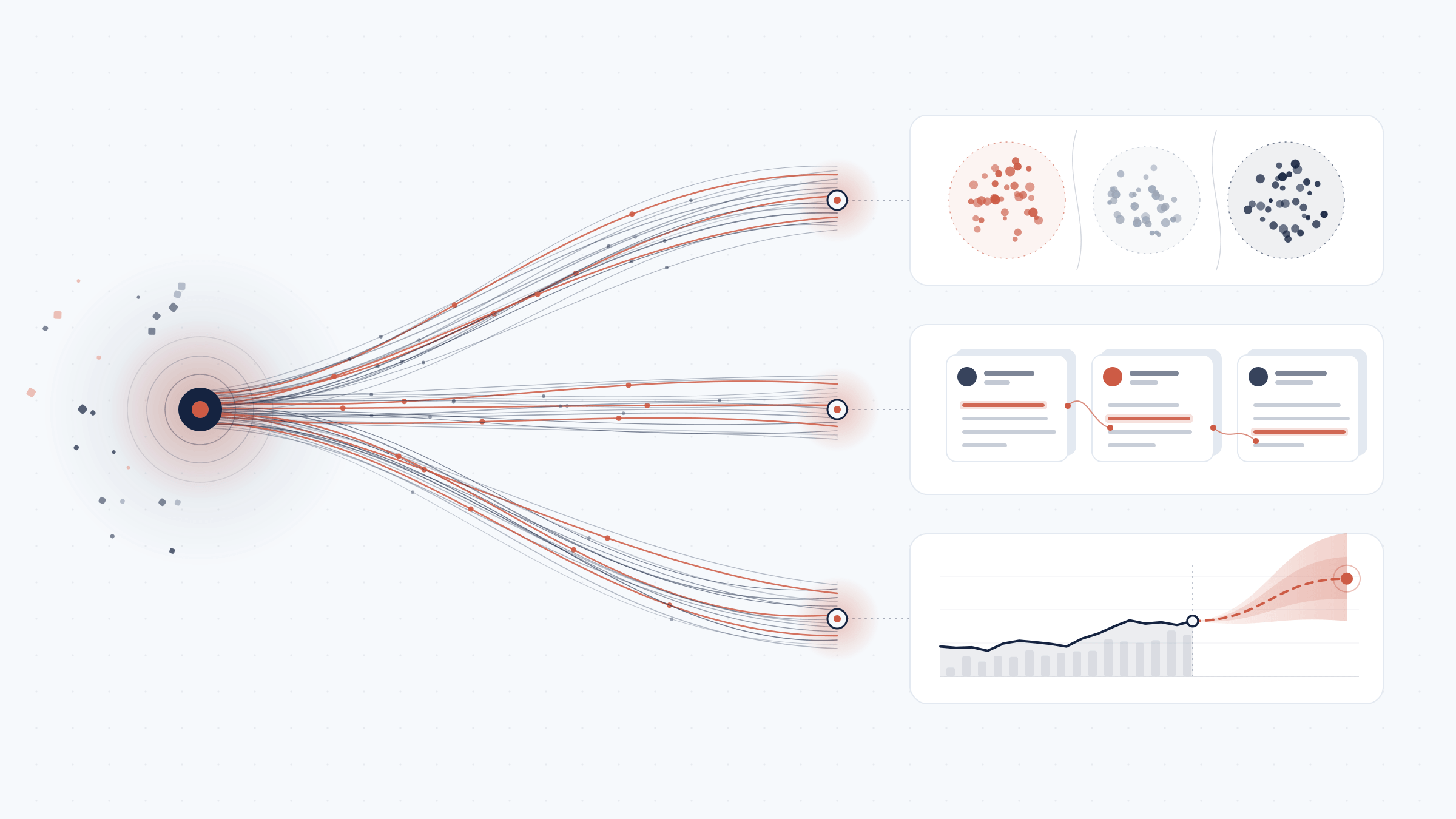
Choosing market research technology starts with the decision it must support, not with a list of AI features. Sentiment analysis, custom consumer research, and predictive analytics perform different jobs: one organizes expressed opinions, another gathers new evidence from real human respondents, and the third estimates a defined future or unobserved outcome.
Before reviewing vendors, document the decision, target population, available evidence, research gaps, timeline, acceptable uncertainty, and review responsibilities. Then determine whether the project requires analysis of existing information, new primary research, prediction, or a defensible combination. No platform should be selected simply because it uses AI or combines many features.
TL;DR
Identify the research job before choosing a platform. Demand separate evidence for sentiment analysis, primary research, and predictive capabilities because strength in one does not establish strength in the others. Test shortlisted platforms with representative material, review methodological and governance documentation, and evaluate portability, support, and total cost alongside functionality.
Three capabilities, three different jobs
Sentiment analysis organizes expressed opinion
Sentiment analysis classifies or organizes opinions expressed in text or another supported input. Depending on the system, it may assign labels, identify themes or aspects, summarize language, or distinguish positive, negative, neutral, and mixed expressions.
Buyers should ask what the platform means by sentiment, which inputs and languages it supports, and how its labels are validated. Context, irony, ambiguity, specialist vocabulary, source bias, and the population represented can all affect interpretation. Research on how sentiment analysis is framed and interpreted cautions against treating textual sentiment as a direct, universally reliable measure of consumer preference, attitude, purchase intent, or demand.
A market research platform for sentiment analysis can help teams organize open-ended responses or other supported text and develop hypotheses. The output still needs to be interpreted in relation to the data source, research question, and people represented.
Predictive analytics estimates a defined outcome
Predictive analytics uses historical, experimental, or choice data and a specified model to estimate a defined future or unobserved outcome. Useful evaluation begins with precision: what is being predicted, for which population, under what conditions, and over what time horizon?
Vendors should disclose the model type, assumptions, training and evaluation data, and appropriate performance evidence. Depending on the use case, this could include out-of-sample testing, calibration, discrimination, error measures, subgroup results, and monitoring. TRIPOD+AI offers a rigorous analogy for evaluating prediction evidence, although it is guidance for clinical prediction models rather than a consumer-research standard.
Consumer insights are interpreted understanding
Consumer insights are the interpreted understanding produced from one or more evidence sources and applied to a business decision. They are a research outcome and organizational practice, not necessarily a single software feature.
The three jobs can complement one another. Expressed opinions may reveal hypotheses; qualitative or quantitative research can investigate and quantify them; and a validated model may estimate a defined outcome when suitable data and assumptions exist. However, a consumer insights platform does not automatically include robust customer sentiment analysis or validated prediction.
A practical comparison of the three research jobs
One project may involve all three jobs, but combining them in one interface does not prove methodological validity or predictive performance. Each capability requires its own evidence and acceptance criteria.
Build the scorecard around evidence, not feature labels
A defensible scorecard translates broad product claims into requirements that can be tested. Useful columns include requirement, priority, vendor response, evidence supplied, evaluator notes, and a pass/fail result or weighted score.
Use-case and data fit
- Use-case fit: Confirm which decisions, populations, methods, and research modes the platform is designed to support. Separate mandatory capabilities from convenient extras.
- Inputs and portability: Ask which sources and formats are supported, how prior research can be submitted, and whether raw data, metadata, codebooks, tables, charts, and reports can be exported in usable formats.
- Primary research quality: Examine the target population, recruitment source, sample construction, fieldwork controls, weighting, research mode, questionnaire wording, and methodological disclosure. AAPOR best practices support asking these questions while recognizing that requirements vary by study design.
Analytical and human oversight
- Transparency: Require definitions, assumptions, coding or model documentation, and uncertainty information where appropriate. Users should be able to connect conclusions with supporting project evidence.
- Human oversight: Identify which methodological decisions are made by researchers, which steps are automated, who reviews outputs, and how a user can correct or challenge an AI-generated result.
- Capability-specific validation: Do not accept a general statement about AI quality as evidence for sentiment classification, survey estimates, qualitative interpretation, or predictive accuracy.
Governance and operational fit
The NIST AI Risk Management Framework identifies validity and reliability, security, accountability and transparency, explainability, privacy, and harmful-bias management as characteristics relevant to trustworthy AI. These are assessment categories, not qualities that an AI market research platform possesses automatically.
Request documentation covering privacy, security, access management, retention, deletion, subprocessors, auditability, and the scope of applicable certifications. Operational assessment should also cover implementation effort, collaboration, expected project volume, training, service dependencies, support, and total cost.
Questions to use in vendor demos and procurement
Send important questions before the demonstration so vendors can prepare relevant evidence. The answers can then become part of the scorecard or proof-of-concept acceptance criteria.
- Data scope: What existing data can the platform analyze, and which file types, languages, input limits, and connectors are documented?
- Sentiment definition: Which labels or aspects are supported, and how does the system address mixed sentiment, ambiguity, sarcasm, and domain-specific language?
- Sentiment validation: Has the method been evaluated against human-reviewed, domain-relevant data, and can it be tested on representative buyer examples?
- Primary research: How are respondents recruited, screened, deduplicated, and quality-checked? Can the sampling approach and proposed fieldwork partners be documented?
- Prediction target: What exact outcome is predicted, over what period, and with which model, data, assumptions, and evaluation procedure?
- Prediction evidence: Can the vendor supply out-of-sample results, suitable calibration or validation evidence, subgroup performance, known failure cases, and a monitoring process?
- Researcher review: Which decisions require researcher approval, and how are generated findings checked against underlying evidence?
- Traceability: Can users move from a chart, theme, summary, or recommendation to the relevant project data?
- Governance: Which privacy, security, retention, deletion, access, and subprocessor controls apply to the proposed deployment? What is the documented scope?
- Portability: Which data, analytical artifacts, visualizations, and reports can be exported during the contract and when it ends?
- Implementation: Which customer resources, onboarding steps, service dependencies, training, and ongoing support are required?
- Commercial terms: What does the price include, and which costs vary by user, respondent, project, data volume, method, or service level?
Evaluate AI-native platforms at the workflow level
For an AI-native platform, map where AI is used across the end-to-end research workflow. Record the data each step receives, the output it creates, where context may be lost, and where researcher review occurs.
Ask the vendor to demonstrate a realistic project using buyer-supplied or representative test material rather than relying only on a polished generic demo. Examine whether context and traceability survive the movement from planning and fieldwork through analysis, visualization, reporting, and interactive exploration.
AI-generated findings are not inherently accurate, unbiased, representative, or appropriate for high-stakes decisions. Require separate evidence for primary research quality, analytical validity, data governance, and operational efficiency rather than allowing one claim to stand in for all four.
Where Compeers fits – and what buyers should verify
Compeers is an AI-native, all-in-one platform designed to bring custom qualitative, quantitative, and mixed-method market research into one end-to-end research workflow. It connects research planning, fieldwork, analysis, visualization, reporting, and interactive exploration, helping insights teams work across methods without treating each stage as a separate process.
The platform supports research with real human respondents, including interviews, focus groups, and surveys. Its analytical capabilities include segmentation, key-driver analysis, conjoint, MaxDiff, tracking, and TURF. Teams can also bring prior research into the platform and explore related qualitative and quantitative findings together.
For organizations evaluating sentiment analysis and predictive capabilities, the distinction between supported use cases matters. Compeers lists sentiment analysis within Qualitative Compeer and offers discrete-choice modeling, market simulations, and market-share prediction within Rapid Concept Evaluation. These capabilities should be evaluated against the buyer's specific requirements rather than assumed to cover every sentiment analysis or predictive analytics use case.
Compeers is particularly relevant to teams looking to connect research execution and analysis within a single platform while retaining human involvement in methodology, interpretation, and recommendations. As with any enterprise research platform, buyers should request demonstrations using representative projects and verify the technical, methodological, integration, and security requirements that matter to their organization.
Final Thoughts: Make the decision with a use-case test
Shortlist platforms against mandatory use cases before comparing optional features. Run a proof of concept using representative existing data, a defined primary-research scenario, or a clearly specified predictive target as applicable. Research, analytics, procurement, security, and legal stakeholders should assess the evidence relevant to their roles. Choose based on demonstrated fit, methodological transparency, governance evidence, usability, support, portability, and total cost, not the number of AI features.
Frequently asked questions
How do you choose a market research platform?
Define the decision first, then identify whether the project requires existing-data analysis, new primary research, prediction, or a combination. Establish evidence and governance requirements, test shortlisted platforms with representative material, and compare methodological fit, portability, implementation, support, and total cost.
What should an enterprise market research platform include?
The right components depend on the organization’s methods and governance needs. An enterprise platform may support planning, fieldwork, analysis, visualization, reporting, and exploration, but buyers should also evaluate methodological disclosure, human oversight, exports, privacy, security, access, retention, support, and implementation requirements.
What is the difference between sentiment analysis, predictive analytics, and consumer insights?
Sentiment analysis categorizes or organizes expressed language. Predictive analytics estimates a defined future or unobserved outcome using specified data and a model. Consumer insights are the interpreted understanding developed from evidence and used to support decisions; they are not simply another analytical feature.
Can one platform support sentiment analysis, custom research, and predictive analytics?
Potentially, but the three functions must be validated separately. A platform’s ability to collect custom research does not prove the validity of its sentiment classifications or predictions. Buyers should test each required capability, inspect its evidence, and confirm that integration preserves methodological quality and traceability.
Latest articles
Browse all posts


.svg)
Custom research, reimagined
.svg)
.svg)
.svg)
.svg)