.svg)



5 Best AI Market Research Platforms for Enterprise Teams
Enterprise research teams comparing AI platforms need more than a feature checklist. Here's how the top five stack up before you dig into the details.
- Compeers AI: The best end-to-end platform for mixed-method research and stakeholder-ready reporting
- quantilope: Automated survey design for consumer brand tracking studies
- Zappi: Ad and concept testing automation focused on creative optimization
- GetWhy: AI-moderated qualitative interviews for exploratory research
- Suzy: Panel-based consumer research for quick-turn quantitative surveys
How we chose the best AI market research platforms for competitive analysis
Evaluating an AI market research platform requires more than reading feature lists. Enterprise research teams need to understand how each platform handles real workflows, from project scoping through final stakeholder presentation.
The platforms on this list were selected based on the following criteria:
- End-to-end workflow coverage: Does the platform handle planning, fieldwork, analysis, and reporting in one environment, or does your team still need separate tools for each stage?
- Mixed-method support: Can you run qualitative, quantitative, and mixed-method projects without switching platforms or re-uploading data?
- Stakeholder-ready outputs: Does the platform generate editable reports and presentations you can take directly to leadership, or does your team need to rebuild deliverables manually?
- Analytical depth: Does the tool offer advanced analytics such as segmentation, key driver analysis, and conjoint, or is it limited to basic tabulation?
- Traceability and verification: Can you trace every finding back to source data without leaving the platform?
- Enterprise security: Does the vendor hold current SOC 2 Type II and ISO 27001 certifications?
- Time-to-insight: How quickly does the platform move from data collection to a finished, interactive report?
The 5 best AI market research platforms for enterprise research teams
1. Compeers AI: The best end-to-end platform for mixed-method research and stakeholder-ready reporting
Compeers AI is built for lean insights teams that need to move from a business question to a finished research deliverable without managing six or seven disconnected tools. The platform handles qualitative, quantitative, and mixed-method research in a single environment.
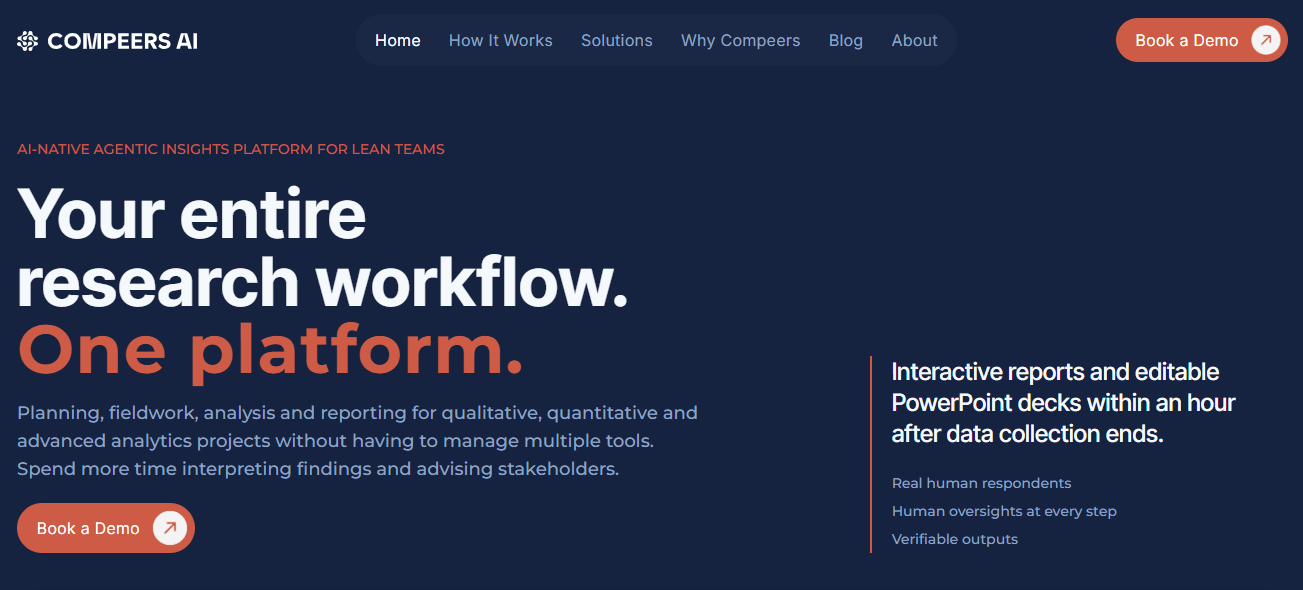
Compeers AI delivers interactive reports and editable PowerPoint decks within an hour after data collection ends. Every finding is traceable back to source data, which means your stakeholders can verify claims without requesting a separate data appendix.
The platform supports advanced analytics including segmentation, key driver analysis, conjoint, and max-diff. It also automates transcription, thematic coding, and first-draft narrative reporting for qualitative projects.
Compeers AI features
- End-to-end research workflow: Covers planning, fieldwork, analysis, and reporting for qual, quant, and mixed-method projects. Your team avoids repeated data transfers and manual coordination between research stages.
- Savant AI Data Analyst: A conversational, context-aware agent for slicing data, discovering trends, and generating visualizations on demand. Non-technical stakeholders can explore project data independently.
- Automated first-draft reporting: Generates executive summaries, editable chart decks, and multimedia presentations. Your first draft arrives within an hour of fieldwork closing.
- Advanced analytics suite: Includes segmentation, key driver analysis, conjoint, max-diff, and pricing sensitivity research. No external statistical software is required.
- Multi-language transcription and translation: Supports global research projects across multiple languages with automated transcription, translation, and qualitative data Q&A.
- SOC 2 Type II and ISO 27001 compliance: Enterprise-grade security certifications with documentation available before any data is shared.
Pros:
- Handles the full research lifecycle in one platform, eliminating multi-tool coordination
- Reports arrive within an hour of data collection, with every finding verifiable back to source
- Supports qual, quant, and mixed-method in a single project environment
Cons:
- Teams accustomed to point-tool interfaces may need a brief onboarding period to learn the unified workspace
- Full-service engagement model may require initial alignment on methodology preferences
- Newer entrant in the market compared to legacy research platforms
2. quantilope: Automated survey research for brand tracking programs
quantilope automates quantitative survey workflows end to end, from questionnaire design through fielding, analysis, and reporting, with an AI research assistant called quinn guiding each step. The platform is best known for its library of automated advanced methods, including MaxDiff, conjoint, TURF, and implicit association testing.
quantilope also offers a qualitative video module, inColor, which captures videoed responses to survey questions and analyzes sentiment, keyword trends, and facial expressions. This gives quantilope some qualitative capability, though it's built around structured video responses to survey prompts rather than moderated interviews, focus groups, or open-ended thematic coding.
quantilope features
- AI-guided survey creation: quinn assists with questionnaire design and method selection for structured quantitative projects
- Automated advanced methods: Includes templates for MaxDiff, conjoint, TURF, and implicit association testing
- inColor qualitative video: Captures videoed survey responses with AI-driven sentiment and expression analysis
- Dashboard and automated reporting: Generates charts, dashboards, and instant report summaries for tracking studies
Pros:
- Runs the quantitative research lifecycle end to end within one platform, from survey design to reporting
- Offers the deepest library of automated advanced quantitative methods of the platforms compared here
- AI assistant reduces manual survey programming and setup errors
Cons:
- Qualitative capability is limited to structured video responses (inColor) rather than moderated interviews, focus groups, or open-ended thematic coding
- Built for quantitative-first, tracking-oriented research rather than custom exploratory or mixed-method projects that need deep qualitative analysis
- Reporting output is dashboard- and summary-based rather than a fully editable, presentation-ready slide deck
3. Zappi: Ad and concept testing automation for creative teams
Zappi specializes in creative testing and innovation research, with pre-built frameworks for evaluating ads, packaging, and product concepts against normative benchmarks. The platform focuses on speed-to-result for marketing teams testing multiple creative variants.
Zappi includes a library of benchmarked tests that score creative assets against category norms, along with key driver analysis and segmentation through cross-tabulations. The tool is designed for iterative creative and concept optimization rather than open-ended custom exploratory research.
Zappi features
- Pre-built testing frameworks: Standardized tests for ad, concept, and packaging evaluation with normative benchmarks
- Key driver analysis: Shapley regression identifies which attributes most influence an outcome metric, benchmarked against Zappi's own project database
- Segmentation via cross-tabs: Breaks results down by audience segment within the standard reporting flow
- Automated AI-generated reports: Quick Reports summarize scores and findings automatically after each test
Pros:
- Pre-built frameworks reduce setup time for standardized creative and concept tests
- Includes key driver analysis and segmentation as part of its standard reporting, not just raw scores
- Normative benchmarks allow comparison across categories and time periods
Cons:
- Built around standardized, benchmarked test formats rather than open-ended custom exploratory research design
- No dedicated moderated qualitative research (interviews, focus groups); qualitative input is limited to open-ended verbatims within a test
- Not positioned as a full end-to-end platform for planning, fielding, and reporting custom studies outside its testing frameworks
4. GetWhy: AI-moderated interviews for exploratory qualitative research
GetWhy uses AI to moderate qualitative interviews at scale, allowing research teams to collect open-ended responses from large sample sizes without scheduling live moderators. The platform focuses on the qualitative data collection stage rather than full project management.
GetWhy delivers transcribed and analyzed interview data with AI-generated summaries and narrative reports, including one-click export to presentation format. The tool is oriented toward teams that need high-volume qualitative data collection with fast turnaround, rather than a combined qual-and-quant research platform.
GetWhy features
- AI-moderated interviews: Conducts qualitative interviews using AI moderators, removing the scheduling constraints of live moderation
- Large-sample qualitative: Collects open-ended responses from hundreds or thousands of participants simultaneously
- Narrative reporting with one-click export: Generates narrative-driven reports with embedded video evidence and one-click PPT export
Pros:
- Scales qualitative data collection beyond what live moderators can handle
- Removes scheduling and logistics bottlenecks for interview-based research
- Narrative reports with one-click PPT export reduce manual deck-building for qualitative findings
Cons:
- AI moderation cannot replicate the follow-up depth of a trained human moderator in sensitive or complex topics
- Purpose-built for qualitative research; does not run quantitative surveys, segmentation, or advanced quant analytics within the same platform
- Mixed-method projects still require a separate platform for the quantitative side of the study
5. Suzy: Panel-based consumer research for quick-turn surveys
Suzy combines a proprietary consumer panel with survey tools, allowing marketing teams to field quantitative studies quickly, and markets itself as an integrated quant/qual research cloud. The platform focuses on rapid consumer polling and concept validation against its built-in respondent base.
Suzy includes qualitative features such as open-end video responses and live focus groups, along with quantitative analytics including MaxDiff and dynamic, machine learning-based segmentation. These capabilities sit within one platform, though Suzy is positioned around speed and its owned panel rather than deep custom methodology design.
Suzy features
- Proprietary consumer panel: Integrated respondent access for fast survey fielding without third-party panel procurement
- Quick-turn quantitative studies: Surveys can be fielded and results returned in hours for simple study designs
- MaxDiff and dynamic segmentation: Machine learning-based segmentation and forced-choice preference ranking within the platform
- Qualitative video and focus groups: Video open-ends and live remote focus groups for qualitative input
Pros:
- Integrated panel removes the need for external sample procurement on standard consumer studies
- Fast fielding for simple survey designs with built-in audience
- Combines quant analytics (including MaxDiff and segmentation) and qualitative video/focus groups in one platform
Cons:
- Panel composition is limited to general consumer demographics; niche B2B or specialist audiences require external sourcing
- Conjoint analysis and key driver analysis are not confirmed as native capabilities, unlike platforms built around a broader advanced-analytics suite
- Built around speed and its owned panel rather than custom study design or interactive, editable presentation decks for stakeholder reporting
Comparison table: The best AI market research platforms for enterprise research
"Partial" means the platform offers some capability in that area, but not to the same depth or breadth as a platform built specifically for it. See each platform's features and cons above for specifics.
How do you evaluate workflow depth in an AI research platform?
Workflow depth refers to how many stages of the research process a platform can handle without requiring data exports or manual handoffs to other tools. A platform with shallow workflow depth might automate survey programming but still require manual analysis and separate reporting software.
When evaluating workflow depth, ask the vendor to walk through a single project from business question to final stakeholder deliverable. Note each point where data must leave the platform or where manual intervention is required.
Compeers AI covers planning, fieldwork, analysis, and reporting in one environment. This eliminates the manual coordination that typically adds days to project timelines when teams manage three to four separate tools.
Why do stakeholder-ready outputs matter for enterprise research teams?
Enterprise research teams present findings to leadership, cross-functional partners, and external clients. If the platform generates only raw tables or basic dashboards, your team must rebuild deliverables manually before every readout.
A platform that generates editable slide decks, interactive reports, and executive summaries directly from project data removes this bottleneck. Compeers AI delivers first-draft presentations within an hour after fieldwork closes, ready for review and customization.
This capability matters because the time between data collection and stakeholder presentation is often where projects stall. Automating the reporting stage gives your team more time for interpretation and strategic recommendations.
Why Compeers AI is the best end-to-end platform for enterprise research
Compeers AI addresses the core evaluation criteria that matter to enterprise research teams: end-to-end workflow coverage, mixed-method support, and stakeholder-ready outputs. Where other platforms cover one stage or one methodology, Compeers AI connects the full research lifecycle in a single, verifiable environment.
The platform reduces time-to-insight from weeks to hours while maintaining analytical rigor. Every finding is traceable to source data, which satisfies the verification requirements enterprise stakeholders expect.
For teams evaluating AI market research platforms, the practical question is whether the tool can handle your full workflow or whether you still need multiple vendors. Compeers AI eliminates that fragmentation. Book a demo to walk through a study your team has already completed and compare the results.
FAQs about AI market research platforms for enterprise teams
What is an end-to-end AI market research platform?
An end-to-end AI market research platform handles every stage of a research project, from planning and data collection through analysis and reporting, in a single environment, rather than requiring separate tools for each stage.
How do AI market research platforms handle mixed-method research?
Mixed-method research combines qualitative and quantitative data in a single study. Some platforms require you to export data between separate qual and quant tools, which breaks traceability and adds manual steps between stages.
What should enterprise teams ask about data traceability?
Ask whether every AI-generated finding can be traced back to the specific source data that produced it. Compeers AI generates verifiable outputs grounded in project data, so stakeholders can validate findings without requesting a separate data appendix or audit trail.
What security certifications should enterprise research teams look for?
Enterprise procurement teams should verify SOC 2 Type II and ISO/IEC 27001:2022 certifications. Compeers AI holds both certifications, and documentation is available before any data is shared with the platform.
How quickly can an AI platform deliver a finished research report?
Delivery speed depends on the platform. Compeers AI generates interactive reports and editable PowerPoint decks within an hour after data collection closes. This speed comes from automating analysis, visualization, and narrative assembly rather than just data collection.



.svg)
Custom research, reimagined
.svg)
.svg)
.svg)
.svg)