



The Best AI Tools for Market Researchers in 2027
Summary
- AI now helps at every stage of market research: study design, fieldwork, analysis, reporting, and secondary research.
- Most AI tools specialize in one stage, such as concept testing, social listening, or qualitative interviews, so teams often combine several and pay for each.
- General AI assistants such as ChatGPT and Perplexity are useful for drafting and desk research but do not collect data from real consumers.
- Compeers AI covers custom surveys, AI-moderated interviews, analysis, and reporting on one platform, with usage-based pricing and no per-seat or platform fees.
- Compeers is 50 to 70% more cost-effective than a traditional agency, and the checklist at the end covers what to ask any AI vendor.
Where AI helps market researchers most
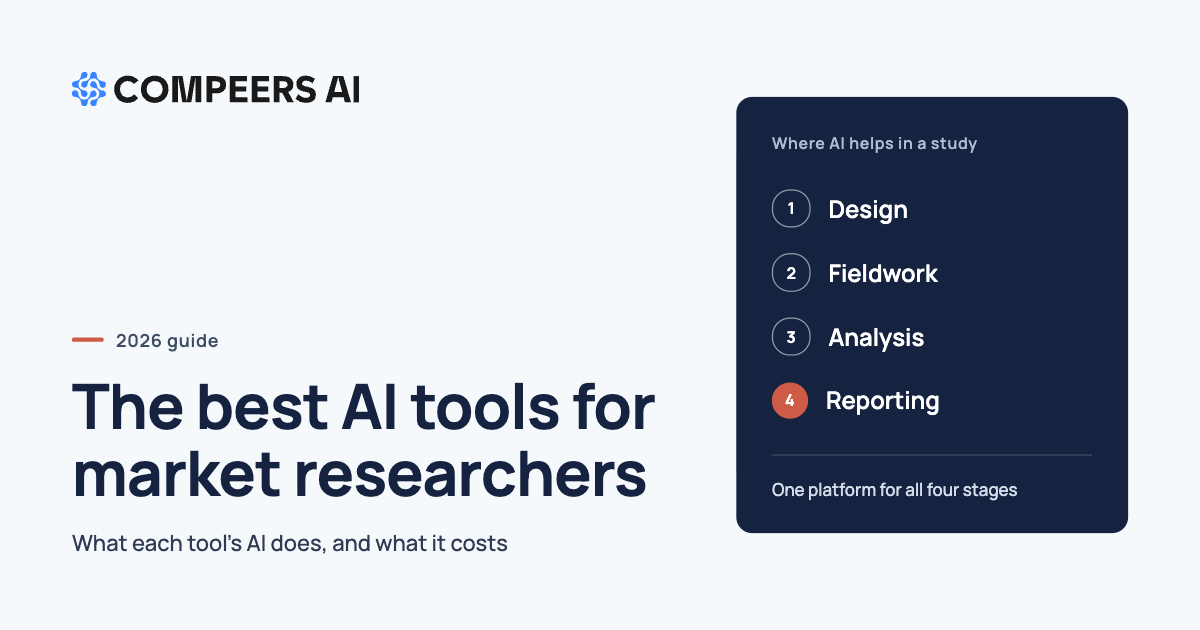
AI is most useful where research work is repetitive and time-consuming. Across a typical study, that means five stages:
- Design: drafting questionnaires and discussion guides from a brief, and suggesting sample quotas.
- Fieldwork: moderating interviews at scale with follow-up questions, and checking response quality as data arrives.
- Analysis: cleaning data, running crosstabs, coding open-ended responses, and applying methods such as conjoint and MaxDiff.
- Reporting: turning findings into charts, summaries, and first-draft reports.
- Secondary research: searching published sources and summarizing them with citations.
The researcher's role shifts toward framing the business question, reviewing the AI's work, and interpreting the results for stakeholders. Tools differ mainly in how many of these stages they cover and how much control they give the researcher over each one.
AI tools for market research compared
The table compares eight AI tools by what the AI does, the work each suits best, and how it is priced.
Pricing for the tools other than Compeers is as reported in SurveySparrow's review of AI market research tools, updated October 2026.
The tools in brief
Compeers AI
Compeers AI is an all-in-one AI market research platform for consumer insights and B2C marketing teams, and the publisher of this guide. It covers custom surveys and AI-moderated interviews in one workflow. Socratic, its AI interviewer, runs voice and video interviews and asks follow-up questions, while the platform drafts questionnaires, cleans data, runs crosstabs, codes open-ended responses, and produces first-draft reports. A researcher reviews and approves each step, respondents are real people, and every finding can be traced to the underlying data.
quantilope
quantilope automates quantitative research, including conjoint, MaxDiff, and TURF, with AI-assisted study design and automated reports. It suits teams running regular quantitative studies such as brand tracking and pricing research.
Zappi
Zappi tests ads and product concepts against consumer panels and uses AI to produce quick reports benchmarked against its database of past tests.
Attest
Attest combines a survey builder, a managed consumer panel with layered quality checks, and AI analysis of results, including open-text responses.
Conveo
Conveo's AI moderator runs qualitative interviews with real people and adds each conversation to a knowledge layer that teams can query in natural language.
Brandwatch
Brandwatch applies AI to online conversations across social media, forums, reviews, and news, identifying sentiment shifts and emerging topics.
Perplexity and ChatGPT
Perplexity searches the web and answers with citations, which makes it useful for desk research. ChatGPT helps draft questions, summaries, and reports. Neither collects data from real consumers, so both work best alongside a primary research tool.
What AI changes about the cost of research
AI reduces the labor in each study, but it does not automatically reduce what a team spends. Three costs tend to remain:
- One tool per stage. Specialist AI tools usually cover one method or stage, so a team running concept tests, brand tracking, and qualitative interviews may pay three vendors, each quoting by study volume or annual commitment.
- Respondents and data. General AI assistants are inexpensive but do not supply real consumers, so panel costs and survey tools still sit on top.
- Agency fees. Teams that outsource still pay agency rates for the manual work in each study, even where AI could handle much of it.
Compeers is built to remove those layers. Surveys, AI-moderated interviews, analysis, and reporting run on one platform, so there is no stack of separate subscriptions. Pricing is based on usage, with no per-seat or platform fees, so teams pay only for the studies they run. When Compeers sources respondents, sample costs are passed through with no markup, and teams can bring their own panel instead. Because AI handles the operational work while a researcher approves each step, Compeers is 50 to 70% more cost-effective than a traditional agency, and full results are typically ready within 24 hours of kickoff.
Checklist for evaluating an AI market research tool
- Which stages of your research does the AI handle: design, fieldwork, analysis, reporting, or all of them?
- Can a researcher review and edit the AI's work at each step?
- Can every finding be traced back to the underlying data?
- Are respondents real people rather than synthetic or simulated ones?
- Does the tool cover both surveys and interviews, or will you need a second vendor?
- How long does a typical study take from kickoff to final report?
- Are you paying for seats and platform access, or only for the research you run?
- What is the total cost once panels, other tools, and staff time are included?
- Which security certifications does the vendor hold, such as SOC 2 Type II or ISO 27001?
- Will the vendor run a pilot on a past study so you can compare the results with your original report?
To see how Compeers AI works in practice, the videos below cover how to choose an insights platform, how Compeers runs quantitative research from start to finish, and how its AI interviewer conducts qualitative interviews.
Ten Criteria for Evaluating Insights Platforms in 2027
Latest articles
Browse all posts


Custom research, reimagined


